
An easing in the very tight conditions in New Zealand's labour market is a "critical precondition" for the Reserve Bank (RBNZ) to stop raising interest rates, BNZ economists say.
In the BNZ's latest Markets Outlook publication, BNZ's head of research Stephen Toplis says with labour supply continuing to deteriorate, thanks to a combination of the resurgence in COVID and increasing net migration outflows, demand for labour "simply must abate" if the RBNZ is to achieve its targets.
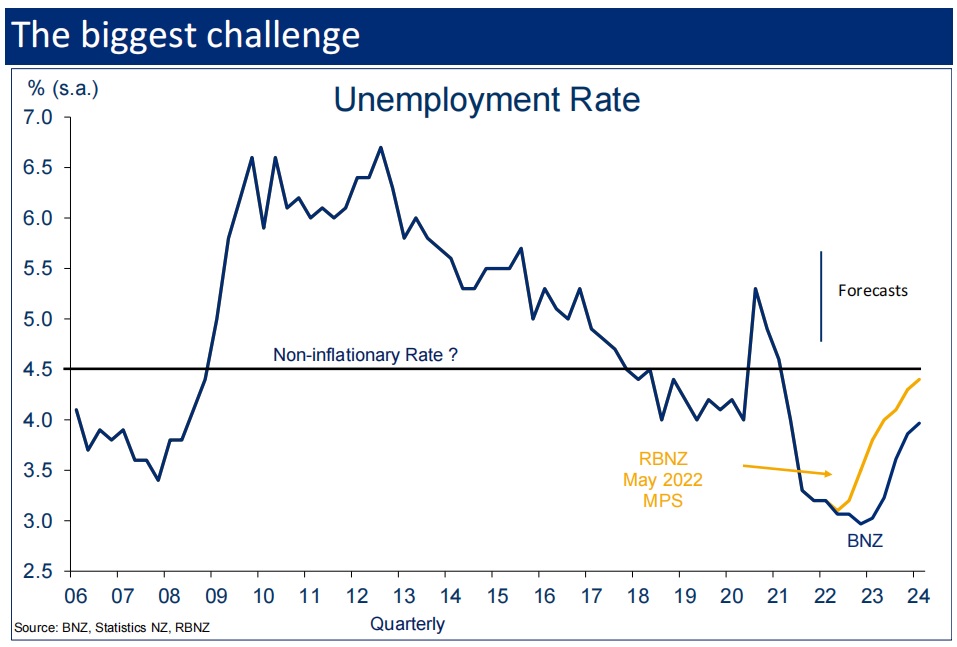
"Unless there is clear indication soon that the worm is turning on the labour market front, the RBNZ will have to contemplate a more aggressive interest rate track than it suggested at its May MPS [Monetary Policy Statement] in order to achieve the unemployment forecasts it predicted at the time," Toplis says.
In that May MPS the RBNZ forecast the Official Cash Rate (OCR) to be nearly 3.5% by the end of this year and peaking at just under 4% by the middle of 2023. The OCR is currently at 2.5%, with widespread expectation that the RBNZ will hike it again by another 50 points to 3% at its next review on August 17.
Before that happens, Statistics New Zealand will be releasing the full suite of labour market data for the June quarter on Wednesday, August 3. As at the end of the March quarter, unemployment was 3.2%. In the May MPS the RBNZ forecast unemployment to drop just slightly again in the June quarter - to 3.1%, but then start rising again, reaching 3.5% by the end of 2022.
Toplis says ongoing labour market tightness is "our greatest fear" in terms of the upward pressure on interest rates.
"The RBNZ forecasts the unemployment rate to rise to 3.5% by the end of this year. We, in contrast, see it falling to 3.0% or below."
Two widely watched ANZ surveys, the Business Outlook survey and the Consumer Confidence survey are due to be released over the coming week (on Thursday July 28 and Friday July 29 respectively).
Toplis says he was tempted to headline his latest economic note 'New Zealand in a crisis of confidence'.
"But “crisis” has become so grossly overused and misused of late that it no longer seems to hold any meaning. Indeed, we seem to now have a crisis of crises."
Crisis or not, he says, the "parlous" state of both business and consumer confidence is, and will be, a critical determinant in the evolution of the New Zealand economy over the next twelve months.
"Morose householders do not spend, and upset businesses neither hire nor invest. When both businesses and consumers are unhappy then there is little chance that an economy will flourish."

Commenting on the ANZ's consumer confidence survey series, Toplis says over the last five months consumers’ confidence has sat in a range of 77.9 to 84.4, at levels which are record lows for the series.
"In the first instance, rampant inflation poleaxed hopes and aspirations but, more recently, rising interest rates will have played their part as household disposable incomes are further eroded."
Such low levels of sentiment are consistent with a resultant sharp drop in retail spending, Toplis says.
"The last time consumer confidence got anywhere near as low as its current levels, retail sales fell a cumulative 8.7% in real terms.
"We are not forecasting such a large drop this time around, largely because we think that the labour market will remain relatively tight, but we still think a correction of some sort is highly likely. The biggest hits will occur for discretionary goods and services, and durable goods.
"Durables spending will also suffer from the increased 'leakage' of money used for offshore holidays and the fact that there was a massive run up in durables spending during the Covid lockdowns."
Toplis says only when inflation, more generally, starts to fall and house prices stabilise are we likely to see a marked improvement in confidence levels.
"And confidence is yet to be impacted by an inevitable increase in the unemployment rate."
Toplis says the ANZ's Business Outlook survey this week will give further insight into labour market developments.
"Hiring intentions have been continuously stronger than would be consistent with an increase in the unemployment rate. This has been the theme that we and other commentators have focussed on throughout 2022.
"However, we may have been a bit remiss in not heeding the extent to which hiring intentions have moderated over the course of the year. The direction is clear and employment intentions sat only just above zero when the June survey was released.
"A further reduction in hiring intentions would be one more step closer to indicating a genuine softening in the labour market."
Toplis says he's "just had another look" at his Consumers Price Index (CPI) inflation projections in light of recent commodity price moves, especially the drop in retail petrol prices, and last week’s June Quarter CPI publication, which showed annual inflation of 7.3%.
"In short, our view on the headline inflation profile is largely unchanged. However, its composition is quite different with a decline in tradables inflation expectations offset by more inflation in non-tradables.
"From the RBNZ’s perspective this will be disconcerting as it has stated in the past that if feels that non-tradables better reflects excess domestic demand over which it has some control.
"This is yet more reason to believe that the risks to our, and the Reserve Bank’s, interest rate track are weighted to the upside," Toplis says.
We welcome your comments below. If you are not already registered, please register to comment
Remember we welcome robust, respectful and insightful debate. We don't welcome abusive or defamatory comments and will de-register those repeatedly making such comments. Our current comment policy is here.