
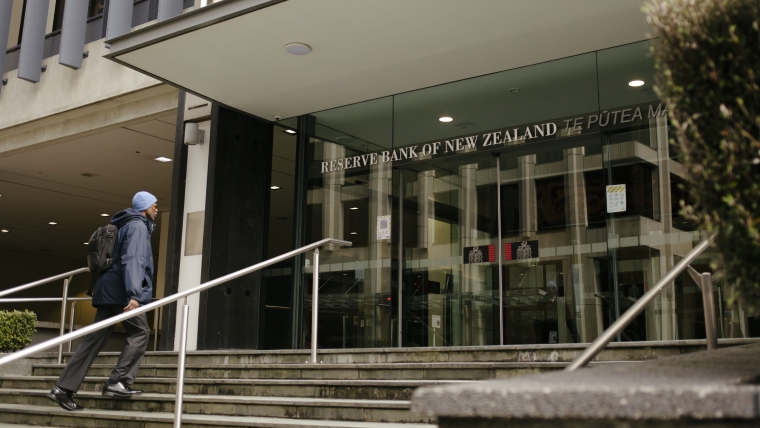
Economic pundits are in almost universal agreement that the Reserve Bank of New Zealand will opt for a 25 basis point hike in its monetary policy review on Wednesday, taking the official cash rate to 5%.
An increasing number of economists and traders think this hike could be the last, although the central bank is unlikely to signal if they share that view.
Financial markets have priced in a high probability of one more increase in May, or possibly July, followed by an increasing chance of a rate cut from October onwards.
The banking crisis in the United States and the weak December GDP data have caused traders to predict one less hike, on the basis that credit conditions have naturally tightened.
Hamish Pepper, director of fixed income at Harbour Asset Management, pointed to a 2019 paper by RBNZ which described how international financial shocks impact New Zealand.
The effects flow through three main channels: trade, financial markets, and economic uncertainty.
It was too early to tell what kind of impacts would be experienced through the first and last channels. However in financial markets, interest rates had declined around 50 basis points and the kiwi dollar had weakened slightly since Silicon Valley Bank collapsed in early March.
“All else equal, this is positive for New Zealand economic growth and provides an offset to the possible reduction in export demand,” he said.
“While NZ bank bond yields have declined by a smaller amount relative to interest rate swaps … the large drop in risk-free rates has meant that wholesale NZ bank funding costs have reduced.”
The stress in offshore financial markets would not be enough to spook RBNZ, however the hike next week may be the last before a long pause.
“There are clear signs from leading indicators that monetary policy is working and we think the RBNZ is very close to the end of its tightening cycle”.
Signs and portents
One difficulty with monetary policy is that it operates with a long lag time. This means the financial conditions being experienced today are a result of policy settings months ago.
RBNZ has been looking for strong evidence that rates are high enough to halt inflation, but knows it may not see significant movement until it has already passed that level.
Last week, ANZ’s business outlook survey showed early signs the tightening of monetary policy has been gaining traction in the real economy, with inflation indicators falling slightly.
The bank’s monthly survey of several hundred NZ businesses asks what they think will happen regarding business conditions, employment, inflation, and other issues.
In March, there were a mix of small rises and falls across activity indicators but most remained much lower than average.
ANZ chief economist Sharon Zollner said inflation indicators continued to inch lower, albeit “painfully slowly”.
“The headline inflation and pricing indicators eased a smidgen. Pricing intentions have turned downwards the most convincingly (while still being problematically high), but inflation expectations are finally starting to look as though they may have turned lower too”.
A net 83% of firms in the retail sector expect to raise their prices in the next three months, which was up compared to February but still well down from a peak of 96% nine months ago.
Economy-wide pricing intentions were unchanged with firms expecting to lift prices 3.4%, compared to 5.5% in March 2022. There was also a downtrend in businesses' expected costs in the next three months, with the economy-wide measure at 5.2%.
“The data imply that on average, firms continue to expect margin compression, given costs are expected to lift more than prices,” Zollner said.
RBNZ has pointed to corporate profits and worker wage growth as being responsible for a large chunk of inflation in 2022.
The survey showed firms were expecting to raise wages considerably less in the next 12 months than they did in the past year. Still, 84% of respondents expect to raise wages somewhat.
“The winter could expose a few more rocks as the wave of tourists depart. But for now, the slowdown is looking broadly in line with the Reserve Bank’s intentions”.
Grave expectations
ASB chief economist Nick Tuffley expects two more rate hikes but said there were signs that higher interest rates were already having the desired effect.
“The economy may be losing momentum faster than anticipated, implying monetary policy is now starting to bite hard. There is more policy impact to come: the average mortgage rate being paid is only about halfway through its climb from trough to peak.”
Westpac economists Kelly Eckhold and Michael Gordon think the next hike will be the last.
“We’re currently forecasting a peak of 5% for this cycle, though we acknowledge that the risks are skewed towards a higher peak than a lower one”.
Economists expect the economy and the labour market to slow during the year, but said so-called weakness “remains in the realm of the forecasts” while actual economic data has been fairly robust.
“Until the RBNZ gets clear confirmation that the economy is slowing, it will continue to emphasise the potential for further rate hikes.”
Recently, the central bank has signalled it is paying close attention to inflation expectations when making its policy decisions. This is because inflation has become embedded in the economy and is starting to look more like a wage-price spiral.
BNZ economist Craig Ebert said: “If there was a key message in the February Monetary Policy Statement, it was that the Bank is considering inflation expectations intently”.
The central bank will be displeased by the results of Friday’s ANZ-Roy Morgan consumer confidence survey in which inflation expectations rose to a nine-month high of 5.4%.
Zollner said consumers were the first to spot inflation coming in 2021 — beating the pundits — and expectations were important in a tight labour market as wage demands were being met.
Without more substantial evidence of an economic slowdown, the central bank will be unlikely to signal any pause in its inflation fighting plans.
102 Comments
I don’t believe for a second that the reserve bank have control of the situation, they are trying to install confidence in the public that they are in control. Interest rates have to increase because the US are putting theirs up. Because of the leverage in businesses this will translate into higher prices and more inflation. This is going to end badly for NZ….the 2008 that we didn’t really get. On that note, given Nash contacting the police commissioner, wonder if they contacted Orr and demanded he drive down IR and LVRs during Covid…..I would bet they did and now have thrown loads of young families under the bus
they are trying to install confidence in the public that they are in control.
People don't seem to realise that the RBNZs guidance is often more of a tool than the actual OCR.
And that's probably a take-home from all of the last 3 years. We have all these institutions, and have given them a misguided level of importance.
They have some level of influence, but never get to decide on the outcome.
The OCR needs to be at least 5%. Consumers SAY they are pessimistic, but are still spending, even on disretionary items. Take Sky TV as a bell-weather. If times were as dire as some say, the subsriptions would fall, but they arent. I am not picking on Sky, but just making the point. In the past when inflation has been very high the OCR has gone to 6 or 7 (was it 6.5% in 2008 from memory?). It cant do that now because of the over-priced housing game NZers have played. My pick is up to 5.0 or 5.25%, then hold for at least 6 months.
Sky is an interesting one. I have Sports. It’s not a big monthly expenditure, and it probably means I don’t go out as much. Hence it probably helps me spend less overall.
I was 50/50 on going to the All Whites vs China. I decided not to, because of the hassle getting there, and also once the kids and I have eaten something at the stadium we are talking spending more than $100.
Yes your right, Sky is discretionary, but as you say, is cheaper than going to a game and a night on the town. Thats why Sky generally does ok even in downturns.
Rate cut in October? So housing market rising in November?
Come October I think we will have bigger things to worry about than if the housing market has turned!
We already do, there's just a lag between what people are upset about, and what's actually happening.
I predict the housing market won't be rising after one rate cut.
No? Not one? How many rate rises will it take
Well if recent history is anything to go by - ie in 2008-2009 when the OCR was cut from 8.25% to 2.5% over 10 months - it took the housing market until 2012 to show any sign of life and it wasn't really until 2014 that the housing market showed significant gains. So my guess is anywhere between 3-5 years.
I said rate cut. How many rate cuts? There are too many variables to predict that, such as, how big will the cuts be, over what period. Trying to forecast to that degree is a fools game, but it won't be after the first is my guess.
Agree,the housing market began its decline in December 2021 when the CCCFA took effect. Nothing to do with interest rates at that point.
Still a lot of loans to roll off circa 2% as fixed rates expire. Accordingly a lot of economic hurt yet to arrive in many an over leveraged household near you. RBNZs actions so far have had little to no meaningful impact on inflation so fully expecting the same message from the FED recently. " there is more coming"
Higher rates for longer. Bank crazy profits to continue...
“RBNZs actions so far have had little to no meaningful impact on inflation” - not sure you can say that, who knows what inflation would be right now had they not raised the OCR.
I guess if you factored in indexes of global pricing relative to NZs experience it'd give you some sort of idea.
We can see that the factors impacting inflation extend well beyond just central banks, based on the wildly varying degrees inflation is increasing or decreasing - despite so many central banks taking similar approaches, and then also some good case studies of other countries doing the exact opposite.
There is a 95% correlation (!!) between our Goods CPI and international oil prices. RBNZ impact on inflation is minor and probably around neutral - some price reductions through demand side as mortgagors throw more money at the banks and less at retail, balanced out by price rises caused by suppliers passing on the higher cost of credit to their customers.
Jfoe are you saying that if the RBNZ lowered the OCR to 0% right now it wouldn’t change anything? Or if they increased it to 20%?
You may well be right. But I’m not sure it’s an experiment worth trying.
They're extreme examples, which would generate major ripples - eg a big drop would kickstart the housing Ponzi and play havoc with the currency (with some pass through to prices), a big hike would destroy loads of businesses, bankrupt households, and throw us into a deep recession. However, I don't think that realistic moves in rates makes much difference to rate of increase of prices we pay for goods and services - i.e. the thing that RBNZ is trying to achieve.
I thought it was about balancing the relationship between the debtor and the creditor. Inflation erodes the debt for the debtor, which is good, but also does the opposite for the creditor (reduces the amount they get back) which is bad. So to fix that imbalance caused by inflation, interest rates are raised which means extra payments from the debtor to the creditor.
For instance, if a bank lends a million, and we get high inflation with low interest rates, over time the wealth of the bank will be transferred to its customers. Is that really how the world works?
Yes on the first paragraph - this is the often unspoken objective of monetary policy - to protect the amassed financial wealth of the wealthy.
On the second paragraph, banks don't lend any existing money to customers, they create brand new deposits in customer bank accounts when they agree to make a loan. The loan agreements then form the bulk of the bank's wealth (the assets on their balance sheets).
Banks do effectively play an intermediary role between creditors and debtors though. In NZ, the banks currently get about $2 billion per month in interest, and they pay out around $0.8 billion in interest per month to depositors (and about the same to their shareholders). This mechanism, as you say, transfers more wealth when rates are high.
All ticket-e-boo, until the debtors cannot pay back their loans. Fractional reserve banking will always create a liquidity crisis, because when the loan was originated (money creation), the interest required to pay back the loan was never created. That is a Ponzi!
Fractional reserve banking doesn't exist in real life - although banks in most countries (like NZ) do have to have a given level of equity. Bank loans create deposits, deposits become bank equity, and so the ponzi rolls on. But, yes, the whole system relies on net new money creation - either by Govt or banks.
FRB is money creation by govt via the banks as their agents. Banks couldn't do it without the State.
Don’t we have an oversupply of houses now? Dropping interest rates won’t kick start any ponzi. Just maybe steady the market.
There's still a severe under supply.
Partially because the population growth has been healthy, but mostly because household dynamics have changed significantly.
Yup. There's an over-supply of unaffordable houses, and an under-supply of affordable ones.
Once that balances, we'll see the market start going up.
On the one side, we have 1/3 of households who might want to buy a house, and on the other, a small cohort of people who need to sell. The former cohort slowly shrinks as house prices drop, but the latter can grow rather alarmingly.
How this resolves ain't gonna be pretty.
How can there be a correlation to oil prices? Oil prices go up and down all the time, yet we very rarely get deflation. Oil prices were higher in 2008 than now.
The correlation is in rate of change - when oil prices move up quickly year on year so do prices, when oil prices move up slowly year on year so do prices. This is to be expected - oil and oil products are major input costs for just about every business.
The global economy must be kept in check. Growth in demand and growth in the energy that fuels it can't be allowed until Vlad's war machine is subdued and even then it will take years to get back to Jan 22 in terms of stabilised supply.
I don't know. Extra investments in things that increase productivity or create alternative energy supply seem like a better strategy to me.
Vlad's war machine never bombed the Nordstream pipelines. Russia was happy to supply Germany with all the natural gas they wanted at a fair price. The US was not. Perhaps it is the US war machine that needs subdued.
I like how much attention people are paying to who's blew up a specific pipeline many months ago, when Russia is very obviously attacking civilian infrastructure and population centres on a frequent basis.
It's one of the most idiotic instances of whataboutism in modern times.
What does year on year mean? When does that year start? Calendar year? - seems arbitrary. Oil is currently well down on 1yr ago, so shouldn’t we have deflation?
Latest CPI data is obvs Q4 2022 - when oil and (critically) petrol and diesel prices were still up compared to Q4 2021. What the trends show is that year on year increases in oil prices push Goods CPI up - eg in 2016. But oil price drops just calm goods CPI down - apart from in 2015 when a big drop in oil price took Goods CPI negative for a couple of quarters.
MBIE publish all the oil data weekly.
Inflate or bust. I see no signs of inflation abating. Bankers will continue to lend (money creation) and western world governments will continue to deficit spend (to their corporate cronies), probably in the name of saving the planet from climate change! After all they saved us from communism, terrorists, drugs, Covid even madmen with WMD's. The only 'bust' will be the fiat currencies.
The idea that rates will reach a peak and then "normalise" back down again once inflation is back under control is wrong. These increases are the normalisation.
If rates ever head back down again after this, it will be in a desperate attempt to prevent the global financial system from collapsing, again. Except we might not get away with it next time.
These increases are the normalisation.
A lot of prices for things possibly wont go down, but after a time the rate of increases will slow. At some point all the zombie corporations and jobs will die, hopefully leading to a greater degree of stability.
At least that's the theory. I really like seeing the mechanics of a business, at the moment dysfunction has become accepted, and when things are dysfunctional they're usually sub par and more expensive. Is that permanent? Hard to say. Creates some good opportunities though.
Problem is that a lot of the zombies aren't just corporations. They're integral components of the global financial system. We've seen a couple of stark examples of this recently with major banks collapsing, and another major which looks like it's on the verge. Prior to this we had the wheels falling off the gigantic Chinese construction sector, led by Evergrande. These are not isolated issues, they're systemic, and have global repercussions.
How about this for a bold statement on a Sunday morning: the US is bankrupt. The amount of debt they currently hold is staggering, and ultimately unrepayable. Yes, in theory it is impossible for a sovereign state to default on debt held in their own currency, but the alternative - printing your way out of it - is not without consequence either. You end up destroying said currency in the process, and the currency we're talking about in this case is the global reserve currency. That's pretty bad news, and one of the reasons we're seeing countries agree to stop using it in trade (China and Brazil being the latest example).
So I don't think this is just a matter of the tide going out so we can see who's been swimming naked. The entire financial system will be exposed as the gigantic casino it is, eventually. The only question is how long it will take, and what the fallout is likely to be.
Are you taking government debt or private debt? Japan has double the government debt (to GDP) than the US and it’s own currency and is not bankrupt.
Government debt. I'm only picking on the US here because of their dollar's status as reserve currency, but they're far from the only ones. The Eurozone is certainly in the same boat, so is China, possibly Japan too. I would say that one major difference between the US and Japan though is that Japan has a major manufacturing industry, whereas >1/5th of US GDP comes straight out of the financial sector, which will be ground zero for any financial crisis. Although a financial crisis will obviously affect all industries, machine tool production is likely to be more resilient than money chasing its tail in New York. These are the sorts of things which can determine a currency's relative value, and perceived safety in hard times.
Even if they lost 1/5th of their GDP overnight their debt to GDP would still be a lot lower than Japan.
I do think being the reserve currency allows them some leeway, but other countries that don’t have that leeway are not bankrupt despite having higher debt. But if they are greedy enough to keep increasing that debt then yes it will eventually go horribly wrong.
Although a financial crisis will obviously affect all industries, machine tool production is likely to be more resilient than money chasing its tail in New York.
Typical UK household incomes have fallen further behind those in Germany. In 2008, the gap was over £500 a year, now it is £4,000 as wages & productivity have stagnated. Recently, wages have failed to keep up with rising costs. I reveal the reasons here: Link
Being the reserve currency means, by literal definition, that other countries hold large amounts of US dollars and treasuries. This is Govt debt. China hold about 3 trillion of it simply because they accept payments in dollars and they have used those dollars to buy Treasuries. If the US attempted to balance it's books, the world financial system would collapse. Clinton made the mistake in 1998 of running a surplus (having been terribly advised). Helen Clark and Ardern made the same mistake here - pushing the private sector into deeper debt.
Hamish Pepper, director of fixed income at Harbour Asset Management, pointed to a 2019 paper by RBNZ which described how international financial shocks impact New Zealand.
Remember when Powell dismissed yield curve inversions because his ''preferred indicator'' was not inverted yet? Well, this is how it looks like today Link
Why is the RBNZ tasked with doing all of this? Perhaps Maudlin gives us a clue.
Our political system is sadly not up to the task. The current structure is all we have, and it won’t improve until a crisis forces change.
And the situation demands changes. Which means—and I don’t say this lightly—we’re going to have a crisis which will give us that change.
https://images.mauldineconomics.com/uploads/pdf/TFTF_Apr_1_2023.pdf
And on another topic altogether; the demise of a radio station, but perhaps a prescient comment from one who didn't see it coming:
"Our demise was ruthless, immediate, without warning and got worse as it went on."
CPI in 18 days is more critical. The OCR has been raised too late and slowly. It is playing catch up, but falling behind. 18 days to go then, to reveal whether that is right or wrong.
It'll be high, but more because of weather than the interest rate.
I am most interested what the CPI is doing in the 3rd quarter, due out in Oct. This will be the key quarter.
... unless I'm as brain addled as a cabinet minister , isn't this radio station a serial demiser ... from Auckland Radio Pacific in 1978 ... to Radio Pacitic ... Radio Live ... Today FM ...
Used to enjoy it when someone was chatting away to the host & they'd break in with the TAB to bring you the 6'th race from Te Awamutu ...
Everyone you meet, the children in the street
Are swayin' to the rhythm, there's somethin' movin' in them.
There's no place to hide, so, why even try?
Can't you hear it coming your way, it's here to stay. ("Can't stop the music" ...Village people)
Ive given up pondering whats next from the powers that be ... adapt and roll with it is my plan. Russia is a bigger 'risk' than the RB in my book...
'Russian President Vladimir Putin on Friday announced a new foreign policy strategy aimed at curtailing Western "dominance" while drawing the country closer to China and India."The Russian Federation intends to eliminate the worldwide dominance of the United States and other unfriendly countries,” the strategy reads.(The Moscow Times 1 day ago)
The good news is 'Crisis creates opportunity' (Einstein)
... heard Ron Mark being interviewed on Toady FM recently : he's had 3 trips to Ukraine since Russia invaded ... he lays out a good argument that Russia is rooted .... we can but hope he's right ...
Maybe, but even if Russia is rooted it will be the Russians that decide that, no one else.
I hope Russia at least gets to keep the east and south. The bulk of people there don't want to be under Kiev's thumb.
Exactly, much nicer under Russian leadership, they care about people.
The Bolsheviks replaced centuries of Tsar brutal rule with a version of their own. Took one of the most violent and barbaric revolutions and civil war, to get that done though. Whether they were the serfs of yore or the comrades of today, their lives have always been of little consequence to those in power. That’s the way it is and what is simply expected, it’s deeply embedded in their ethos & society, not really any great mystery about it, but if there is ever to be change, don’t anticipate any other than Russians to effect it.
Slim chances after a century or two of oppression, the gene pool of people who are prepared to go against the grain is pretty thin.
The YouTube channel 1420 is quite telling, the population is split between those who romanticise over the Soviet era and younger people who don't like things but are mostly politically apathetic.
As much as we all might agree it's a bad decision for some Ukrainians to want to join Russia, they do. So I'd prefer they were let go to do that. Of course it won't happen - govts never give up territory except by force.
Check out Youtube channels like Patrick Lancaster, who roams the east and south and get's people's view on the war. It's not good against evil.
Dont bother unless you want more russian propaganda..
Lancaster’s pro-Russian position and the manipulative approach he takes in his coverage have also been exposed by the Polish fact-checking organisation Demagog.
Also link to factcheck https://factcheck.bg/en/the-claim-that-western-media-are-silent-on-the-…
I didn't need Demagog to tell me Lancaster's vids are propaganda, any more than CNN et al is obvious western propaganda. I watch it all - it all contains information.
Russia is trying to destroy and/or take all of Ukraine.
The fact Ukraine, the US and NATO aren't angels shouldn't detract from the fact that Putin's Russia is the baddie.
You're either an idiot or a victim of russian propaganda.
PS: I was born & raised in Eastern Ukraine, speak both Ukrainian and russian languages.
The Russian economy's crashing, the ruble's effectively worthless and the Russian stockmarket has been suspended. And the population's declining as Russians vote with their feet.
So , Adrian is raising the OCR , attempting to slam down hard on inflation ...
... and Robbo is raising benefits & entitlements by 7 % , pushing on the inflation accelerator ...
Couldn't we just get them into a ring for a punch up , and leave us innocent victims of their incompetence out of the fight ?
Orr takes Robbo out with a cracking liver shot...then raises 100 basis points.
... the Lamington Kid is KO'd in the first round ...
You sound like a heavy weight yourself gummy..but hey keep the fat jokes coming if it makes you feel better about yourself.
... welterweight ...
.. you used to be such a chill dude ... but now , tee off at the slightest thing ...
C'mon mon ami , I'm having a Boatrocker tripel ... 9.2 % ... pull up a chair & I'll pour you a glass ...
Boatrocker? Recommend instead, Foxgloves Brewery. Basil Brush, Best British Bitter! Blowsy, Billowy Bowel Booster. Boom, Boom! Certified “B” grade. Nothing quite like a bit of alliteration, Sunday evening, to set up for the week.
Tox Brewery in Connecticut have a Foxglove NEIPA , 7.2 % ... 4.1/5.0 rating on Untappd ...
... worth a trip over there to test run that bad Foxy ?
Actually next May we are going to be back in our old neighbourhood in New Jersey. The old local bottle store used to have a great range will look for your tip on the shelves. Aside from that consider yourself a visit to Seattle, there they make PA’s & IPA’s, lumberjack strength, you can stand a fork up in a pint of it!
Sounds like one pint would knock a kid out the far end of puberty!
Typical white sith male comment :)
... " sith " , as in Star Wars ? ... you know me too well young prince of the universe ... May the 4'th be with you .
According to MBIE advice, Robbo could put up the minimum wage to about $35, which would allegedly push around 70,000 extra people on to the dole... saving RBNZ the job! Team work makes the dream work.
I've heard of three businesses closing down in recent weeks (Cafe, two retail stores. Times are tough, and about to get tougher.
... doing my best to support the craft beer industry ... but , the next 6 months are a crap shoot for SME's in Zealandia ... hopefully most can last until a change of government ushers in less antagonistic policies towards the productive sector ...
Quite a few job losses or possible job losses announced last week.
Yes discretionary spending is taking a hit and much more in the pipeline. All to protect bank debt/profit ahead of the populations buying power. But let's keep the OCR well behind the Inflation rate and continue to protect the root of the issue. To much debt not supported by income.
What happens when a predatory population gets too large for a fixed ecosystem...?
MBIE says the $ 1.50 lift in the minimum wage to $ 22.70/hr will result in 5100 fewer jobs ...
.. they recommended a $ 1.30 rise instead ... just 100 fewer jobs : that 20 cents per hour extra is costly ...
Naturally , the government ignored MBIE's advice ...
If an employer is insolvent over 20 CENTS PER HOUR, they should not be in business.
MBIE calculated that the extra 20 cents per hour would cause an extra 5000 jobs to be lost / or not created ...
... instead of ripping employers , why not rip at the government who once again chose to ignore the advice of their own public servants ...
And the public
Exactly, these employers of bad and struggling businesses who would prefer to pay their staff $18 per hour are well rid of in my opinion. If a better or larger buisness picks up the slack and can pay decent wages so be it. Downturns always strip out the dead wood.
MBIE’s advice is often not worth the paper it’s written on.
The MBIE model is a joke - it's been reviewed by people who found loads of errors and wacky assumptions.
As our population ages the era or low wage labor is coming to a close. We need wages to rise so that we can efficiently redistribute people to where they can have the greatest impact:
Wages won't keep up; we'll strip mine labour from SE Asia instead.
If CPI remains above 3% I image RBNZ will keep tightening.
Ideally I'd like a deceleration of 1-2% per quarter back to that target range. Less than 1% and I'm worried we will overshoot the runway, more that 2% and I think we might undershoot the runway.
The hardest thing to understand is if consumers will start spending again as CPI/retail interest rates fall. If they do I can assure you that peak rates will be a long way north of the 5% range and RBNZ will have to go the distance with inflation. This will manifest itself as only seeing small drops (less than 1%) in CPI.
Happy to bet on 5% being the upper limit of this cycle. They have to go that high next week to save face (although they absolutely should not), but as the dole queue grows into the winter, they will have to accept that NZ is a price taker, and we might need some new ways to tackle 'inflation'.
I think they will go to 5.25 or 5.5 before they stop
People who are being hurt badly by interest rates (a relatively small group). have pretty much left the discretionary spending game and aren't coming back even if inflation eases. So customer bases for many products have shrunk and the obvious path for firms to keep their returns high is to make a higher margin on selling to the remaining base, i.e. the (relatively large) group of Kiwis who aren't hobbled by debt. And that group can pay higher prices because their wages / super have increased. The problem the RBNZ has is that the latter group aren't at all tempted to spend less at the moment, because savings rates are still below inflation and other investment options have done poorly recently. Don't overlook the role of asset price swings too: young people increasingly see saving as a fool's game, because it involves a lot of sacrifice and very slow progress; they see their future as being mostly determined by factors outside their control, i.e. asset price cycles, and the timing and size of their inheritance windfall...
A relatively small group have been hit by interest rate rises * so far*. It will be a significant number by late 2023.
Also, it’s much more than rate rises. Our household wasn’t hit that much by rate rises, but we are definitely pulling back on discretionary spend because of the rising costs of things. No way I am going to pay $20 for that foodcourt Indian combo which might have been $14 two years ago. If the three of us are there, that’s $60 for a lunch!
Another thing I have mentioned before is that bonuses will disappear or shrink in many sectors. Don’t underestimate the bolstering effect that a $5k or $10k bonus can have for households, and conversely what the disappearance of that can mean.
Yep Super has now increased. But as my dad, a superannuant, said to me yesterday it’s hardly covering the inflation of the last few years.
Exactly.
And how about fuel prices to rise back up again. Although I suspect the government will further extend till after the election.
Grab a 50cc for cheap while you can, they will be in high demand soon enough. $11-12 a tank that goes 160km.
Not a bad time to have a bank term deposit.
Yes Tds and Cash Kiwisavers have been the place to be for the last 12 months, and now. But the cycle will turn again in a couple of years, and risk will be back on again.
Job losses mounting. I said the carnage would start to become apparent by around May.
my infamous ‘May Day’.
https://www.nzherald.co.nz/business/liam-dann-economic-pain-about-to-ge…
Net lending negative (except personal consumer loans from non-banks!) + net govt spending stalled + imported high prices = tens of thousands of people on the dole queue. Nothing surer.
0.5% is the call!...
How good are the economists and banks?
useless!... 100% inaccurate
We welcome your comments below. If you are not already registered, please register to comment
Remember we welcome robust, respectful and insightful debate. We don't welcome abusive or defamatory comments and will de-register those repeatedly making such comments. Our current comment policy is here.