
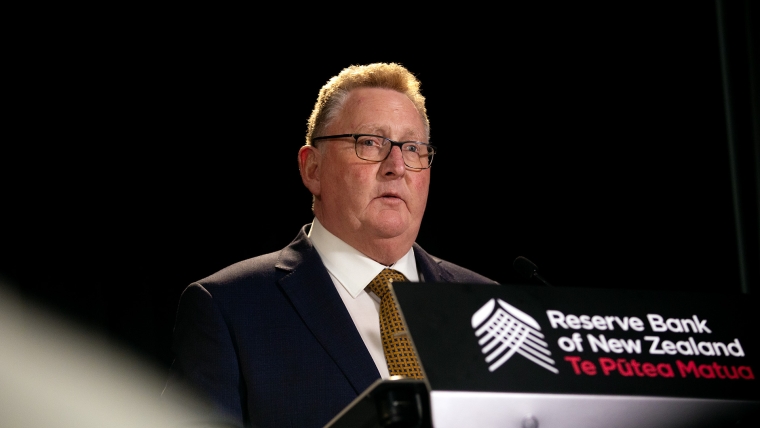
The Reserve Bank (RBNZ) has opted to hold the Official Cash Rate (OCR) at 5.50% for a sixth time in its April review.
The RBNZ’s Monetary Policy Committee said the economy was evolving as anticipated with high interest rates reducing capacity pressures and inflation. The Committee reached a consensus to keep the OCR unchanged, the RBNZ said.
A restrictive policy position was still necessary and would allow consumer price inflation (CPI) to return to the 1% to 3% target range before the end of 2024. Statistics NZ releases its March quarter CPI Index next Wednesday, April 17. For the December quarter CPI came in at 4.7%, down from a peak of 7.3% in the June 2022 quarter.
The RBNZ said global economic growth was below trend but most major central banks were cautious about easing policy given the ongoing risk of persistent inflation.
Economists had universally expected the RBNZ to leave policy unchanged, but some commentators have called for interest rates to be cut sooner rather than later.
An influential business survey released on Tuesday showed business confidence was weak and firms were letting go of staff. Pricing intentions were also falling.
The record of the April meeting said the Committee thought the economic slowdown was in line with what was expected in the central bank’s forecasts, published in February.
Gross domestic product data was “close to expectations and implies a continued easing in capacity pressure in the economy,” it said.
“Some higher frequency indicators suggest a modest recovery in activity in the first quarter of 2024. However, measures of business confidence have declined and firms’ own expectations for activity and investment have weakened”.
The Committee said the March inflation data could be higher than forecast, although it would likely be due to volatile components such as domestic airfares and overseas accommodation.
Members agreed there was “limited tolerance” for any delay to headline inflation returning to the target band.
There were still upside risks to the inflation outlook due to persistent services inflation and the possibility that goods prices wouldn’t fall as expected.
“Anticipated near-term increases to local government rates, insurance, and utility costs, could also further slow the decline in headline inflation,” they said.
On the downside, they noted restrictive policy in the context of weak global growth could cause inflation to fall more rapidly than forecast.
“Business and consumer confidence remain particularly weak which could lead to more unemployment and financial stress than expected,” they warned.
Challenges in the Chinese economy also posed a risk to both the global economy and New Zealand’s trade outlook.
However, the balance of risks was broadly the same as when the Committee met in February and restrictive monetary policy settings were still necessary to reduce inflation.
The OCR has been held at 5.50% since May 2023, after a dozen consecutive hikes which lifted the benchmark rate from 0.25% in just under two years.
Economic activity and headline inflation have both fallen faster than was forecast then, but employment and non-tradable prices have been stronger than expected.
The RBNZ has forecast headline inflation to fall below 3% in the September quarter of this year, and suggested the OCR could be lowered from 2025.
'The shortest statement we've ever seen'
Kiwibank Chief Economist Jarrod Kerr said this RBNZ statement was the shortest one Kiwibank's economists had ever seen at just 140 words.
"The RBNZ were never going to adjust policy today. And the likelihood of a change in May is very slim (to none). Some in the market are calling for cuts to commence in August. That’s premature in our view. Although we’d love to see it," Kerr said.
"We think they need to see inflation below 3% before they will contemplate cuts. And the earliest that will happen is October, when the third quarter inflation report is published. So that means the first reasonable chance of a rate cut is November."
ANZ NZ economists Sharon Zollner and David Croy also described the RBNZ's statement as the shortest they'd ever seen. They said the RBNZ saw nothing to cause a deviation from the central bank's “watch, worry and wait” stance, and thus didn't take a strong stance on when OCR cuts might come.
"All told, today’s review was a placeholder, as expected. Kudos to the RBNZ for efficiently issuing the shortest policy assessment ever seen so we can all get back to watching, worrying and waiting," Zollner and Croy said.
"We continue to expect that the RBNZ will require considerably more certainty before contemplating cuts. Current upside risks on the tradable inflation front got very little airtime in RBNZ comments, but they do highlight the fact that headline CPI inflation is still a long way from where it needs to be. We continue to expect [OCR] cuts won’t be on the table until 2025."
The RBNZ's full statement is below.
OCR 5.50% - Official Cash Rate remains unchanged
The Monetary Policy Committee today agreed to leave the Official Cash Rate (OCR) at 5.50 percent.
The New Zealand economy continues to evolve as anticipated by the Monetary Policy Committee. Current consumer price inflation remains above the Committee’s 1 to 3 percent target range. A restrictive monetary policy stance remains necessary to further reduce capacity pressures and inflation.
Globally, while there are differences across regions, economic growth remains below trend and is expected to remain subdued. However, most major central banks are cautious about easing monetary policy given the ongoing risk of persistent inflation.
Economic growth in New Zealand remains weak. While some near-term price pressures remain, the Committee is confident that maintaining the OCR at a restrictive level for a sustained period will return consumer price inflation to within the 1 to 3 percent target range this calendar year.
Summary Record of Meeting – April 2024
The Monetary Policy Committee discussed recent developments in the New Zealand and global economies. The Committee agreed that the New Zealand economy has evolved largely as expected since the February Statement. Restrictive monetary policy is contributing to an easing in capacity pressures to ensure inflation returns to target.
Economic growth in most of New Zealand’s major trading partners has been below trend. However, this has varied across regions, with stronger activity in the United States compared with the Euro Area and Australia. Economic growth in most major economies is forecast to slow further over 2024. In China, policymakers have announced a similar growth target for this calendar year, which may be difficult to achieve amid ongoing structural challenges.
The Committee noted that in most major economies the better balance between the demand for, and supply of, labour has been reflected in a decline in job vacancies. However, growth in unit labour costs remains elevated. Inflation will continue to be persistent in regions where higher labour costs have not been accompanied by improved productivity or reduced profit margins.
Most major central banks remain cautious about easing monetary policy given the risks of inflation persistence and elevated inflation expectations. Financial market pricing for most central bank policy rates continues to imply some easing later this year, although this has lessened over recent weeks. Participants in global financial markets continue to exhibit strong confidence in the corporate earnings outlook, as reflected in equity prices and credit spreads.
Aggregate commodity price indices have remained relatively stable despite ongoing geopolitical uncertainties. Oil prices have increased while agricultural commodity prices have generally been weaker. The recent spike in global shipping costs, which has partially receded, has yet to be observed in New Zealand merchandise trade data. This timing is consistent with information from discussions with businesses that suggest shipping contracts in New Zealand are typically renegotiated every three to six months.
The Committee discussed domestic economic data released since the February Statement. Gross Domestic Product for the December 2023 quarter was close to expectations and implies a continued easing in capacity pressure in the economy. Some higher frequency indicators suggest a modest recovery in activity in the first quarter of 2024. However, measures of business confidence have declined and firms’ own expectations for activity and investment have weakened. Near-term business pricing intentions have declined but remain elevated, in part reflecting an uptick in both realised and expected costs.
The Committee noted that recent monthly Selected Price Indices (SPI) imply some upside risk to the March 2024 quarter Consumers Price Index (CPI). The Committee agreed that there was large monthly variability in the SPI series and noted that recent relative price changes are due mostly to volatile components including fuel, domestic airfares, and overseas accommodation.
The Committee noted the continued strength in net migration, which is supporting aggregate consumer spending and rising dwelling costs. While the rate of net migration has declined from its recent peak, there have been significant upward revisions to recent historical data. Net migration also adds to labour supply in the economy and has helped to alleviate capacity pressures. Members noted the large decline over recent quarters in the share of firms reporting difficulty in finding labour.
The Committee discussed the outlook for fiscal policy and its implications for monetary policy. Based on the most recent published forecasts in the Half-Year Economic and Fiscal Update, and the commitments outlined in the Budget Policy Statement, the Committee noted that government expenditure is indicated to decline as a share of the economy in coming years.
Domestic financial conditions have eased marginally since the February Statement with declines in wholesale interest rates and the New Zealand dollar. There have been modest reductions in retail interest rates. However, these remain consistent with the Committee’s restrictive monetary policy stance, with credit growth remaining subdued. The Committee noted that despite a reduction in wholesale funding costs, term deposit rates were little changed reflecting increasing competition for retail deposits.
The Committee discussed whether recent developments in the New Zealand and global economies had implications for when inflation returns to target. Members agreed that there had not been a material change since the February Statement and that monetary policy settings continue to constrain demand broadly as expected. Members agreed that there remains limited tolerance to increase the time to achieve the inflation target while inflation remains outside the target band and while inflation expectations and pricing intentions remain elevated.
The Committee discussed upside risks to the inflation outlook. Members agreed that persistence of services inflation remains a risk and goods price inflation remains elevated. Anticipated near-term increases to local government rates, insurance, and utility costs, could also further slow the decline in headline inflation.
The Committee discussed downside risks to the inflation outlook. Members noted that ongoing restrictive monetary policy in an environment of weak global growth could lead to a more rapid decline in inflation than expected. Business and consumer confidence remain particularly weak which could lead to more unemployment and financial stress than expected. Structural challenges facing the economy in China remain a concern given its importance for the global economy and for New Zealand’s trade.
Overall, members agreed that the balance of risks was little changed since the February Statement. Ongoing restrictive monetary policy settings are necessary to reduce inflation, while avoiding unnecessary instability in output, employment, interest rates and the exchange rate.
In discussing the appropriate stance of monetary policy, members agreed they remain confident that monetary policy is restricting demand. A further decline in capacity pressure is expected, supporting an ongoing decline in inflation. The Committee agreed that interest rates need to remain at a restrictive level for a sustained period to ensure annual consumer price inflation returns to the 1 to 3 percent target range. On Wednesday 10 April, the Committee reached a consensus to keep the Official Cash Rate at 5.50 percent.
Attendees
MPC members: Adrian Orr (Chair), Bob Buckle, Carl Hansen, Caroline Saunders, Christian Hawkesby, Karen Silk, Paul Conway
Treasury Observer: Tim Ng
MPC Secretary: David Craigie
*Additional reporting Gareth Vaughan.
We welcome your comments below. If you are not already registered, please register to comment
Remember we welcome robust, respectful and insightful debate. We don't welcome abusive or defamatory comments and will de-register those repeatedly making such comments. Our current comment policy is here.