sign up log in
Want to go ad-free? Find out how, here.

A review of things you need to know before you sign off on Thursday; FMA warns insurers, Kiwibank profit falls, Heartland profit rises, an Auckland traffic solution?, big bond demand, retail failures up, swaps stable, NZD jumps, & more

Economy / news
A review of things you need to know before you sign off on Thursday; FMA warns insurers, Kiwibank profit falls, Heartland profit rises, an Auckland traffic solution?, big bond demand, retail failures up, swaps stable, NZD jumps, & more

Here are the key things you need to know before you leave work today (or if you work from home, before you shutdown your laptop).

MORTGAGE RATE CHANGES
WBS raised its floating rate today. All current mortgage rates are here. And note, you can compare mortgage offers with our unique calculator that takes into account other costs and cashback incentives, here.

TERM DEPOSIT/SAVINGS RATE CHANGES
None here today. All updated term deposit rates less than 1 year are here, for 1-5 years, they are here.

RETAILER STAFF ACTIONS CAN'T SHIELD INSURER'S RESPONSIBILITIES FOR ON-SOLD FEATURES
The FMA has released a review of add-on insurance and extended warranties, highlighting the need for stronger oversight of sales and distribution channels to support fair consumer outcomes. Insurers cannot outsource the responsibility for fair consumer outcomes, they said. “Where products are sold through intermediaries, insurers still need robust systems, controls and monitoring to ensure consumers are treated fairly. We saw a recurring gap between the policies, processes, systems and controls insurers described and how they operated in practice."

TRANSACTION GROWTH BUT LOWER PROFITABILITY
Kiwibank profit fell as it focuses on market share growth in 'very competitive' environment. They reported a -9% lower profit result for the year to June to $174 mln on tighter margins (NIM). CEO Steve Jurkovich says ANZ NZ has been 'very competitive' in mortgage market. He also notes bank mergers are 'quite tricky' to pull off, in a back-hand reference to the Heartland/TSB proposal. Annual Report is here.

INSOLVENCY LEVELS HIGH BUT FLAT, HOWEVER RETAIL FAILURES RISING
The number of retail businesses entering insolvency rose sharply in Q2, even as overall business failure numbers nationally remained largely unchanged. BWA Insolvency's latest Quarterly Market Report shows that retail insolvencies increased from 39 to 68 cases in Q2 2026 out of a total of 760 in the quarter.

'THE SOLUTION IS TRAFFIC MANAGEMENT AND MORE CAPACITY'
The Government has launched an Auckland Motorway Strategic Plan that sets out how the city will cope over the next 30 years. The plan focuses on three core outcomes: Optimising the existing network - making better use of the network we've already got through smarter traffic management, quicker responses to crashes and breakdowns, small-scale improvements, and delivering Time of Use Charging. Targeted increases in capacity - adding extra capacity where bottlenecks are impacting efficiency, progressively delivering rapid transit, closing critical gaps in active mode networks where they interact with motorways, prioritising projects to increase capacity and address resilience risks. Wider system improvements - improving the wider transport system, including public transport capacity, rail network improvements, and local roads/active modes, so fewer trips need to use the motorway network.

UNDERWATER A GROWING TREND
The percentage of residential properties selling at a loss has increased from less than 1% in 2022 to 13% in Q2 this year, according to Cotality's latest Pain & Gain Report.

-->

NZX50 ON HOLD
As at 3pm, the overall NZX50 index was unchanged today, and up +0.8% for the past 5 trading sessions. It is up +4.7% from six months ago. From a year ago it is now up +6.6%. Market heavyweight F&P Healthcare is up +1.1% so far today. Spark, Gentrack, NZX, and Skellerup led the 65 gainers while Auckland Airport, The Warehouse, a2 Milk and Chorus were among the largest decliners (66).

TRANSACTION GROWTH & HIGHER PROFITABILITY
Also reporting its results today was Heartland Group. The trans-Tasman banker said its annual profit beat guidance and jumped to $93 mln, up from $38 mln in the prior year. Margins increased (NIM). They say they are focused on growth in its reverse mortgage portfolio and pursuing its proposed merger with TSB. Annual Report is here.

PAMU DELIVERS 'STRONG' RESULT
PAMU/Landcorp said it has delivered its strongest operating result on record, Net Operating Profit (NOP) of $113 million and Net Profit After Tax (NPAT) of $160 million for the year ended 30 June 2026, compared with NOP of $49 million and NPAT of $120 million in the prior year. It is paying a dividend of $15 mln. Total equity is about $1.9 bln. They are forecasting a full-year Net Operating Profit for the 2026/27 financial year in the range of $77 to $87 million, with a midpoint of $82 million.

SUPER-SIZED IS NOW NORMAL
Super-sized demand is becoming the norm for recent NZGB bond tenders. Today's $450 mln offer drew 94 bids worth $2.14 bln for two maturities. YTM was little different to the prior equivalent events which were quite recent. You might have thought this demand would have depressed the YTM. At least it kept it from rising.

ANOTHER AVANTI SECURITISATION
Meanwhile Avanti Finance has securitised $250 mln of personal and car loans out of its New Zealand business.

WOOL PRICES STILL RISING
PGG Wrightson is reporting that limited volumes coming forward for sale continue to underpin the recovery in strong wool, particularly second-shear and oddment types. Competition remained supportive across these categories. The first offering of merino wool for the new season opened to a strong, competitive bench of buyers, providing an encouraging start to the season. Mid-micron styles also sold well, considering the easing in the Australian market earlier in the week. Overall, the market maintained a positive and confident tone.

AUSSIES DON'T EXPECT INFLATION TO EASE ...
Australian inflation expectations rose by 0.2 percentage points in August to 4.9%. This follows a three-month period of moderating inflation expectations. Wage expectations also rose in August, after remaining static for a prolonged period.

... BUT LABOUR MARKET EASES
Staying in Australia, full-time jobs rose +16,300 in July but part-time jobs fell -32,200 in the month for a new decrease in employment levels. So instead of the expected +15,000 rise in jobs, they had a -15,800 net fall. While this may seem like a big movement, in fact the June positive result was quite elevated so a leveling out is probably to be expected.

JAPANESE EXPORTS HIT NEW RECORD HIGH
Japan said its exports swelled +23% in July from a year ago and to an all-time record high, boosted by AI-related semiconductors and data center equipment. Meanwhile, imports were up almost +28%, boosted by fuel imports which were up more than +53% in value. and total imports also hit a new record high. The net was a small trade deficit on merchandise.

STAYING VERY LOW BUT NOT GENERATING ANY EXCITEMENT
China held its key lending rates at ultra low levels in the regular monthly update. But these very low rates aren't exactly generating a boom, more just holding things together. The People's Bank of China kept its key lending rates at these record lows for a 15th straight month. And that is what analysts were expecting.

SWAP RATES LITTLE-CHANGED
Wholesale swap rates will likely be flattish again today. Keep an eye on our chart below which will record the final positions closer to 5pm. The 90 day bank bill rate was up +1 bp at 2.99% on Wednesday. Today, the Australian 10 year bond yield has dipped -5 bps to 4.99% from this time yesterday. The China 10 year bond rate is up +2 bps at 1.69%. The Japanese 10 year bond is now at 2.84% today and down -7 bps. The NZ Government 10 year bond rate is now at 4.72% and down -2 bps.. (The RBNZ data is now 'prior day' with the Wednesday rate down -3 bps at 4.71%.) And the UST 10yr yield is now at 4.63%, down -6 bps from this time yesterday on the US Treasury buy-back plan after these rising yields spooked them. (How long that can mask natural market shifts is open to question.)

EQUITIES MIXED
The NZX50 is now little-changed from Wednesday's close. The ASX200 has opened up +0.3%. Tokyo has opened up with a +1.0% recovery. The KOSPI has also recovered, up +5.5%. Hong Kong has opened up +0.6% but Shanghai is only up +0.3% at its open. Singapore is down -0.5% in early Thursday trade today. Wall Street ended its Wednesday session with the S&P500 up +0.2% and the Nasdaq composite was also up +0.2%.

OIL PRICES MIXED
American oil prices are down -US$1 from this time yesterday with the WTI benchmark is now just over US$84.50/bbl, while the international Brent price is still just under US$92/bbl and up +50 USc.

CARBON PRICE HOLDS
We see very few trades today but the price has firmed +50c to $53.50/NZU. See our daily chart tracker of the NZU price for carbon, courtesy of emsTradepoint.

GOLD JUMPS
In early Asian trade, gold is up +US$136/oz from yesterday, now at US$4489/oz. Silver is up +US$4 at US$67/oz. These sharpish moves are mostly about the falling USD.

NZD JUMPS AGAINST ALL-COMERS
The Kiwi dollar is up +80 bps against the USD from this time yesterday, now just on 59.5 USc. Against the Aussie we are up +60 bps to just under 83.6 AUc. Against the euro we are up +30 bps at 51 euro cents. This all means the TWI-5 is now just on 63 and up +70 bps.

BITCOIN JUMPS
The bitcoin price is now at US$69,166 and up an elevated +7.6% from yesterday. Volatility has been very high at just on +/- 4.4%. Trump is making moves to benefit the industry (and himself).

Daily exchange rates

Select chart tabs

Source: RBNZ
Source: RBNZ
Source: RBNZ
Source: RBNZ
Source: RBNZ
Source: RBNZ
Source: RBNZ
Source: CoinDesk

Daily swap rates

Select chart tabs

Source: NZFMA
Source: NZFMA
Source: NZFMA
Source: NZFMA
Source: NZFMA
Source: NZFMA
Source: NZFMA

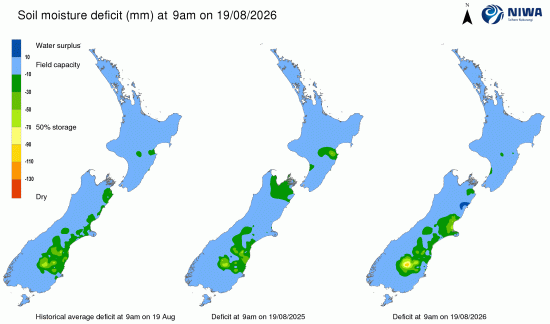
This soil moisture chart is animated here.

Keep abreast of upcoming events by following our Economic Calendar here ».

We welcome your comments below. If you are not already registered, please register to comment

Remember we welcome robust, respectful and insightful debate. We don't welcome abusive or defamatory comments and will de-register those repeatedly making such comments. Our current comment policy is here.

25 Comments

And just like that the US tries to repress long term interest rates ie US30Y

Up
4

Its pretty clear now that the 40 year down cycle in mortgage/discount rates is over (I've been saying this for a few years now, but its only become more certain in that time). We're living in a new paradigm/cycle/trend....adjust your thinking to the new paradigm or suffer the consequences (avoid excessive debt/leverage/risk for a few years!)

https://fred.stlouisfed.org/series/DGS10  Put this chart onto 'Max' timescale to see multi decade trends. 

In my opinion, we are now living in a new economic situation, nothing similar unless you go back 60 - 80 years. The 'boomer economy' died in 2020-2021, but quite a large component of society is still struggling with cognitive dissonance to wonder why the 'green shoot's aren't reappearing with lower interest rates and booming asset prices. 


Up
4

Too right IO.  America’s era of unchecked financial privilege is being yanked away from multiple angles.  Washington faces a severe financial trilemma while at the same time resisting a multipolar world shake up.

We are in a new world now.  But America doesn’t want this new world.  They will fight against this new world for as long as possible.

At its core, American foreign policy is the MIC.  This is a system that relies on global instability to justify its dominance..

Here’s some of the messaging they’re hiding in plain sight:

  • Donald (Trump)
  • Fight Fight Fight
  • Department of (War)
  • Kevin (War)sh
Up
2

Difficult to imagine just how the collapse of the USA on the world stage might play out internally. Historically, generally speaking, most empires have fallen by defeat and/or invasion. An exception to that being the British Empire but the homeland there at least remained  geographically intact as to does that of Russia in a different sense. But as it is impossible to visualise an invasion of the USA that then introduces the prospect of fragmentation, state by state, metropolis by metropolis and community by community. As it is, it is not un reasonable to contemplate that the USA has already outgrown itself, far beyond a singular identity and out of the reach and the control of central government. If that is so then it would be fair to say that President Trump has certainly provided impetus. 

Up
2

Hollywood has long mirrored these anxieties through a rise in civil war, invasion, and dystopian films.  Even the Escape from LA, Escape from New York movies.  And of course Obama’s Leave the World Behind film.  

They’re already imploding internally with the path Trump is on.  Public opposition to the Middle East situation is already high and further escalation could trigger some movements.  They don’t want to be the nation that started WW3.

 They currently have online movements such as the 'De-Flock America' campaign - calling for masked protesters to dismantle Flock Safety ALPR cameras.

Or perhaps divine intervention, because the earth beneath us is rumbling rather loudly…

Up
2

A question for the Interest.co hive mind. I've had an HSBC Australia Premier account which has been useful for several reasons including a holiday debit card, facilitating family money arrangements with my Oz relatives, a few Oz 3P  investment transactions & earning a significantly better TD rate than NZ.

HSBC have now announced the closure of their Australia Bank in ~18months, just as they did in NZ some years ago.

I've been looking at alternatives & they're very limited for NZ residents. HSBC are hands off, their expat options don't apply to NZ residents now (no idea why, they are still ok for Aussies) & the other main Oz banks generally require Oz residency.

I can of course use my Wise card for Fx  transactions including 3P investments however theres no interest on savings deposit & it would be helpful to retain access to the better foreign TD rate options.

Any experience / suggestions welcome.

Up
0

Take a look at Revolut. I believe they pay interest on cash. All depends on your needs I guess. I had a Citbank Gold account in Japan as my cash balance hit JPY10 million. No fees, fancy looking credit card, VIP personal banking, etc. Thinking about it now, it was little more than an ego stroke.  

Up
0

Wise does pay interest now though?

Up
0

It's been a while since I looked at Wise by my recollection was they only allowed a max of $60k transfers per year. Might be a stickler if you ever wanted to get your money out of Oz and have more than this.

Up
0

Thanks very much to everyone for your feedback.

Up
0

In early Asian trade, gold is up +US$136/oz from yesterday, now at US$4489/oz. Silver is up +US$4 at US$67/oz. 

Don't miss the trees for the woods. Gold miners are like Aotearoa houses in 2022. The GDX proxy up 9% in US trading and now up a whopping 36% in a month. Outperforming spot gold by 1x over past 12 months and even over 5 years. 

OceanaGold now up 527% in past 5 years. Chances are you won't read about it in Granny Herald or hear about it at the water cooler, despite the associations with Aotearoa.

Up
2

Not that long ago (circa 5 years ago) I took a lot #@^^ from the likes of HW2 about the benefits of owning some gold/silver and GDX etc - laughed at as a 'gold bug' and 'doom gloom merchant'. All you need as an inflation hedge was a few investment properties I was told.......I argued that if interest rates go up, housing will be a terrible inflation hedge as the discounted cash flows will cause the asset price to go down - meaning house prices will fall both in nominal and more so in real (inflation adjusted) terms. 

How quickly times change (and the truth reveals itself in time).

Up
4

The way I see it is that the Ponzi is kind of an inflation edge. It has to be. Why? because the Ponzi is basically a product and key driver of money supply growth. The Bank of England confirmed that the respective Ponzis across the Anglosphere are the primary driver of money supply growth [https://www.bankofengland.co.uk/quarterly-bulletin/2014/q1/money-creati…]

So the housing stock is a store of this money supply growth. There is an important difference between base and broad money growth, which is why I think is useful to contrast Japan with the EU and the Anglosphere.

But the issue is that market dynamics do not guarantee you can cash out your inflation hedge proportionate to or above the money supply growth. That is why the idea that property prices cannot fall below replacement cost is a cop out. If it weren't a cop out, we would not have seen the CRE apocalypse in the US (and happening across Aotearoa, Aussie, and Canada). 

Up
0

I saw a Stuff headline about American federal debt standing at over $40 trillion.

With a population of 343 million,  That's about $116,000 for every man woman and child. Add in per capita state and local government debt of $18,400, plus private and commercial debt of $160,000; that's a total per capita liability of $294,000. In $US

Same comparison in NZ, population 5.4 million, gives per capita debt levels of: Central government $33,740, plus local/regional government $5,537, plus private and commercial $117,000; giving a total per capita debt level of $156,300. In $NZ.

Sobering. 

Up
2

Historically, Aotearoa has combined relatively low public debt with very high household leverage and substantial net foreign liabilities. Persistent external deficits, the Ponzi (high house prices and bank-centered mortgage credit), and fiscal restraint (except for the gravy train for the consultants and mates of the public sector and ruling elite) have jointly supported high private leverage.

Up
1

Lol..."historically"...not much more than one lifetime ago.

https://www.youtube.com/watch?v=CB2NvNw77ig

Up
1

Let's replace historically with since the original Basel Capital Accord

Up
0

Public debt as % total: US 45%, NZ 25% illustrates the taxpayer reality.

Including Private debt in a total per capita number, while strictly correct also seems rather  irrelevant?

Up
0

Irrelevant? Maybe.

I included it to get a perspective on what burden every man, woman and child carried, at least on a notional basis.

Up
1

We borrowed up large for bigger and better houses, new cars, and loads of Chinese crap we don't need. And we demanded low taxes that couldn't even cover infrastructure maintenance and left the government borrowing just to keep the lights on. There you go younger generations, enjoy! 

Up
3

Not often we agree, but we do there. 

But finish the sentence - There you go, younger generations; a collection of fossil-dependent infrastructure and a compressed way of life, ditto. Buth unmaintainable. Oh, and we left you 7 billion too man; you'll have to fight them over 'what's left'. Sorry it's a tad hot and about the crop failures. Sorry too about the entropy - everything decaying. 

But hey, the good news is that those doomed growth-requiring monetary systems are all gone. 

Enjoy

Up
1

The Stuff-sourced $294K liability you mention, Lou, are according to my research, only a part of the story, especially for the US.

When you add in unfunded liabilities, the true numbers sits at closer to  ~$535K per citizen and a mind-numbing $1.35 million per taxpayer.

The sums...

A total of $176.3 trillion in liabilities minus $6.1 trillion in available assets = $170.3 trillion net

Federal Net Shortfall (Debt + Unfunded liabilities)  ~$170.3 trillion

State and Local Govt. debt ~$3.5 trillion

Private Sector Debt (mortgages including corporate) ~$62 trillion

Total Burden $235.8 trillion ~ $1,12 trillion per tax payer*

*(the broad taxpayer - someone who contributes via sales tax, petrol tax, state tax, property tax etc of ~210-220 million people)

Adding in private/corporate debt and that pushes the total liability out to a mind-numbing ~$1.35 million per US taxpayer.

For NZ, my research tells me the numbers calculated in the same way as for the US, and including unfunded liabilities, come to ~$219,500 per taxpayer and $192,500 per citizen. 


Up
0

Today, the Shenzhen Intermediate People’s Court sentenced Evergrande founder Xu Jiayin to life imprisonment for multiple crimes connected to large-scale financial fraud. His political rights were revoked for life and his personal property was confiscated.

https://www.scmp.com/business/china-business/article/3364641/china-ever…

Up
1

 "It follows revelations that Health New Zealand has hired just 54 additional full time equivalent nurses in the past two years."

https://www.rnz.co.nz/national/programmes/checkpoint/audio/2019048482/n…

https://www.youtube.com/watch?v=NCpcL8S_ua0 

Up
1

My wife worked in the DHB in multiple capacities. She said when the changes came into effect they would need to get executive approval for any new hiring, which included changes to contracted FTE hours by contract for the likes of nurses who wanted to take on more study and say, drop from 1.0FTE to 0.8FTE etc. This led to a huge pileup of contracts waiting on exec approval which would only be actioned periodically because, of course, exec time is worth far more than doing paltry contract approvals. The result was that those changing FTW would simply work and get paid by the DHB still while outside their contract as they needed the staff still and would simply have to wait on the signoff. They lost a lot of potential workers through this also as it took so long to get the contract approved for the applicants to start.

The 54 full time staff could be misleading as well as there's a big difference between 54FTE in 54 staff, when there could have been many more taken on but at less than 1.0FTE. This is where I think the reporting isn't transparent enough.

Up
0