

Here are the key things you need to know before you leave work today (or if you work from home, before you shutdown your laptop).
MORTGAGE RATE CHANGES
SBS Bank and China Construction Bank have made home loan rate changes. All current mortgage rates are here. And note, you can compare mortgage offers with our unique calculator that takes into account other costs and cashback incentives, here.
TERM DEPOSIT/SAVINGS RATE CHANGES
No changes to report here. All updated term deposit rates less than 1 year are here, for 1-5 years, they are here.
HIGH YEAR-ON-YEAR, BUT PROSPECTS WEAKEN
More than 40,000 new homes were consented in the year to June, up +19% on previous year. The rises were higher in Auckland (+20%) and Canterbury (+33%). But recent conditions may mean the peak has already passed. Population growth is now below average and a large increase in the number of available homes will weigh on demand. At the same time, interest rates and building costs are rising, and the number of builders failing commercially is rising.
NON-RES CONSENTS SHAKY
The value of commercial building work being consented has eased back modestly over the past year. With sluggish economic conditions and ongoing uncertainty about the economic outlook, developers and occupiers are likely to remain cautious about committing to major capital expenditure in the near term. Things would have been worse without good warehouse construction (for on-line delivery).
RBNZ CLOSES CASH CONSULTATION
The Reserve Bank says its "keeping cash local" consultation has closed after receiving nearly 6,000 responses. The RBNZ's proposal would enforce a cash service standard on NZ banks, requiring them to provide cash services across the country for free at an estimated annual cost to the banks of $104 mln. Assistant Governor Karen Silk said on Monday that the consultation findings will be released in late September. Consultation on the Reserve Bank's proposal was originally due to close in April but was extended to July 31. Bank lobby group the New Zealand Banking Association has labelled the proposal "extreme" and a "back to the future solution."
SLIDING
The number of commercial properties advertised for lease is still rising. We had thought we were near its high point in this cycle, but it has proven illusory. Nationally, these listings are up +15.5% at the end of July from a year ago. If there is a bright spot, it is central Auckland were they are down -6.8% from a year ago. But in South Auckland in the city's industrial heartland they are up +33.6%. In Waikato they are up +23% on the same basis, in Tauranga up +10.5%, in Wellington up +34%. Even Christchurch is up +13.8%. This listing data is sourced from realestate.co.nz.
NZX50 FIRMISH
As at 3pm, the overall NZX50 index was up +0.3% today, but down -0.8% for the past 5 trading sessions. It is up +2.4% from six months ago. From a year ago it is now up +8.3%. Market heavyweight F&P Healthcare is essentially unchanged so far today. Kathmandu, Spark, Vista and Port of Tauranga lead the gains while EBOS, Investore Property, a2 Milk and Channel Infrastructure are slipping.
A DIP, BUT NEW ORDERS UP
Over the weekend we noted that China's official factory PMIs all turned down, and into contraction territory. The private S&P Global version has been less gloomy in the past, but today's release also shows a sector slipping in July from June. But at least this alternate versions is not yet contracting. And they feature rising new order levels, which is promising.
GLOBAL FACTORIES STILL BUSY
And while we are at it, we should note that the factory PMIs for Japan, South Korea, Taiwan and Malaysia all remained quite positive and expansionary. All of these noted that cost pressures are easing now. The Australian version is rising too, but cost pressures there are still elevated.
HOUSE PRICES DIP AGAIN
In Australia, the Cotality Home Value Index dropped -0.7% in July from June, the sharpest monthly decline since December 2022 and accelerating from a -0.4% fall in the prior month. The drop was after higher mortgage rates, affordability pressures, and soft consumer sentiment, all hurt housing demand. Sydney and Melbourne lead the downturn, with home values falling -1.4% and -1.2%, respectively in a month.
NOT EASING
Staying in Australia, the Melbourne Institute Monthly Inflation Gauge increased materially in July, after falling in the previous two months. The increase was broad-based, with annual headline inflation of 4.0%. The monthly cost of living also increased across a range of household types. Later this week we will jet the June household spending data from the ABS and also their cost of living indicators. This MI data suggests whatever those ABS results in June, things will get worse in July.
SWAP RATES FIRM
Wholesale swap rates may have firmed today. Keep an eye on our chart below which will record the final positions closer to 5pm. The 90 day bank bill rate was up +1 bp at 2.94% on Friday. Today, the Australian 10 year bond yield is down -2 bp from Saturday at 4.94%. The China 10 year bond rate has held at to 1.71%. The Japanese 10 year bond is up +1 bp at 2.81% today. The NZ Government 10 year bond rate is now at 4.76%, and up +6 bps from this morning. (The RBNZ data is now 'prior day' with the Friday rate down -6 bps at 4.67%.) The UST 10yr yield is down -5 bps at 4.69%.
EQUITIES VERY MIXED
The local equity market is now up only +0.3%. Meanwhile, the ASX200 is dipped -0.3%. Tokyo however has opened down -1.7%. Hong Kong is up a minor +0.3% but Shanghai is down -0.6% at its open today. Singapore is down -0.3% at its open. South Korea is continuing its volatility, down -4.2% to start their week. Wall Street futures suggests the S&P500 will open up +0.8% and the Nasdaq up +1.4%.
OIL PRICES DROP
Trump threats gave way to yet another pullback (TACO) and oil prices have fallen sharply today so far. American oil prices have fallen -US$5 from this morning with the WTI benchmark is now just on US$79.50/bbl, while the international Brent price is just under US$83.50/bbl and down -US$4.50.
CARBON PRICE LITTLE-CHANGED
There have been very few trades so far today and the price has eased back slightly to $55/NZU. See our daily chart tracker of the NZU price for carbon, courtesy of emsTradepoint.
GOLD FIRMS
In early Asian trade, gold is up +US$20/oz from this morning, now at US$4062/oz. Silver is now just on US$58/oz and up +50 USc from the same time.
NZD LITTLE-CHANGED
The Kiwi dollar is unchanged against the USD from this morning's open, still at just on 58.9 USc. Against the Aussie we are also unchanged at 83.8 AUc. Against the euro we are holding at 51.1 euro cents. This all means the TWI-5 is now just under 62.6 and little-changed.
BITCOIN HOLDS SOFT
The bitcoin price is now at US$66,083 and down -0.4% from this morning. Volatility has been low at just on +/- 0.5%.
Daily exchange rates
Select chart tabs
Daily swap rates
Select chart tabs
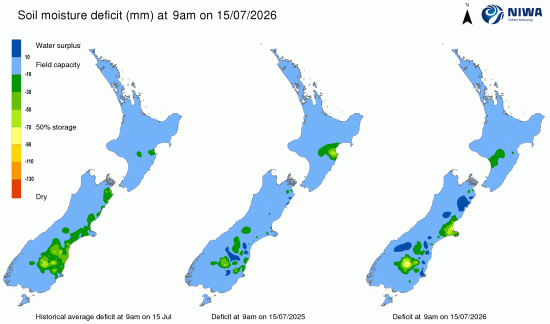
This soil moisture chart is animated here.
Keep abreast of upcoming events by following our Economic Calendar here ».
18 Comments
A major rat poison hardware-wallet exploit was disclosed over the weekend, with attackers reportedly draining funds by abusing a firmware flaw rather than physically touching the device. The losses have grown to a minimum of approx USD89 million.
AI was used to discover and operationalize a pre-existing firmware bug in public code. That means that the hackers were able to "guess" the seed phrases that people use to protect their wallets.
Does this mean that BTC wallets are hackable? To some extent, yes. But I think the more important issue is related to the extent to which AI can be used to break things.
https://www.b2bnn.com/2026/08/ai-may-have-found-the-coldcard-flaw-then-…
Bessent has said that the Trump Administration delivered for the U.S.-Japan alliance in Friday's coordinated foreign exchange actions to counter disorderly yen movements. The Treasury is communicating with the MOF and BOJ and the FIMA Repo Facility is an important backstop. Bessent says the U.S. would encourage it to be upsized in the coming months. He said he strongly supports Japan's decisive market and monetary steps to correct the substantial undervaluation of the yen.
So what does this mean? If we monitor this week's Fed H.4.1 release, we can confirm whether the MOF repo’d their treasury for then sold them to buy JPY. If Bessent can get the counterparty limit increased then the Fed can create money using MOF TSY as collateral.
https://www.benzinga.com/markets/economic-data/26/08/60863030/scott-bes…
Cheers. Queued up for free time later. However, it's directly relevant to what happened on Fri.
The US buying yen - what does this mean you ask, Phoenix...
...my 2 cents worth...
#1 Euros were sold to fund the purchase of the yen (estimated US $5-10 billion)* and the deal was done through the intermediaries Goldman 'Sucks' and Morgan Stanley to try to halt the yen's drop to nearly 40 year lows.
*(This was snapped by a Reuters photographer over the shoulder of the idiotic and incompetent SOT, Bessent - it was as a handwritten "to do" list to himself, during a Camp David Cabinet meeting)
#2 This intervention is done primarily to try to save the US bond market - IOWs the ability for the US to palm their debt of to the RoW, and by definition, to try to mitigate a chaotic unwinding of the gigantic yen carry trade.
Of course it is framed as an act of goodwill, but in essence it is a defensive maneuver to try to guard against threats to the US financial system, which will get into even more serious trouble as soon as it cannot sell its debt without paying huge yields to buyers who demand the huge premiums that offset the risk they take in purchasing US treasury notes and the long-dated bonds, and the risk involved in losing most of their capital when those bond prices inevitably collapse - along with the currency as well.
#3 Meanwhile Bessent is literally begging Japan and Europe to stop selling USTs, to try to avoid a vicious feedback loop involving the US deficit, collapsing yen - all of this is amidst the threat of an impending UST fire sale
Because the budget deficit is on track to be ~$2 trillion for fiscal year 2026, and Bessent needs to borrow another $900 billion just to fund the deficit.
What has been happening is a destructive chain loop that endangers the entire global economy...
...The yen falls...
...Japanese institutes sell USTs to bring money home...
...US Treasury selling pushes US yields higher...
...Higher yields make the deficit grow even larger...
...Larger deficits require even more borrowing just when the historically biggest buyer, Japan, is divesting out of UST's...
...The US buys yen to try to stop the rot...
... The chain-loop continues...
Bessent is also championing an upsized smoke and mirrors Fed Repo Facility, allowing Japan to temporarily swap its treasuries for US dollars directly via the Fed, to avoid them dumping them directly onto the market.
With the Euro Swap side, the NY Fed sold Euros to buy yen on behalf of the US Treasury, using existing foreign reserves rather than creating even more debt.
The Trump Admin with the blathering Bessent in charge, stepped in to prop up the yen, precisely because they realised that if they didn't, Tokyo would be forced to trigger a fire sale of USTs, that would break the US bond market, and supercharge the US deficit even further.
What you describe is what Dalio warns about in ‘The Changing World Order’ book. And when people say ‘how would the USD ever lose its reserve currency status?’ Well..,,
Its when what you describe above starts happening.
Nations start selling bonds of the reserve currency while at the same time the reserve currency nation is running massive fiscal deficits to fund its worldly ambitions. Interest rates rise because the risk of default on those bonds rises, and a vicious feedback loop starts. This is true for every nation that was a reserve currency player in the past, but no more.
Agreed - IMO, Independent, its another financial tragedy waiting to happen.
This is the stuff that historical hyperinflations, and sovereign debt crises, are built upon. Its a case of a classic monetary regime shift, where the gap between the official BS govt statistics and economic reality kicks in and becomes so glaring that the market snaps.
I remember the UK gilt crisis in the late 70's, and early 80's, when UK govt bonds spiked to 15.7%. The US govt is currently operating at a debt;GDP level of ~124% and rising, whereas the UKs ratio was hovering between 50-60%.|
Also, official inflation figures grossly under-measure the true rates. The real world cost for private citizen's inflation of essentials, food, energy, insurance, and healthcare, etc, has dramatically outpaced the official headline.
If investors price bond yields based on a false 2.7% inflation rate, while their real world inflation rate is closer to 10%, the are locking in a guaranteed loss of purchasing power.
If the 10 year treasury yield hit even 8%* the US govt would be spending nearly 50% of its entire tax revenue solely on interest repayments. At this point the maths breaks - no amount of austerity or tax hikes could even come close to filling the gap.
*(IMO, the entire Ponzi will implode well before yields even get to 60%, so forget getting anywhere near 8%)
This is simply a monumental Ponzi scheme which relies entirely on new investor cash paying off older investors, without producing any underlying wealth. When the US Treasury borrows $550 billion (and climbing) each quarter just to roll over maturing debt and pay interest, this perfectly fits the definition of the Ponzi dynamic.
The final straw will be when bond redemption value vanishes. When yields rise the market value of existing bonds crashes. and investors holding long term treasuries, are sitting on massive urealised losses.
Under these circumstances if they want to prolong the Ponzi, and prevent the banking sector, plus the bond market imploding, the Fed is ultimately forced to step in and become the buyer of last resort. They would have to print trillions just to buy the bonds nobody else wants.
Because the US is a consumer driven economy which imports the vast majority of its manufactured goods and components, that massive injection of printed dollars instantly debases the USD even further.
That leaves the US alone in an empty room, printing money to buy its own debt until the purchasing power of its own currency is completely wiped out.
Dalio has been pushing videos on youtube recently (and promoting his books of course), however early this year his wording was that we could get to a tipping point of no return, and in his recent videos he asserts that we are now past this point of no return - with his message being more of warning and education than that of just caution. Take from it what you will.
The FIMA Repo Facility is a Fed backstop that lets foreign central banks and monetary authorities temporarily borrow dollars by repoing U.S. Treasuries, instead of dumping assets into the market.
Its purpose is to provide temporary dollar liquidity and reduce stress in global dollar funding markets, and the Fed says it is mainly meant for periods of unusual market stress.
https://www.federalreserve.gov/monetarypolicy/fima-repo-facility-faqs.h…
Agreed, Phoenix - and this Repo Facility is also another way to prolong a Ponzi.
https://thespinoff.co.nz/politics/03-08-2026/the-new-uk-prime-minister-…
maybe if we had a party for the working man, alas we do not
Because pubs & restaurants have a right to be become welfare beneficiarys dependent on taxpayers charity, same as churches, Iwi, the horse racing "industry", Sanitarium...
Last year NZ IRD consulted on taxing our "charitys" - that initiatIve got buried by year end because "excessive compliance costs".
Oh my. Aussie billionaire Anthony Pratt has struck a deal for his private manufacturing giant Visy Industries to tap in to super funds to raise $150 million in long-term debt.
Why could this be seen as problematic? Pratt is closely connected to Team Albo through political donations and interactions, including Pratt’s own company Pratt Holdings donating to Labor.
Pratt is estimated to be worth around US$11.7-11.9 billion.
What could possibly go wrong?
Historically, Super fund trustees were required to invest as a "prudent person", typically fixed interest, govt bonds, blue chip companies.
Well I have nothing against Pratt's businesses, but there are questions as to who, what and why gets access.
Presume that's 1.4% for the NASDAQ
Everything, everywhere, all at once.
That clip connects to the yen/USD point above, and to Iran.
Buckle up
We welcome your comments below. If you are not already registered, please register to comment
Remember we welcome robust, respectful and insightful debate. We don't welcome abusive or defamatory comments and will de-register those repeatedly making such comments. Our current comment policy is here.