
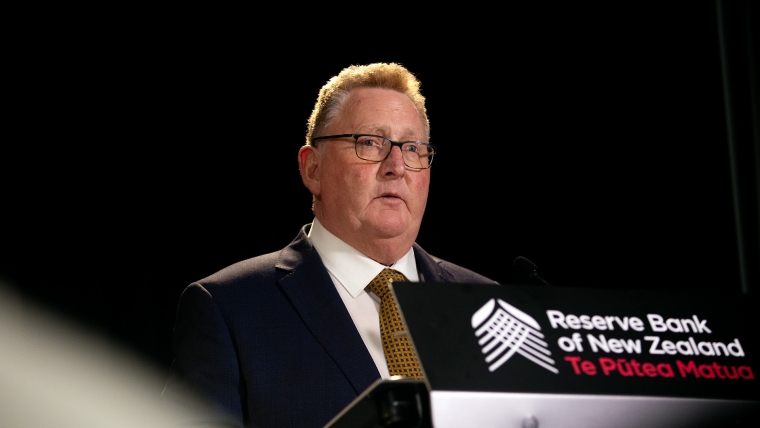
Policymakers at the Reserve Bank (RBNZ) have slashed half a percentage point from the Official Cash Rate (OCR) and claimed victory in achieving its inflation mandate.
The seven person Monetary Policy Committee chose to cut the benchmark interest rate from 5.25% to 4.75% after meeting on Wednesday. In a statement, they said annual inflation was now within the target range and was "converging on the 2% midpoint".
"The New Zealand economy is now in a position of excess capacity, encouraging price- and wage-setting to adjust to a low-inflation economy. Lower import prices have assisted the disinflation," the media release said.
"The Committee agreed that it is appropriate to cut the OCR by 50 basis points to achieve and maintain low and stable inflation, while seeking to avoid unnecessary instability in output, employment, interest rates, and the exchange rate".
This move follows a 25 point cut at its previous meeting in August when high frequency data showed the economy was faltering faster than RBNZ had forecast in May.
Economists and financial markets mostly expected the 50 basis point cut on Wednesday afternoon, despite the central bank having signalled it would only cut 25 basis points.
In reaction to the OCR cut, New Zealand’s benchmark stock index climbed almost half a percentage point after the announcement, while the Kiwi dollar dropped 0.4% against the US and Aussie dollars. According to Westpac economists, in the financial markets, the two-year swap rate was down 7 basis points to 3.64% and the 10-year rate was down 6bps to 3.96% within a quarter of an hour of the announcement.
A recent survey of businesses found pricing intentions had dropped to pre-Covid levels, and headline annual inflation for September is forecast to be on target, when released next week.
Meanwhile, economic activity and labour market data have continued to weaken, prompting concerns that unemployment could hit 6% and the economy could experience deflation.
In a note published last week, ANZ’s chief economist Sharon Zollner said it was likely the RBNZ would be confident it had done enough to stamp out inflation.
Economists at ASB said they were increasingly concerned that interest rates were still very restrictive even though inflation and capacity pressures had already normalised.
In August, RBNZ projected it would gradually ease rates towards 3% over the next 18-months as long as pricing behaviour remained consistent with a low inflation environment.
Near-term surprises
The RBNZ Monetary Policy Committee said on Wednesday that the economy had evolved largely as expected in the past two months and the economy was running below its potential.
"Members agreed that increasing excess capacity is leading to lower inflationary pressure in the New Zealand economy. Economic growth is weak, in part because of low productivity growth, but mostly due to weak consumer spending and business investment."
The committee was confident next week’s consumer price index release for the September quarter would show annual inflation not just in the 1%-3% target range but almost at the 2% midpoint.
“Recent business visits suggest that weak demand is restricting the pass-through of increased input costs to prices faced by consumers. This is consistent with business surveys, which show a declining share of businesses intending to increase prices”.
Policymakers discussed both 25-basis point and 50-basis point cuts and ultimately reached a consensus that the larger cut would better avoid economic instability.
While the central bank’s price stability mandate has been simplified—removing a secondary target of full employment—it is still tasked with avoiding “unnecessary instability in output, employment, interest rates, and the exchange rate”.
The committee said the economic outlook was broadly consistent with its August assessment and an OCR of 4.75% was restrictive enough to "deal with any near-term surprises".
It said future changes to the OCR "would depend on its evolving assessment of the economy".
We welcome your comments below. If you are not already registered, please register to comment
Remember we welcome robust, respectful and insightful debate. We don't welcome abusive or defamatory comments and will de-register those repeatedly making such comments. Our current comment policy is here.