

As we approach a year since the Reserve Bank (it was May 24, 2023), somewhat surprisingly, called a halt to its extremely bracing cycle of Official Cash Rate hikes, we can say with every confidence that the forthcoming OCR decision will be another 'hold'.
There's been nothing since the last review in April to change the RBNZ's mind on keeping the OCR unchanged.
But while it is the safest of safe bets that the OCR will remain on 5.5% after the latest review on Wednesday, May 22, there will be much interest and intrigue around what the central bank has to say in its new Monetary Policy Statement (MPS), the first one since February.
The forecasts in it will be crucial.
Here is an abridged version of the key forecasts from the RBNZ's February MPS:
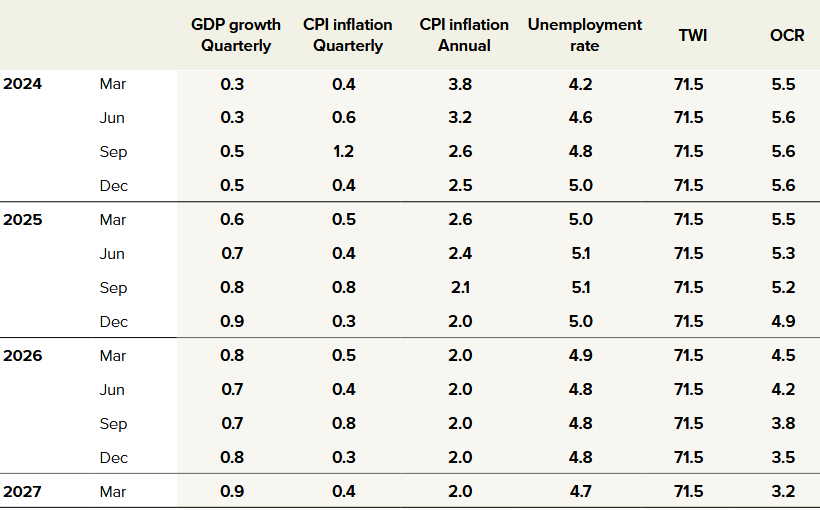
The most anticipated figures in the new May MPS will be the OCR forecasts. There will be much interest as to whether or not the RBNZ signals through its new forecasts that it now expects the OCR to be cut for the first time earlier. Interest will also centre on whether it chooses to remove the possibility of of another hike before we get to the cuts.
As per its February forecasts the RBNZ was implying that the first cut to the OCR was likely to happen in the second quarter of next year. But it was also still forecasting about a 40% chance of another RISE of the OCR by the September quarter of this year.
I think the RBNZ could be justified in both removing the implied suggestion of a potential further rate hike and bringing forward the forecast time of the first OCR cut.
But I don't think it will, because that would not be the sort of signal it wants the financial markets to be given.
The markets like to run ahead of themselves - and of the RBNZ. At time of writing wholesale interest rates are pricing in NO chance of another OCR hike, but a very high probability of the first cut by October this year, with a pretty fair chance of TWO cuts by November 2024.
If the RBNZ does either or both of removing the chance of an OCR hike from its forecasts and bringing forward the time of the first forecast cut, the financial markets will run with that and will be quickly pricing in an even earlier start to the cuts. That would be very significant because it could lead to meaningful cuts ahead of time in mortgage rates.
So, the signal from the RBNZ's going to be important. Of course the RBNZ and Governor Adrian Orr are very well aware of how the the markets think and are not averse to wrong footing said markets with pronouncements and forecasts that 'the market' might not have expected. For example, the February media statements and press conference that accompanied the release of the February MPS were far more 'dovish' in their messaging than financial market participants had expected.
The RBNZ folk won't want to see mortgage rates falling significantly from current levels till they are very confident inflation is under control.
So, what of inflation?
Well, if the OCR forecast is the first thing economists and the like will look at in the new MPS, the RBNZ's latest inflation forecast will be a close second.
Importantly, people will want to see if there's any 'slippage' around when the RBNZ thinks inflation - as measured by the Consumers Price Index (CPI) - returns to inside the 1% to 3% targeted range. It's been outside of that target range for nearly three years now.
The past week saw some good news and some slightly less good news for the RBNZ on the inflation front. On the not-so good news front, Statistics NZ's latest new monthly Selected Price Indexes data, which covers about 45% of the things in the quarterly CPI, again pointed to some 'sticky' inflationary pressure - particularly in respect to things such as rents.
But against that, the RBNZ's own Survey of Expectations mostly showed another solid fall in the expectations of future inflation, with all timeframes (one-year, two-year, five-year and 10-year) being under 3% for the first time since the September 2021 survey.
In the February MPS the RBNZ was forecasting that the annual rate of inflation would return to under 3% in the September quarter of this year. It's very unlikely the RBNZ would change that forecast timeframe. It would be a bad look.
But there's no doubt there will be some fingers crossed as the latest forecasts are signed off - assuming that September quarter date for inflation going under 3% is retained.
In terms of the actual inflation figures to date, March quarter CPI rose by 0.6%, which was higher than the RBNZ's 0.4% pick. Annual CPI rose 4.0% (down from 4.7% as of the December quarter) against an RBNZ forecast of 3.8%.
The big 'miss' for the RBNZ forecasting was in domestic (non-tradable) inflation, which was much stronger than the RBNZ was picking. The RBNZ forecast quarterly non-tradable inflation of 1.1%, but it actually came in at 1.6%, while in terms of annual figures, the RBNZ had picked 5.3% but it came in at 5.8%.
Overseas-sourced, or tradable inflation, was -0.8% for the quarter (versus an RBNZ pick of -0.7%) while the annual rate was 1.5% versus the RBNZ's 1.6% pick.
The RBNZ won't want to be depending on continued low inflation or even deflation from offshore, so, it will want to see domestic inflation beginning to drop more quickly.
Other key economic data, however, are perhaps suggesting that more downward pressure is going to start coming for domestic inflation. December quarter GDP showed a 0.1% contraction, while the RBNZ had expected a flat (0.0%) result. Unemployment rose from 4.0% to 4.3% in the March quarter (the RBNZ had picked a rise to just 4.2%).
A contracting economy and a now quite quickly softening labour market would together suggest downward pressure on inflation through fewer wage rises and reduced spending. The soft GDP and labour market figures would therefore probably allow the RBNZ to be 'patient' with inflation for now.
The upshot is, I would be surprised if the RBNZ does change that forecast of inflation going under 3% by the third quarter of the year.
Likewise, I would be fairly surprised if the RBNZ makes much, if any change to its OCR forecasts. It won't want to give the financial markets the opportunity to start pushing down those wholesale rates and thereby, by implication, opening the door for large mortgage rate cuts.
As others have said, the RBNZ won't want to say it's cutting the OCR virtually until the time it does it.
So, for now it's likely we will get a largely unchanged message. But really, you can never exactly tell with the RBNZ. Anybody looking for clear signs of some significant mortgage rate relief coming before the end of the year is, however, likely to be disappointed.
Just as a final thought, however, I've seen some comments asking whether there is any chance of a cut by the RBNZ now? I say no. But the economic news is certainly worth keeping an eye on. There are definitely signs the economy is really starting to roll over. The RBNZ wants to slow the economy. Not break it.
The RBNZ's overwhelming priority is to smash inflation, and to some extent to hell with the consequences for the economy. But yes, I think there is some possibility if the economic news keeps getting darker and darker the RBNZ may yet have to compromise a little on its inflation target. Maybe. But we are not at such a point yet. Watch this space.
I'll finish with a quote from ANZ chief economist Sharon Zollner:
...We don’t see OCR cuts until the RBNZ has more confidence that the downward path for inflation won’t peter out before reaching the desired destination: not only back in the [1% to 3%] band, but also likelier than not to stay there. The timing and specifics of such a ‘confidence’ pivot are very difficult to pinpoint, as it will depend not only a bunch of inflation indicators, but also whether the economy is still going south or recovering. A range of combinations of data could meet the requirements. But the general theme is that the weaker the real economy is looking, the fewer inflation runs on the board the RBNZ is likely to require in order to feel confident about cutting the OCR."
*This article was first published in our email for paying subscribers early on Friday morning. See here for more details and how to subscribe.
We welcome your comments below. If you are not already registered, please register to comment
Remember we welcome robust, respectful and insightful debate. We don't welcome abusive or defamatory comments and will de-register those repeatedly making such comments. Our current comment policy is here.