

Cash is back, with a 70% surge in the volume of cash withdrawals compared with a year ago, according to the latest quarterly release of spending data from Kiwibank customers.
Kiwibank chief economist Jarrod Kerr, senior economist Jeremy Couchman and economist Mary Jo Vergara "the renewed demand for cash" has been an interesting development in the past year.
"Over the covid pandemic, there was an understandable aversion to handling and exchanging cash," they say.
"Today, the volume of cash withdrawals has taken a step-change higher – up 70% compared to a year ago."
They suggest that the resumption of international travel may explain the sudden jump in cash withdrawals.
"When travelling abroad, it’s handy to have cash on you."

However, the demand for cash also appears to have coincided with a slowdown in the number of online purchases.
"Over the pandemic, we witnessed a tec(h)tonic shift toward digital commerce. Though storefronts were boarded up, households continued to shop – click and collect style. But Kiwi are now redirecting their spending toward services. The number of online purchases has fallen back to 2019 levels."
The economists say 2020 "will be remembered for many things", one of which will be the "exorbitant spending" on all things housing.
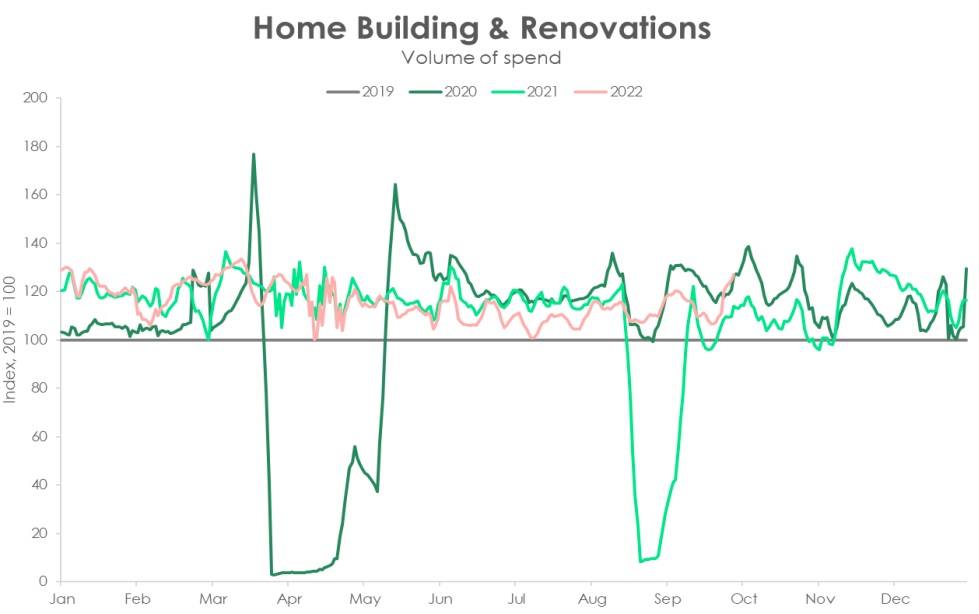
"Kiwibank spending data supports the countless anecdotes of Kiwi DIYing, everything from renovating bathrooms to installing pools. And with the adoption of working from home, many sought to create a home office. There was fresh demand for office equipment.
"But now Kiwi are fully decked out, and much has changed since 2020. Consumer confidence has weakened, credit is harder to get, and the housing market is in retreat. Households are just not in the mood to splash out on big-ticket items anymore."
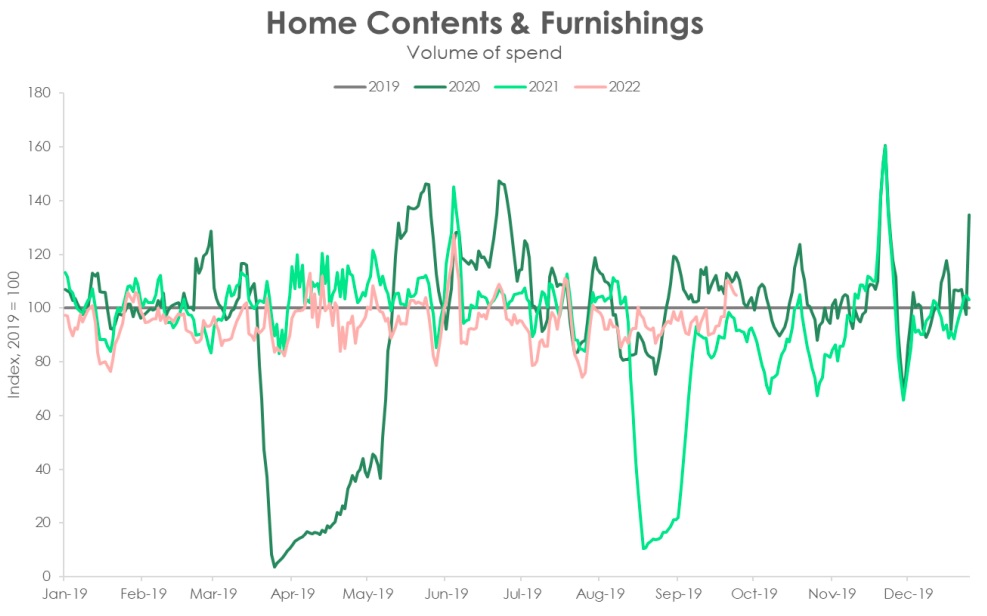
The economists say that as a consequence, housing-related spend continues to fall. Spending fell another 4.5% in the September quarter.
"We’re making fewer purchases on household contents & furnishings, down 3.4% and sitting below 2019 levels. Similarly, the volume of transactions on home electronics dropped 2.4%. Kiwi are also putting down the tools, with the number of trips to hardware stores virtually unchanged from the prior quarter."
The economists say that as house prices continue to fall, "the wealth effect" will continue to weaken and spending alongside it.
"Weaker appetite to spend on the house is a clear sign that demand in the economy is cooling."
The economists say that overall, Kiwibank electronic card spend rose 3.1% in the September quarter.
"Supported by historically low levels of unemployment, consumer spending appears to be holding up. Although, the rise in consumer prices is working behind the scenes.
"High inflation is helping to prop up the value of transactions. When adjusting for inflation, consumer spend rose by a lesser degree up 2.1%. And slower than the 5.2% increase last quarter. The widening gap between nominal and real spend underscores the rapid rise in consumer prices."
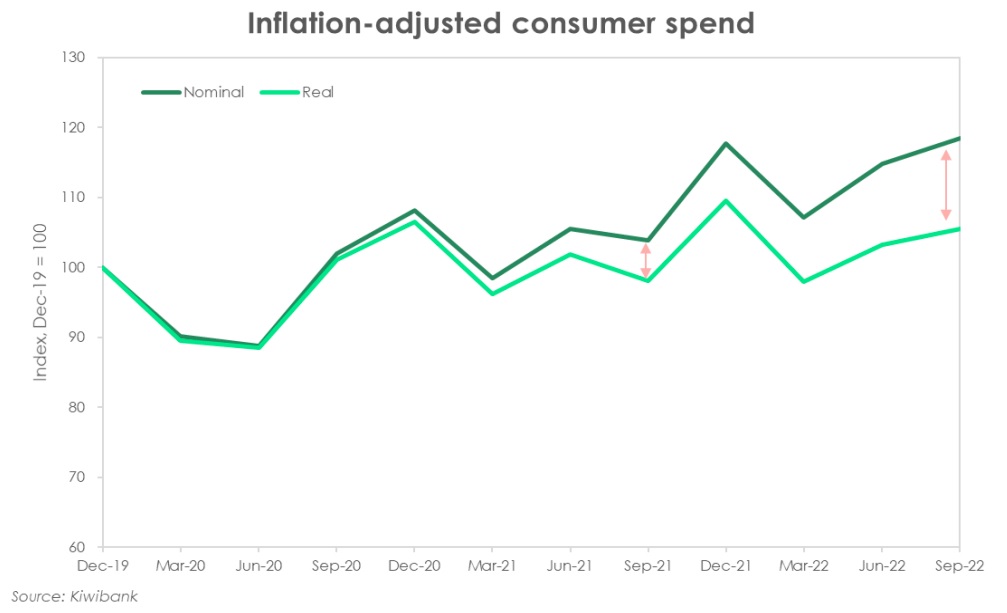
They say the slower rise in real spend also suggests that Kiwi are tightening their belts.
"Evidently, the growth in dollars spent is outpacing the growth in the volume of transactions. It appears that the number of times Kiwi tapped, swiped and inserted their cards is slowing. And in September, the volume of transactions was unchanged from the prior month.
"The outlook for consumer spending is weakening. With rising interest rates, high living costs and falling house prices, the appetite to spend up large is waning."
18 Comments
So it seems that Charlie Ash is alive and well in NZ....
Love a good cash business.
using cash is a key budget tool for many -- you take out what you can afford and you can see it physically go down not some mythical figure on a screen at an ATM -- or on line when you check balance --
Suspect it will grow even further over the next 12 months as more people start using this strategy
Bargains materialise at the sight of cash.
Remember...Cash has always been King!
If they have been listening to the grapevine and seeing the global economy the past few years, they are all feeling the risk of bail-ins and doing what the wise are...drawing down cash before the banks steal it all to bail themselves out of their corruption.
Great news. Have always been a 'cash' person and yes the credit schemes, buy now pay later etc etc have their place for the savvy but they are absolute money pits more most.
Perhaps people are using cash as a way to minimise the appearance of expenses on their bank statements so that when banks are assessing affordability for home lending under the CCCFA Regulations that came in December 2021 the banks are less likely to identify the expenses. Although the banks do of course have processes in place to pick up on cash withdrawals as potential expenses if they are regular.
Have had a couple of customers tell me that they always get their cash out from the Supermarket once or twice a week, that way it appears to just be groceries. Always just for 3-4 months for the bank before applications. Just so they can continue to live a normal life and buy coffee or have takeaways every so often. The whole thing is dumb, you either have enough money left over to pay your debts, or you don't. What you spend it on is no ones concern.
That makes zero sense... the bank will just take into account their higher grocery bill. It'd be the same if they had just done their normal shop + bought coffee.
People trying to be clever like this will just end up getting caught out... it might actually end up being worse for them.
No that's exactly how it works. If it was about the amount of money they had left over at the end of the week, then they could have just kept buying the coffees in the first place. This is about the banks scrutinizing and questioning about the particular types of expenses.
I think you'll find its changed with CCCFA updates. The banks will be more worried about random large withdrawals that they can't identify...
Up 70% just doesn't sound right to me, so I am doubting the numbers someone in admin has come up with. We could start with 70 being a typo, looking at the numbers it's more like a 40% increase from around 150 to 210. Plus 2020 and 2021 were unusual years to be comparing to.
Good grief. Anybody in the real world will know that (a) a recognised response to higher costs of living (and a higher performing IRD) is more people taking cash-in-hand work, and (b) people are spending less at the shops because more of their money is going directly on higher mortgage payments, insurance, bills, rent etc,
Also the rise in second hand shopping or buying stuff and services off Facebook Marketplace. People are looking for a bargain or additional income, and if thats a cash job or trade so be it.
"When travelling abroad, it’s handy to have cash on you."
Yeah right. Those merchants in Instanbul and Croatia get excited when you pull out a NZ$20 note. But not in a good way.
It's a freedom thing. It's harder for wokesters and virtue signallers to social credit score your folding stuff.
https://www.telegraph.co.uk/politics/2022/09/27/paypal-reinstates-free-…
Trudeau vows to freeze anti-mandate protesters' bank accounts
https://www.bbc.com/news/world-us-canada-60383385
The push back on PayPals woke bullshit has been promising to see. At least the general populace is not fully asleep yet.
CBDCs will be the ultimate fight, but they will bride you to use it to gain adoption, then they will hit you with the reductions.
Opt out, buy Bitcoin that no one can confiscate or stop you from spending.
The problem with walking around with a wallet full of cash is if you misplace that wallet your cash is likely toast. Given Kbank is govt owned any fears of a bank run are deluded. National median savings of around 3k says it all really and if folk are cashing it ,that median will drop. Nice to think that cash is king but when you have a national median of 3 k savings,What is it king of ? . The best way of saving money is to leave it in the bank and stick to a cuthroat budget not cash it out... Build it up and lock it into a TD ,I suspect Kiwis are still spending like theres no tomorrow ,hard to break old habits , I dont see many taking cut lunches to work...or catching the bus...Maybe a wallet full of cash makes them feel richer than they actually are....Good luck convincing IRD all's above board...fools and their money ...easily parted. How long before those that pour everything into RE understand they enslave themselves to higher forces and do so by forfeiting the ability to be financially free ...then when your too old to do anything your still entrapped because you need to downsize or reverse mortgage ... then you sit and look out the window from your retirement villa still under the pump of monthly service fees...Life is much more complicated than many foresee . Your damned if you do and your damned if you dont...and guess what ,you cant take it with you when you go, Until someone comes up with a more efficient way of housing the masses its bonded servitude for those that sign up. Enjoy the us and them because its a mirage ,some of them have more liquidity....and live wherever they lay their hat. They are the real savers that have liquidity to burn, a national median of 3k is a joke to them.... they can be seen unwrapping their cut lunches and drinking from a thermos, they are a dying minority that hides in the 3k national median ....lol
Many Kiwis are probably spending like there's tomorrow because they likely don't have a choice. There's a huge number of people working far harder than you or I and living paycheque to paycheque.
Sometimes it's not just a question of discipline. Sometimes you need to accept it's a lot harder to cover the basics than it used to be, let alone get ahead.
We welcome your comments below. If you are not already registered, please register to comment
Remember we welcome robust, respectful and insightful debate. We don't welcome abusive or defamatory comments and will de-register those repeatedly making such comments. Our current comment policy is here.