
sign up log in
Want to go ad-free? Find out how, here.

In most economies with independent money markets, investors are signaling a much higher chance of more rate rises, with positions hardening weekly

Bonds / news
In most economies with independent money markets, investors are signaling a much higher chance of more rate rises, with positions hardening weekly
up-arrowsrf1.jpg
Source: 123rf.com

Over the last month there has been a substantial shift in how money markets are thinking about what central banks will do to fight inflation.

The view is hardening that the next rate review will be a hike. And that is a view in many key economies.

In Australia and England the shift is the most dramatic, from virtually no chance a month ago, to now seeing it as a 90% chance.
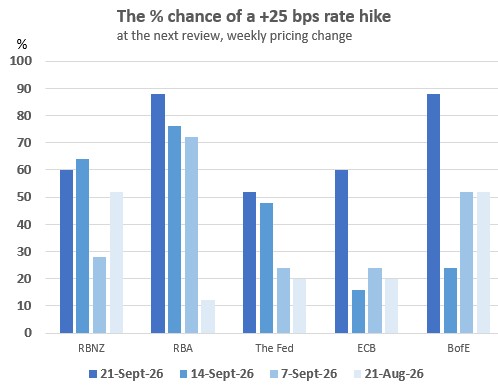
 

Driving these financial market views are how they think the respective central banks see urgency in pushing back against inflation.

Slow or timid policy responses risk inflation embedding. When that happens, it is so much harder to recover without causing a recession in economic activity.

Recent policy guidance is much clearer now that central banks are looking at the inflationary forces they face and seeing more urgent action is required and required soon.

This is true in New Zealand as in others jurisdiction. But for us if the Reserve Bank of Australia, US Federal Reserve, and even the Bank of Japan start moving up, beyond last weeks' Fed and BoJ increases, then the tide will come in globally for interest rates. And no matter what the Reserve Bank of New Zealand does, our interest rate environment will rise.

We welcome your comments below. If you are not already registered, please register to comment

Remember we welcome robust, respectful and insightful debate. We don't welcome abusive or defamatory comments and will de-register those repeatedly making such comments. Our current comment policy is here.

6 Comments

Higher interest rates will not succeed in reducing the real cause of inflation, which of course is the rising cost of oil. 

All it will achieve is to inflict more financial pain on top of higher prices for good and services by also making the cost of money more expensive.

As a result, 2027 will be a world wide recession.

Up
5

"Higher interest rates will not succeed in reducing the real cause of inflation, which of course is the rising cost of oil"

But for the past 20-30 years we have lowered interest rates in order to fight deflation caused by importing cheap goods using foreign labour (ie all those things in the CPI we imported from SE asia using cheap labour to make our cost of living lower).

So its okay to drop rates for 20-30 years because we were importing deflation (creating a massive private debt to GDP bubble), but as soon as we import inflation, then it isn't okay to raise rates? 

You can't have it one way when it suits, and then not when the shoe is on the other foot. If you drop rates when you import deflation (like we have for decades), then you have to raise rates when you import inflation. Otherwise severe and damaging distortions occur in the economy that will cause it to become extremely imbalanced. It means the economy (as protected by a biased central bank) exists only to support the banking sector and mortgage debt, but never to control inflation and protect the purchasing power of the NZD. 

Lowering interest rates for the past few decades to fight off deflation, was never going to solve the deflationary issue of importing cheap stuff made using cheap foreign labour - and yet we did that for decades!!! But you want to complain if we raise rates for a few years because the price of stuff we import now goes up a bit? 

The central bank lowered interest rates over the past few decades to create aggregate demand in the economy to offset the deflationary forces of cheap foreign labour (using mortgage debt/credit to do so). Hence why we have such high house prices relative to GDP. If you don't tame that aggregate demand (increased on purpose by the central banks for the past few decades) then when the deflationary force has gone (now), then you seriously risk overcooking the economy and cause the NZD to take an absolute hammering (and an inflationary feedback loop that could become extremely difficult to stop). Hence why from an aggregate demand perspective, central banks have to raise rates - they have no other option in the current circumsntaces - as a result of past decisions to artificially stimulate aggregate demand via excessive mortgage/debt creation. Its their own grave they dug and one that we have to lie in - at least you made a million dollars in capital gains from it via housing and a private debt bubble created by the central bank.

Up
3

Your copy and paste spiel still doesn't address how raising rates will combat this inflationary cycle due to high fuel prices. You've been complaining about interest rates and house prices for years now (I agree with your premise about the damage it's done), but that doesn't address what is going to happen with inflation or the price of fuel. What "should" happen and what "will" (or won't) happen are two different things. I guess Yves is more concerned about the latter which you continually ignore. It certainly comes across as sour grapes with your last statement so I'm quite sure there is an element of schadenfreude with these posts of yours. Most certainly with averagemans below. 

Just because the CB's didn't make the right decision regarding lowering rates doesn't mean they HAVE to make the same mistake again. You might not like that but it is true. Raising rates in this environment will just be another increase in costs that businesses will pass on, increasing the costs of goods/services.  

Up
2

Up up and away indeed. And thus down down in ponzi town. Those holding excess debt not supported by income, remember to did this to yourself.

Last one standing holding the bag of debt is the last sucker. Developers have collapsible companies for this very reason, so perhaps its their funders.

Up
0

We have a chance to recover the ground we lost between 2023 and 2026. Freeze interest rates, shield businesses from high fuel prices, invest in the actual real-life economy, increase our energy, food and capital sovereignty... and watch the world try to cure short-sightedness by stabbing itself in the eye with high interest rates.

Up
2

Indeed !

Up
0