By Peter Gluckman*
 An assessment of current scientific reports1 on the global climate show a very high level of consistency with previous work and with the continuing scientific consensus.
There is unequivocal evidence that the Earth’s climate is changing, and there is strong scientific agreement that this is predominantly as a result of anthropogenic greenhouse gas emissions.
Any short-term departures from the long-term warming trend can broadly be explained through a combination of other causes of climate variability and inherent lags in the system.
That is not to say that our understanding of the global climate is complete; inherent in any scientific assessment of the future is a component of uncertainty2.
There is no way to completely remove uncertainty, given the nature of climate science and the climate system, but despite this there is strong scientific consensus on the general trends and drivers of recent climate change.
The most probable future scenarios are cause for concern.
For New Zealand, the resulting impact of changes in wind patterns, precipitation, and the chemistry of our oceans can be expected to be at least as significant as the changes in temperature itself.
Such changes are not expected to be uniform across New Zealand; there may be pronounced differences between the North and South Island and between the East and West coasts, and there are also likely to be unequal and important effects on seasonal patterns of rainfall and extreme weather events.
In the intermediate term (over the next 30-40 years)3, New Zealand will face significant adaptive requirements to cope with these shifts in climate and there will need to be a consequent readjustment in expectations of frequency of extreme events.
The impact of change is likely to be greatest in domains unable to adapt quickly or in those areas already close to limits of tolerance.
These include natural and farming ecosystems evolved to function in current conditions and infrastructure requiring a long lead-time to plan and build, but also areas with high vulnerability such as those already prone to flooding or drought.
The magnitude of environmental changes will depend in part on the global trajectories of greenhouse gas emissions and land use change.
Given there is significant uncertainty in such future trajectories, and natural variability within the system, future climate projections are best represented as probabilistic distributions.
It is important to understand that the average predictions represent what is calculated to be the most likely pattern of change, but there is always the potential for more or, indeed, for less extreme change to occur.
Effective risk management also requires consideration of the possibility of experiencing more extreme components of the predictive range.
Continuous and on-going work is needed to monitor climate and environmental change across New Zealand, and to test and improve estimates for future changes specific to New Zealand.
Advances have been made in the past five years in assessing some impacts of change, however many gaps still remain.
In addition, the understanding of second-order4 and higher level effects are very limited for all sectors. As an example, climate change may alter the spatial distribution of existing food production, leading to pressure for land use change in new areas and destabilisation of social settings where such change occurs.
Finally, given that global emissions continue to track near the upper end of previous projections, it will be important to gain a better understanding of the adaptive capacity of New Zealand to more extreme scenarios of climate change.
A risk management approach is needed when New Zealand faces the likelihood of significant impacts. An upcoming paper from the Office of the Chief Science Advisor will discuss the interpretation and communication of risk generically in more detail. Active and adaptive management is required.
The strong dependence of New Zealand’s economy on international trade implies that the country will also be affected by the impacts of climate change other nations’ economies, and by changes in production internationally as well as in New Zealand.
It is therefore important to consider New Zealand in a global context and not as an isolated system.
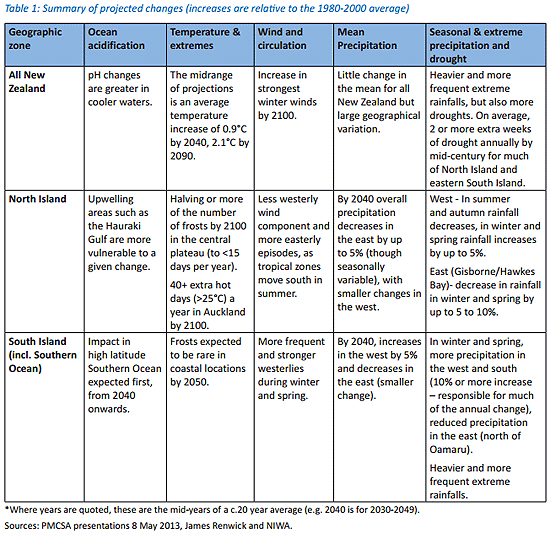
The table below summarises some of the projected changes by region and season, described in more detail within the report.
1. There is also considerable information synthesised by authoritative science bodies available to the general public, one recent example is ‘The Science of Climate Change: Questions and Answers’ by the Australian Academy of Science.
2. For a good discussion about scientific uncertainty and how this is addressed within science see ‘Making Sense of Uncertainty: why uncertainty is part of science’; A report from Sense about Science 2013: http://www.senseaboutscience.org/resources.php/127/making-sense-of-unce… .
3. Over shorter time intervals, changes due to natural variability may appear to dominate over anthropogenically-driven trends.
4. In this context, a first order effect is a change as a result of global warming, a second order effect occurs as a result of some reaction to this new change.
------------------------------------------------------------------------------------------
Professor Sir Peter Gluckman is the Chief Science Advisor to the Prime Minister of New Zealand.
This piece is the Executive Summary of the full Report.
We welcome your comments below. If you are not already registered, please register to comment
Remember we welcome robust, respectful and insightful debate. We don't welcome abusive or defamatory comments and will de-register those repeatedly making such comments. Our current comment policy is here.