
sign up log in
Want to go ad-free? Find out how, here.

Greens pledge publicly owned supermarket chain called KiwiMart with Foodstuffs and Woolworths required to divest at least 120 stores and distribution centres

Public Policy / news
Greens pledge publicly owned supermarket chain called KiwiMart with Foodstuffs and Woolworths required to divest at least 120 stores and distribution centres
smarket
Image sourced from Shutterstock.com

The Green Party wants to establish a publicly owned supermarket chain called KiwiMart, with a mandate to prioritise affordability for consumers.

The party's food and grocery policy, released on Sunday, also wants to break up the Foodstuffs and Woolworths supermarket duopoly and would require them to divest at least 120 stores and distribution centre capacity into public ownership to establish KiwiMart. 

This proposal is part of the Green Party's affordable kai policy as they seek to give people “lower prices, more choice, and greater security.”

“Access to affordable, healthy kai cannot be left in the hands of profit-driven privately owned corporations.”

The Greens want KiwiMart to operate as a “self-sustaining and commercially viable competitor in the grocery market” comparing it to Kiwibank’s role in the banking sector “but at a competitive scale."

“We’ll task the Commerce Commission to work with the duopoly to identify which stores should be divested to KiwiMart based on local market share, and to determine fair compensation without merely rewarding them for their dominant market position.”

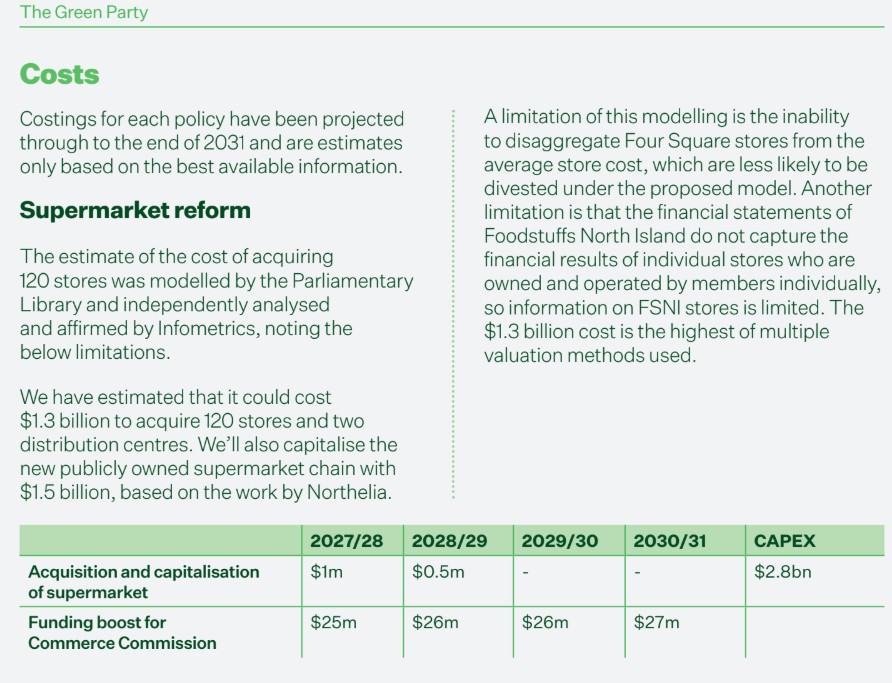
The party estimates that the acquisition and capitalisation of supermarkets would cost around $2.8 billion. 

Broken down, it could cost $1.3 billion to acquire 120 stores and two distribution centres based, according to modelling by the Parliamentary Library and independent analysis and affirmation from Infometrics. The Greens would capitalise KiwiMart with $1.5 billion based on work by a group of entrepreneurs who wanted to set up a third supermarket chain, Northelia.

"Two companies control what almost everyone in this country eats, and they take about a million dollars a day in excess profit out of our shopping baskets. That is money that should be in people's pockets," Green Party co-leader Chlöe Swarbrick says.

Swarbrick says everyone agreed that competition was needed in the grocery sector to drive down prices but successive Government have “failed to lure one.”

“That's why today we are announcing the real solution: a supermarket owned by all New Zealanders, for all New Zealanders."

"There are only so many places in a town where a supermarket can go, and Woolworths and Foodstuffs have seen to it that these sites are locked up," she says. 

"We're not short of supermarkets, we're short of competition. As experts have noted, divestment - that is, buying already existing stores - is key to breaking up the duopoly."

Consumer data and giving more powers to the Commerce Commission

The Greens also want to explore extending the Consumer Data Right framework to the supermarket sector.

The party says it would allow “consumers to share their loyalty data with other supermarkets and trusted price comparison tools and use their own purchase history to get better offers and compare baskets”.

“This would give consumers control over their information and help level the playing field for new competitors who lack the duopoly’s decades of information.

“To limit the shopping data collected and to prevent against ‘surveillance shopping’, we’ll give consumers greater rights to choose what data supermarkets can collect about their shopping habits, how long they can keep it, and what supermarkets can do with it.”

The Green Party says its reforms will put the Commerce Commission in a stronger position to enforce competition not just in the grocery sector but across the whole economy.

“We’ll deliver these priority interventions to address supermarket competition as part of a wider overhaul to ensure the Commerce Act is fit for purpose and stops giving big companies a free pass.”

The party wanted to ensure the Commerce Commission was resourced “and empowered to hold the supermarkets and other big corporates to account.”

“In contrast, over the last three years, the Luxon Government has reduced funding for the Commerce Commission by millions of dollars.”

Alongside this, the Greens are also proposing:
- Banning price gouging at supermarkets through a Bill to ban excessive pricing. This ban would also be extended to other sectors such as energy and fuel 
- Increasing funding for the Commerce Commission to put them in a stronger position to enforce competition laws
- Raise the maximum penalties available under the Commerce Act 
- Increase the Commerce Commission’s powers by giving the organisation the ability to issue binding directions in response to market study investigation like in the UK and Canada - not just recommendations 
- Allow the Commerce Commission to directly regulate the use of loyalty cards, store brands and “other anti-consumer practices to protect competition and transparency 
- Establishing a mandatory supermarket pricing accuracy code which includes compensation requirements for shoppers if they are overcharged - Creating a National Food Strategy, including a legislative right to “adequate and nutritious food” 
- Establishing  $150 million a year Fair Food Fund for community-led food security 
- Increase funding for food banks and doubling the cap on food grants from Work and Income 
- Restoring and permanently funding Ka Ora, Ka Ako, and expanding the school lunches programme to 400 more schools

Other costs

The Greens have not made clear in its policy document how it will pay for its proposals but has provided estimated costs.

When it comes to boosting the funding of the Commerce Commission, the Green Party estimates an allocation of $25 million in 2027/2028, $26 million in 2028/2029 and 2029/2030, and $27 million for 2030/2031.
 

The Fair Food Fund would cost $150 million yearly through to the end of 2031. Funding to increase the food secure network would be $17 million in 2027/2028, $18 million in 2028/2029 and 2029/2030, and $19 million for 2030/2031.
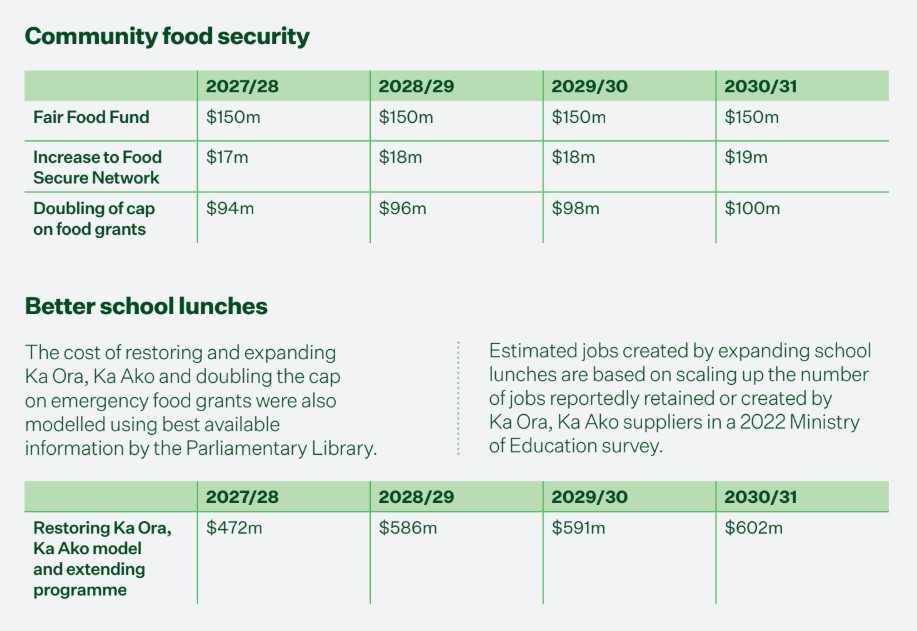
 

When it came to doubling the cap on food grants from Work and Income, the party estimated the costs to be $94 million in 2027/2028, $96 million in 2028/2029, $98 million 2029/2030, and $100 million for 2030/2031.

For Ka Ora, Ka Ako - the Healthy School Lunches programme - the party estimated the costs to be $472 million in 2027/2028, $586 million in 2028/2029, $591 million 2029/2030, and $602 million for 2030/2031.

We welcome your comments below. If you are not already registered, please register to comment

Remember we welcome robust, respectful and insightful debate. We don't welcome abusive or defamatory comments and will de-register those repeatedly making such comments. Our current comment policy is here.

16 Comments

My reckon is that this proposal has been done on the fly and hasn't been thought through rigorously. 

China has state-owned supermarket chains and state-linked grocery networks. The older supply-and-marketing cooperative system has remained important, especially in rural areas. It was originally a major state channel for supplying farm inputs and daily necessities and for buying and distributing agricultural output. More recently, China has strengthened this network partly to preserve resilient distribution capacity during supply disruptions.

The Greens do not explain how they can regulate costs across the supply chain. The only way that can really be done is to regulate profit margins, unless of course they plan to nationalize logistics and production. To think they can do that is something quite absurd. 

Up
10

we state own our airline, generators, transpower.   a bank even why not super markets?

I am a bigger fan of buying out all the generators, energy is in need of more competition.

Up
3

"a million dollars a day in excess profit out of our shopping baskets" - less than 20 cents a day per person, $1.40 a week.

Once they do this, there is no chance of the likes of Aldi coming here. Not if the government will force them to sell their best stores to them. 

Up
3

Aldi isn't coming

Up
2

True. But even the warehouse or similar. 

No one will invest in a market where the government are heavily intervening. 

What makes the greens think the government can run a low profit margin business better than private? It will be a debacle. Probably wont be allowed to sell soft drink and alcohol etc as nanny won't want to harm us. 

Up
2

Why stop there!

Petrol stations

Butchers

Hair dressers

Pubs

What could possibly go wrong ...

Up
12

they should own councils given rates bills

perhaps insurance as well


Up
5

Essentially a forced nationalisation of a large part of something that isn't a natural monopoly public good, creating a commercial enterprise that's run by a government department. 

What could possibly go wrong?

EDIT: how about Co-ops rather than central control? See below.

Up
8

Its the same thing on repeat. People compare our supermarket prices to overseas and blame the duopoly for the 15% price difference when that difference is actually GST (most other countries don't charge it on basic food items). Breaking up the duopoly won't make the slightest dent in supermarket prices, best scenario is that it doesn't make it worse. 

I'm not convinced we actually have enough scale for 3 chains. It means each chain has to be smaller so have to pass on more of the fixed costs to each customer. 

And I'm definitely not convinced the government could do a good job. Look at Kiwibank, can barely turn a profit in the same market the Aussie banks are creaming. 

Up
7

Completely agree. If there’s so much super profit in supermarkets and banking why aren’t we seeing new arrivals? 
Simple - we are a small, distant market and when Kiwibank appears NZers don’t automatically flock to it to escape the clutches of the nasty Aussies, who most KiwiSaver holders have shares in anyway. Why? - maybe some customers are happy? 

Having travelled a lot in the last 4 years we don’t realise how good our supermarkets are, how easy it is to bank here. I enjoy going to a supermarket or doing banking when I get back here and feel very grateful to live here.

Inflation has raised costs all over the world and it’s not easy anywhere. There is a lot of delusion going around at the moment.


Up
5

It would be more to the point to do something about the history of patchwork of regulatory kludges and omissions that have enabled the current situation.

And then take the opportunity to do something new and look beyond a pure market approach - and that's supposedly the Green's wheelhouse, right?

A better solution than a department of grocery supply would be to enable and support co-operative society development, run by the members and for their benefit. There are a lot of Co-ops in the UK, and Costco is similar to a Co-op, with shareholder members. There is also a Co-op movement here.

What would be needed from government is extremely vigorous protection from duopoly behaviour like exclusive supply contracts and restraint-of-lease prohibitions, the simplification of governance requirements, the supply of skilled people to help train the co-op staff to set up and run the organisation, and the reintroduction of auction systems to both reintroduce supply chain transparency for basic commodities and pry the hands of the supermarkets off the suppliers via agreements made secret by the heavy veil of commercial sensitivity.

Something for the Greens to champion if they are consistent in their views about the power of the people but, given their controlling tendencies, the likelihood of them being willing to cede central control is very low, as it is with any party.

Up
1

Agree with exclusive supply contract, restraint-of-lease prohibitions and pry the hands of the supermarkets off the suppliers via agreements made secret by commercial sensitivity.  I believe the government are already doing some of that? I doubt it will make a lot of difference though. 

Up
1

It won't without changing ownership models that just let people get on with things without endless sludge.

Up
1

As usual, Chloe has demonstrated her failure to grasp math and how real businesses work.

What is the ROE for Woolworths?

Is this reasonable or low?

What would happen if Woolworths withdrew from NZ?

Is Food Distribution Critical Infrastructure?

Remove the GST from Fresh fruit and Veg. Consider removing GST from unprocessed meat.

Recover the GST loss with a sugar tax (15% with item with >10% sugar)

This has been implemented in several countries.

Up
1

The Illusion of the Grocery Aisles - Why KiwiMart is a Micro-Distraction from New Zealand’s True Macroeconomic Hemorrhage

New Zealand is currently in the grip of a biting cost-of-living crisis. For working-class families across the country, just the daily act of putting food on the table has transformed from a routine chore into a source of severe financial anxiety. 

It is against this backdrop of genuine economic pain that the Green Party has launched its latest policy headline - "KiwiMart," a proposed publicly owned supermarket chain intended to smash the long-standing domestic grocery duopoly. 

Politically, the move is potentially a masterclass in voter harvesting. By targeting a highly visible, household expense, the Greens have engineered a tangible, emotionally resonant policy, designed to capture the frustrations of hurting New Zealanders. Yet, beneath the populist veneer, KiwiMart is an economic nothing-burger. 

As a commercial entity, its chances of long-term survival, let alone its ability to meaningfully move the needle on working-class living standards, are negligible. More critically, by dedicating immense political capital to a retail side-quest, the Greens are actively distracting the electorate from a structural, multi-billion-dollar systemic failure - a debt-based commercial banking system that bleeds tens of billions out of the domestic economy every year in unearned economic rent.

20 Cents a Day Keeps the Structural Reform Away

To understand why KiwiMart is a structural mirage, we need to look at the cold maths of grocery retail. The Greens’ policy proposes using billions in state funds to forcibly acquire roughly 120 existing supermarkets and distribution centers to build a public competitor. 

However, the Commerce Commission’s own data reveals that the excess profits extracted by the existing duopoly amount to roughly $1 million per day. While a million dollars a day sounds egregious in a headline, when distributed across New Zealand's population, it equates to a meager 20 cents per person, per day. 

Even if KiwiMart successfully eliminated every cent of this excess profit and passed it directly to the consumer, a working-class family of four would save a grand total of $5.60 a week.

Bureaucrats in the Broccoli Aisle: A Recipe for Freshly Audited Lettuce

Worse still, the likelihood of KiwiMart even surviving to deliver those trivial savings is extraordinarily low. Grocery retail is a brutally complex, low-margin industry reliant on hyper-efficient logistics, sophisticated global supply chain management, complex inventory turnover, and razor-thin operational tolerances. 

History shows that when governments attempt to run complex consumer-facing retail networks, they routinely succumb to bureaucratic inertia, rigid procurement rules, and an inability to dynamically adjust to shifting market forces. 

Entrenched private duopolists, possessesing decades of localised logistical optimisation and global buying power, would easily outmaneuver a state-run startup. KiwiMart would likely face a grim choice - either require continuous, multi-million-dollar taxpayer bailouts just to keep its doors open, or watch its artificially lower prices swallowed up by operational inefficiencies. 

It is a policy that risks billions of public capital to fix a 20-cents-a-day problem, only offering a statistical rounding error to the working-class balance sheet.

The $40 Billion Invisible Elephant Extinguishing the Room

The true tragedy of this policy platform is the profound opportunity cost it represents. While the nation’s attention is directed at supermarket checkout counters, a monumental macro-economic extraction is taking place entirely unvetted. Over 98% of New Zealanders do not understand the very basic mechanics of how ~98% of the broad money supply is created. 

The prevailing myth is that commercial banks act as mere intermediaries, lending out the savings deposited by others. The reality, well-documented by central banks globally, is that commercial banks create money out of thin air via ledger entries whenever they issue a loan. This private monopolization of money creation saddles the New Zealand economy with an structural, unearned burden: interest paid on money that cost commercial banks nothing to produce.

This private credit engine results in an estimated $40 billion in economic rent escaping the productive domestic economy annually, primarily funneled out as profits to foreign-owned financial institutions. This is wealth entirely unlinked to actual productivity, a parasitic tax on every business, mortgage holder, and renter in New Zealand. 

If the state were to reclaim the exclusive right to create money as a strict public utility, retaining seigniorage and funding public infrastructure and social services through debt-free sovereign currency creation, the economic transformation would be profound. 

Rather than scraping by on 20-cent retail subsidies, the domestic economy would instantly retain billions in structural wealth. New Zealand could transition into an incredibly vibrant, self-sustaining economy within a matter of years, completely shifting the baseline of working-class societal wealth.

This structural revolution could be supercharged by coupling monetary reform with a modest Financial Transactions Tax (FTT), such as a 0.25% levy on all transactions, INCLUDING high-volume electronic financial transfers. 

Currently, the working class bears the disproportionate brunt of the national tax burden through income tax and GST, levies on the physical necessities of life and labor. Meanwhile, the dizzying volumes of the speculative financial economy escape virtually unscathed. A 0.25% FTT would capture vast revenues from high-frequency institutional trading, currency speculation, and corporate financial looping. 

By forcing the parasitic financial economy to finally carry its share of the national tax burden, New Zealand could aggressively cut regressive taxes like GST and income tax on lower brackets. This single systemic shift would inject more disposable income back into working-class pockets than a lifetime of subsidised grocery aisles ever could.

The Grand Logo-on-a-Bus Voting Heist

Ultimately, the KiwiMart proposal exposes the deep-seated pragmatism, and intellectual cowardice, that plagues contemporary politics. The Greens assume that explaining sovereign money creation, and financial transaction taxes on a campaign trail is politically difficult - when it should be anything but. 

However, it does require educating an electorate that has been systematically conditioned to ignore the mechanics of macroeconomics. It is infinitely easier to stick a "KiwiMart" logo on a bus, validate the public's justifiable anger over food prices, and harvest the votes of desperate families. 

But by choosing the path of least resistance, the party is selling working-class Kiwis an illusion. They are offering an ill-thought-out, commercially unviable publicity stunt that fails to address the underlying disease. 

As long as New Zealand's political leaders choose to fight microscopic battles over 20-cent grocery margins while completely surrendering a $40 billion monetary monopoly to private banks, the structural impoverishment of the Kiwi working class will continue unabated.

Up
5

How much food is produced within NZ? Not enough. Ultimately producer prices would have to be controlled, which means some how subsidizing producer inputs. Why would anyone bother producing anything for no or even a low return. Things are tight enough now. People have to realize prices are what they are and the pressure to date on super markets is keeping them honest, as honest as can be expected.

Up
2