
By Girol Karacaoglu*
The response to Prime Minister Christopher Luxon’s ‘state of the nation’ speech which placed economic growth at the centre of his government’s policy agenda, highlighted the state of dysfunction this country’s policy discourse is in. The Right at once embraced it but complained it did not go far enough. The Left found many reasons for criticising it. Ecologists labeled it ‘ecoside’.
This tribal, dogmatic, automatic response reminds one of the pre-Enlightenment eras when religion, dogma, tradition, and authority dominated thinking, with no place for reason-based and evidence-informed free debate and exploration of options for compromise, leading to prolonged periods of darkness and suffering. In New Zealand, the tribe leaders, political leaders that is, blindly follow the policy prescriptions of their priests, at the expense of current and future generations.
There is an alternative. There is a middle way that seeks a balance between all these competing perspectives, in pursuit of sustainable and shared prosperity. It must start with a change of mindset as well as a willingness by our Parliament to step up to its governance and stewardship role and responsibilities.
I have always been deeply impressed and moved by the wisdom of Walter Benjamin and the Confucian philosopher Xunzi who preceded Benjamin by 2,200 years, who were both able to stand above all currents, at the crossing of the ways, not carried away by any ideology or dogma, exploring a new fusion – searching for a new way of thinking, open to all perspectives, that could not simply be reduced to its components1.
The great news is that there is already a reason-based and evidence-informed framework (the ‘wellbeing framework’) to inform and shape an integrated approach to environmental, social, and economic policy. It offers a fresh lens and new angles for analysing familiar and persistent environmental, social, and economic problems that underpin human suffering and threaten the wellbeing of future generations. If one looks around the world with an open mind, one can easily find its applications.
Nobel laureates in economics such as Amartya Sen and Joseph Stiglitz have helped develop the framework2.World-leading organisations such as the Organisation for Economic Cooperation and Development (OECD) of which New Zealand is a member are championing and promoting the framework. They are able and willing to support its implementation. Many countries, including Wales, Ireland, Australia, the Nordic Countries of Europe, Singapore, and others are trying to adopt and adapt it to suit their own circumstances, often helped by the OECD3. At the heart of this effort is the realisation that the biosphere, society, and economy are part of an integrated and indivisible whole and there are ways of improving the material comforts and prosperity of people, and sharing this prosperity, without causing harm to the biosphere.
The New Zealand Treasury is fully aware of this framework and has indeed adopted it, contributing to its development, under the banner The Treasury’s Living Standards Framework4. There are networks around the world, such as the Wellbeing Economy Alliance which has a presence in New Zealand, that are championing it.
The Labour-led governments of 2017-2023 embraced it but the New Zealand Treasury could not effectively help those governments in operationalising the framework – significantly distracted by the Covid-19 pandemic. The current National-led government turned its back on it on ideological grounds, not appreciating that if properly implemented, it would deliver everything it is championing and advocating – including inclusive economic growth.
I will give a flavor of what that framework looks like, with the help of the figure below - the New Zealand version of the OECD wellbeing framework, expanded and adapted by the New Zealand Treasury. OECD research has discovered a set of ‘domains of wellbeing’ that are common across humanity irrespective of historical, cultural, ethnic, geographic, gender circumstances and/or backgrounds – they are aspects of our lives that are important for our wellbeing as individuals, families, and communities. They are multi-dimensional and interconnected. They are, ‘material conditions’ (income and wealth, housing, and work and job quality), ‘quality of life’ (health, subjective well-being, knowledge and skills, and environmental quality), and ‘community relations’ (social connections, work-life balance, safety, and civic engagement). These domains are in the top third of the figure. Note the explicit inclusion of the economic domains of wellbeing.
At the bottom of the figure are a set of capital stocks, or categories of wealth - natural, human, social, and economic (physical and financial) - that represent resources for future wellbeing, for satisfying the wellbeing domains that sit in the upper half of the figure.
Binding the upper and lower third of the figure are a set of governance arrangements and institutions; they influence how productive we are in using the country’s wealth in generating wellbeing – i.e., a broader measure of productivity.
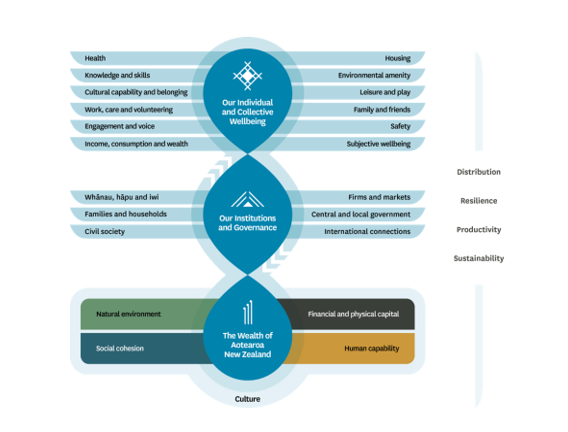
Should we choose to, we can, through a deliberate strategy aimed at strengthening governance arrangements and institutions, generate the outcomes (such as ‘resilience’) listed on the right-hand side in the middle of the figure, towards enhancing human wellbeing on a sustained basis5.
For example, through proper investments, we can potentially build resilience to unknown and unknowable future developments, thus trying to protect our preferred way of life from unforeseen future shocks. As it happens, such investments (in our health, education, social, legal, political, and economic sub-systems – i.e., infrastructure investments) also enhance our lives today. There is therefore a strong complementarity between doing the right things for future generations while also improving our own lives.
Finally, but crucially, at the bottom of the figure, serving as a foundation for everything that sits above it, is culture. The shared narrative we choose to pursue, and the way we choose to pursue it, need to reflect the history and culture of the place we have chosen to call home, without limiting the ability of future generations to shape and reshape it as they see fit.
Partha Dasgupta, a very prominent economist who has spent a lifetime trying to incorporate environmental and social dimensions into long-term economic models of sustainable development, has authored a detailed report commissioned by the UK Treasury6. That report presents the most elegant and concise development and formalization of the wellbeing framework for policy analysis and implementation. It offers a careful rethinking of what human progress is all about, and how it relates to sustainable wellbeing.
In this framework the buckle that connects the concepts of progress and wellbeing is ‘inclusive wealth’ – with material (or economic) progress defined as the growth in ‘inclusive wealth’ (and not simply income, or Gross Domestic Product (GDP)). ‘Inclusive wealth’ is the social worth of an economy’s entire portfolio of capital goods (measured using ‘accounting’ or ‘shadow’ prices). The report rigorously defines ‘inclusive wealth’ and suggests very practical ways of measuring it – fully acknowledging that the data that currently exists is grossly inadequate. The framework and the associated models would guide the collection of data. That was indeed part of the work program of Statistics New Zealand, in support of the Treasury’s Living Standards Framework.
The components of inclusive wealth are, produced capital, human capital, and natural capital, which are a subset of the ‘wealth’ categories that sit at the bottom of the figure. Other types of ‘capital’ such as ‘social capital’ or ‘cultural capital’ are referred to as ‘enabling assets’ rather than capital stocks – not all ‘assets’ are ‘capital goods’.
According to Dasgupta, “Inclusive wealth should be the coin with which citizens would wish to evaluate economic change.” Then comes the analytical ‘killer blow’: “In Chapter 13 we show by way of what may be called the wealth/wellbeing equivalence theorem: social wellbeing is maximised if and only if inclusive wealth is maximised. Accounting prices provide the link between wealth and well-being, which is why the theorem is valid no matter which conception of well-being is adopted ... “
‘Sustainable development’ relates to economic progress that protects and enhances inclusive wealth – the source of sustained, intergenerational, wellbeing.
Thus, this framework rejects the types of economic growth that causes sustained harm to the biosphere and the social fabric while keeping an open mind on exploring ways of achieving it, through the free creation and application of explanatory knowledge. However, it embraces economic growth that stands for growth in inclusive wealth.
In short, there is no need to waste precious time with unproductive debates while people go on suffering, and our beautiful young minds leave the country – the most telling evidence of poor governance. There is a way forward that can integrate all perspectives. Provided our Parliament shows the responsibility to step up and fulfil its governance and stewardship role, creating the proper institutions to support it, emulating Wales for example, as Australia is trying to do, and the policy community shows the responsibility to open their minds up and advise it responsibly, there is a lot to learn from the world. It is a great shame to let this beautiful country and its current and future citizens down when answers to our problems are out there ready for adoption.
1) Löwy, Michael (1988). Redemption and Utopia – Jewish Libertarian Thought in Central Europe – a Study in Elective Affinity (2017 Translation by Hope Heaney). Verso. Puett, Michael and Gross-Loh, Christine (2016). The Path – A new way to think about everything. Viking.
2) Stiglitz, Joseph; Sen, Amartya; Fitoussi, Jean-Paul (2019). Report by the commission on the measurement of economic performance and social progress. Paris: Commission on the Measurement of Economic Performance and Social Progress.
3) OECD (2024). Wellbeing Framework. Measuring well-being and progress | OECD; OECD (2024). How’s Life 2024: Measuring Well-being. Paris. 90ba854a-en.pdf
4) New Zealand Treasury (2021). Our Living Standards Framework | The Treasury New Zealand The Living Standards Framework (LSF) 2021.
5) See Karacaoglu, Girol (2021). Love you: public policy for intergenerational wellbeing. Tuwhiri. Karacaoglu, Girol (2024). Resilient Democratic Governance – Navigating Unity in Diversity for Sustainable Well-being. Emerald.
6) Dasgupta, Partha (2021). The Economics of Biodiversity: The Dasgupta Review. London: HM Treasury.
*Girol Karacaoglu is Adjunct Professor at the Wellington School of Business and Government (VUW). He retired from his role as the Head of the School of Government at VUW at the end of June 2022. He came to this role from the New Zealand Treasury, where he was Chief Economist. His current research interest is in public policy - an integrated approach to economic, environmental and social policies towards improving intergenerational wellbeing.
We welcome your comments below. If you are not already registered, please register to comment
Remember we welcome robust, respectful and insightful debate. We don't welcome abusive or defamatory comments and will de-register those repeatedly making such comments. Our current comment policy is here.