
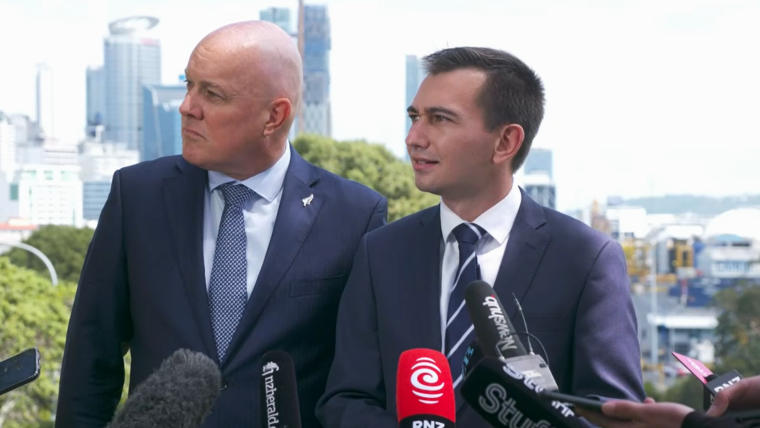
The Coalition Government is proposing hiking car registration fees by $50 to help fund a draft transport plan worth $20 billion over the next three years.
This would raise an extra $660 million to contribute to the transport plan. Revenue from fuel taxes, road user charges, and the licence fee will bring in $14 billion across three years.
National has kept its promise to not lift fuel taxes this term but instead plans to deliver a supersized 12 cent hike in 2027 with six and four cent increases thereafter.
While still in Government, Labour proposed lifting the fuel tax by the same 12 cents by 2026 — except it would do so in smaller steps of 2 cent or 4 cent increases each year.
National opposed this, saying it was able to deliver its transport plan without the “heavy burden” of petrol tax hikes in its first term.
It did not say it would merely delay the hikes, nor that it would significantly increase motor vehicle registration fees.
The proposed $25 increase at the start of 2025 and 2026 would increase the annual cost of registration by 50% for most vehicles. The licence fee component would more than double from $43.50 today.
Transport Minister Simeon Brown said the licence fee hadn’t been increased since 1994 and inflation had effectively halved its value.
“We need to fund the infrastructure New Zealanders expect to maintain our network and build the roads and rail infrastructure required to unlock growth and economic growth and productivity,” he said.
Prime Minister Christopher Luxon said the economy will be in better shape by 2027 and therefore households would be able to afford the 12 cent tax hike.
The Crown will also borrow an additional $3 billion to give to NZTA/Waka Kotahi to help cover the funding shortfall that comes from delaying the tax increases.
Even once all the new tax increases have kicked in, the road network will not be raising enough revenue to cover the Government top-ups being offered this term.
The agency has been instructed to find ways to raise even more money from things such as road tolls, congestion charging, and transitioning all vehicles to road user charges.
What will it all be spent on?
The draft transport plan proposes spending $6 billion upgrading state highways, $2.1b building public transportation, $1.2b improving local roads, and $510 million on walking and cycling.
There will be $4.8 billion set aside for “pothole prevention” on state highways and local roads in addition to a $4b “operations” budget for those two types of roads.
Pothole prevention money has been ring-fenced to be spent on resealing, rehabilitation, and maintaining drainage. This used to be included in a general maintenance category.
Public transport services would get $2.3 billion across the three year period and the rail network another $1.6b.
The Coalition has also outlined 15 “roads of national significance” which will be prioritised for funding. These will be large four lane highways and would be eligible for fast-track consents.
Brown said he wanted as many as possible to include private investment and could be funded through tolls, or even be privately owned and operated.
Eight of these roads would be connected to Auckland and three would be in the South Island.
92 Comments
We spend more on potholes than public transport? Move over Japan, Europe, etc, NZ is “paving” the way to an effective transport network with Simeon Brown (asleep) at the wheel.
Tauranga is the largest port in the country. It has the largest total cargo volume and also container throughput. The access road is so busy it is constantly under repair and recently had diversions in place so repairs could be made.
This is an example of the Government actually listening to the people paying the bills of government and getting on with it.
I know it is a shock to see an effective government, I suspect actually getting things done will come as a shock to everyone.
This is an example of the Government actually listening to the people paying the bills of government and getting on with it. I know it is a shock to see an effective government, I suspect actually getting things done will come as a shock to everyone.
I've noticed this is a new cheerleading chant repeated constantly, word for word.
It's a stellar effort at distracting from reality.
Bit premature
Hwy 29 upgrade to start in 4 to 10 years. At 10 years, that's 2 further election cycles.
Both blue and red jamming in immigrates without the supporting infrastructure. roads, schools, hospitals, can I say ferries.
Hwy 29 being in the golden triangle should have been started 15 years ago. The other roads of national significance, from memory they had delayed start times as well.
The original road (if you're referring to Totara Street) was Asphalt laid straight over compacted topsoil. Not a stellar engineering solution in the first place, but great they repaired it and did it a day quicker than expected (2 instead of 3, probably because they only had to cut into topsoil), and it was actually stage 2 of 2, the first stage being undertaken during the previous govt.
"It has the largest total cargo volume and also container throughput. The access road is so busy it is constantly under repair and recently had diversions in place so repairs could be made."
More evidence of heavy vehicles (deriving private profits) doing the damage that you expect the average car driver to pay for?
"transitioning all vehicles to RUCs" sounds significant. Any indication of when?
I think that the blanket RUC charge on all vehicles up to 3500KG is far too broad and should be far more graduated. This assumes that a small 1100kg 2 door car does as much damage to the roads as a 3.5 ton truck. Clearly ridiculous. It also is very counterproductive when it comes to encouraging people to buy smaller less CO2 producing vehicles. You may as well buy a gas guzzling 7 seat SUV as a smaller more efficient Hybrid. All these price increases are independent of weight and fuel efficiency, so relatively, fuel efficiency differences will become less relevant. Great for the ignorant farmers,the entitled wealthy and tradies, but I suppose that is their support base.
Only about $10 of the $76 RUC charge is related to weight of the vehicle, it's pointless to create another bunch of RUC classes that vary by $1 or so.
And RUCs arent about fuel efficiency or emissions, they are about paying for the roads.
And the damage to roads is very dependent on weight, so it seems that the charging model is very skewed in favor of heavier vehicles.
But the damage to the roads is only a small portion of the cost of roads. It's not heavy vechiles that require the southern motorway to be 4 lanes wide. You could google "ruc-cam.pdf" and learn more if you actually have an interest.
I think his point is more along the lines of incentivizing people to use smaller, more efficient vehicles when they can.
The tax on fuel acts as an incentive to opt for more efficient vehicles since less efficient cars burn more fuel and thus pay more tax. We would dilute that incentive if we transitioned to a flat RUC for all vehicles, which doesn't seem entirely right when there are other negative externalities to people driving larger, less efficient vehicles that go beyond pure RUC costs. For example, the amount of space they take up, less visibility for road users, safety concerns for other road users and pedestrians, and air quality implications from vehicles that burn more fuel.
How it works currently with fuel seems pretty fair, where if you burn more fuel you pay more tax. I prefer that option to what they have overseas where your rego cost goes on engine displacement or cylinder count.
We have a flat RUC for light vehicles, have had it for decades. The same reason why there is only one under 3500kg weight band, and a 3501kg to 6000kg weight band, and the price difference between them is negliable. $76 and $82 respectively. This is because the weight related damage caused by light vehicles to the roads is pretty negliable compared to all the other roading costs. A $2 difference in RUCs is not going to persuade somebody to buy a Swift instead of a Rav4.
The cost of fuel provides the incentive to buy a more efficient vehicle.
Yeah I am aware, but my point isn't about weight or road damage, more that there is an advantage to having a Pigouvian tax on fuel as there are other negative externalities to larger, less efficient vehicles than those two factors that aren't accounted for in RUC's, the price of fuel alone isn't as effective as a direct tax is.
If you want effective, put the tax up front on the purchase of the vehicle, once the vehicle has been purchased people don't have a choice except to purchase the fuel they need. The clean car discount/dirty car tax scheme should never have been ditched.
They should encourage more motorcycles then.They tick all your enviro boxes.
Did you know it costs over $600 to register one motorcycle
Motorcycles can exacerbate local environmental issues in certain aspects due to their lack of emissions equipment compared to cars. Yeah, they emit far fewer greenhouse gases during construction and throughout their lifespan, but they often contribute more to local pollution, which directly impacts the health of nearby populations. So it ends up being a bit of a wash, trading one set of negative externalities for another.
What sort of local pollution do they contribute, more so than cars? Sure, some bikes are noisy but so are some cars. Small motorcycles use about 75% less fuel, are easy to park, and would ease congestion (thereby making cars more efficient) if there were more of them on the road. That's probably why they are the mainstay of personal transport in many parts of the world.
Modern motorcycles are clean enough to use in Europe, so probably good enough for us.
Hydrocarbons (HC), carbon monoxide (CO) and nitrogen oxides (NOx). If proper emissions standards are in place like in Europe it's not an issue but as it stands our emissions are pretty lax compared to theirs and our motorcycle fleet is likely pretty old.
https://propakistani.pk/2023/05/18/motorcycles-are-the-biggest-causes-of-pollution-in-lahore-report/
For example in Lahore, the city with the worst air quality 69% of that is due to motorcycles. Maybe it would be worse with cars but modern emission equipment is reasonably effective at reducing local smog compared to older motorbikes that have no emission systems in place.
To attract motorcycle commuters. Lower costs in what ever form for mcs < 400cc and single cylinder
The motorcycle ACC levy does get a bit ridiculous with four of them sat in my garage. That's $2000+ a year in running costs before they've even left the garage. Given that I can only ride one of them at a time, I'd prefer my ACC levy to be paid differently, perhaps as a fee associated with my class 6 licence, rather than a fee per motorcycle owned.
We all know the outcomes of a crash involving a motorbike and a vehicle, can be car or truck vs motorcyclist, fencepost or tree vs motorcyclist, the list goes on. There's a reason those levies are so high, it's simply paying a higher premium for insurance based on risk.
That may be the case, on average, at a binary level (ie those that ride a motorcycle vs those that don't). But, is the risk, on average, of someone with two motorcycles in the garage twice that of someone with a single bike? It seems ridiculous when thought of like that. Granted, the owner could lend their bike out for someone else to ride. Which is why I'd personally be in favour of the ACC fee being driver licence-based rather than per vehicle. It would also make it easier to manage the Ride Forever rebate scheme I'd imagine.
On a personal level, as somebody who does advanced rider training at least annually, rides defensively, and with all the gear all of the time (including a back and chest protector), it certainly causes me to shake my head when I see other riders riding like idiots with only a helmet on and no other protective gear. I know that's how the system works, and that it could bail me out one day should the worst happen. But it is a bit grating, after no accidents in over 20 years of daily riding, to know that I'm paying so much for other people's poor decisions and lack of basic care for their own safety.
Unfortunately, due to its nature, motorcycling attracts a lot of idiots and risk takers who, in my opinion, massively skew the accident statistics. Although, it'll never be as safe as a car in some situations, there's an awful lot that can be done at the individual level to minimize the risks.
Totally off topic but, there's been one or two occasions over the years where being on a motorcycle rather than in a car has avoided a nasty accident. (Such as coming around a blind corner to find a petrol tanker on my side of the road.) Although the outcome is worse should an accident happen, there's usually a lot more escape routes available on the motorcycle compared with driving a car.
Or the ACC levy could be charged per km, alongside RUCs. Of course this only happens once cars and bikes are all moved to RUCs, which they should be prioritising.
4 seems excessive to most people perhaps greedy others. Hard to get sympathy on your stance.
Just for the record, three of them were gifted to me by my father when he passed away. They'll be in my possession as long as I live. (Assuming some low life doesn't walk off with them of course.)
People are refusing to pay the $600 to ride their bike half a dozen times a year, they simply put the rego on hold and ride it anyway. The government need to introduce a low user charge, my bike has done like 2000km in 5 years do you seriously think I'm going to pay $600 a year ?
You can register it for as little as a day at a agent. Then back on hold again. Very tough on people with multiple bikes,plus cars etc.
Damage to roads by weight is exponential. The real damage comes over 3500kg. That's one of the reasons why there's a single class up to 3500kg.
I preferred Labours petrol tax. Rego increase means an 85 year old that does 2000 km a year pays the same as a commercial vehicle doing 30000 km a year, or a high income earners off to the holiday home for the weekend.. A subtle shift here from National. Again, it is obvious we cannot afford tax cuts.
They are linking revenues with the costs. Rego used to be about $280 before it was reduced under the previous national government. It will still be cheaper than that. Every year they don’t adjust the thresholds is an effective tax increase. You can get less money in real terms and pay a higher percentage in tax. The 30% rate kicks in at 48k which is about what someone on the minimum wage gets. With inflation like what it has been recently, adjusting the thresholds is needed. It isn’t really a cut
Agreed, however the large decrease in costs was due to ACC reviewing it's levies based on more recent data and the ACC levy dropped substantially for mor modern safer vehicles as the risk of injury was far less than in say a 90's or earlier van with toothpick windscreen struts. Considering a diesel I used to own in 2011 was around $340 to register per year, a $25 increase on my current ~$100/yr is no big deal.
I wonder if cutting the ACC levy was politically motivated? ACC no longer covers the cost of you rehabilitation when injured ($50 per session to see a physio these days) but that is less visible than a $50 reduction in your rego.
I'm sure they still contribute. I remember there was a period for a couple of years when physio was fully funded sometime around 2010 but this was changed back. From talking to physios it is a surcharge which differs from business to business same as GP visits for injury consults. I guess some choose to charge an arm and a leg vs others as part of their business model.
Yes, as of March 2023 ACC pays $30.06 incl gst per visit to the physio. My point is that we, the patient, pay more of the cost than ACC.
Rego in NZ is dirt cheap compare to Aussie... Yes, yes ACC, fuel levies etc.. Still cheap though
Yep and they have annoying stuff like rego costs going up on cylinder count.
https://www.qld.gov.au/transport/registration/fees/cost
If they bring something like that in it would make it much harder to exercise my God-given right to own a V12 shitbox BMW.
Username checks out.
A V12 E46 would've been quite a spectacle.
Edit: actually, more or less a McLaren F1
ˢᵗᶦˡˡ ʷᵒᵘˡᵈⁿ'ᵗ ˢᵃʸ ⁿᵒ ᵗᵒ ᵃ ⱽ¹² ᴱ⁴⁶...
at least they are not putting any taxes up, oh wait what/
shite he we go again increasing fees and levys all over the place
Yeah I am totally in favour of paying no taxes at all, who needs roads amirite???
Reductio ad absurdum
they should leave public transport costs as they are. Each increase incentivises more to use a bus.
It would be interesting to see a cost breakdown of the cost of these projects. I am concerned that once again that most of the focus is on the North Island. I can find costs for all South island roading projects except the Otago bridge up grades and the Queenstown connections. Their total is about $1 billion. I expect that the other two are relatively minor, say $100 million. That is $1.1 Billion on South island roading out of a $24 billion package. Add that to Willis's effective destruction of the future of the Cook Straight shipping link and you come to the conclusion that the South Island might as well not exist in the eyes of government. Another good reason for the South Island to secede from the North Island.
Canterbury is the region with the second largest vehicle fleet and second largest vehicle kilometers traveled. So these tax and levy increases will disproportionately affect the region.
Yet what does it get back? One relatively cheap bridge that should have been built 30 years ago. What a joke.
Man canceling those ferries is really going to bite us in the ass in a few years time.
Go on the Bluebridge then..
Chris if there was a referendum on the South Island becoming a state of Australia I would vote for it.
So would the North Island.
Probably not, otherwise the Aucklanders couldn't flee the big smoke to live in paradise so easily.
Can we keep a couple of bits? Queenstown and some of the nicer bits of Central Otago, and the West Coast. They are welcome to Christchurch and Dunners.
No. We get the lot. Including all the power generation, Agriculture and Tourism. And what is more, no immigration from anywhere including the North Island.
That's just heartless. You can't seriously leave those of us south of the Bombay's to prop up those North of them by ourselves.
Heartless.
Additional pricing information from Newshub, because I haven't seen this price breakdown listed elsewhere:
This will increase the annual cost of Motor Vehicle Registration (MVR) in 2026 by $50 for most vehicles, $28 for motorcycles, trailers and ATVs and $16.5 for mopeds
More inflation, more increases in cost of living.
Why does this government hate New Zealand?
And where are all the howls from the usual suspects about "broken" promises. The dissonant brain farts from those who have flip-flopped faster than a PM's accomodation allowance, are hilarious.
I criticised Labour for increasing taxes, what's good for the goose is good for the gander.
The thing I'd like to know is how does this land transport plan differ from the Labour government's land transport plan - aside from the Cook Strait rail link?
Answered my own question;
https://www.stuff.co.nz/politics/350200628/higher-taxes-fewer-potholes-…'
Great table comparing the budgets by transport-type for the two plans (last govt and new govt).
.
Can still download the 2023 plan, and this new one.
Payback time for their road transport donors.
$ 50 on rego nothing to them compared to any increase in RUC's. Just as well heavy trucks don't cause potholes. Well if they do, nobody will know, as there is no reporting required for road projects. Whereas cycleways must prove their worth to the country, and prove they reduce accidents or congestion. This guy is so blatant, maybe he's not the stupid one after all. If he actually had a say in writing any of it, or it was provided by his road transport donors.
No one mentioned the increased allowance of axle weights as a reason for the worsening condition of our roadsz
https://www.drivingtests.co.nz/resources/vehicle-dimensions-and-mass-vdam-changes/
Government to build world's most expensive road.
Given that this project was projected to cost $1.8 Billion in 2017, I imagine it's going to be even more eye-wateringly expensive after 6 years of quite high inflation.
And unless something has changed in the last 6 years we still don't seem to have any solid BCR's for some of these projects. They seem to greenlight roads without much critical thought but then hold every other bit of equally if not more crucial bit of infrastructure to much stricter standards. As is traditon we seem to have replaced one set of clowns with another set of potentially worse clowns who are more driven by ideolgy than getting actual meaningful value.
this road is only for the trucking industry, it will cause huge congestion on the bridge being a pinch point at peak times but will save trucking companies moving between south auckland Wiri, and the airport oaks ten minutes travelling to and from the port outside of peak times
Mill Road looks like an absolute boondoggle for transport industry donors. Just nuts, more taxpayer welfare for companies at a time where the party is also finger-pointing at the poor.
Did the registration not go down a few years back? I thought we used to pay a lot more than we currently do and they dropped them down? Or I could be wrong?
The ACC component has dropped considerably. Rego went up slightly for admin costs . The road use part has stayed the same since the 90's.
It's a pity that ACC is not meeting It's obligation to pay for our rehab when we get injured. $50 surcharge to see the physio while ACC pays about $30. Let's not forget their $900,000,000 operating surplus last year.
You are correct. Car reg reduced by approximately half over 2014-2016.
The proposed ~$50 increase is an annual packet of fags/family feast pack of KFC. Hardly the medias hardship spin windup.
Right that's what I was thinking. $50 aint going to be anything compared to the council rates and insurance increases for home owners. (also tenants once landlords pass increase on)
They don't get it. They still think they need to tax to spend, so the advice they are getting is tied to an obsolete model.
As the sovereign owner of the dollar the Government should use deficit funding for projects that produce an economic return, and roads have to be at the top of that list.
I had to drive to Auckland last week for health reasons (almost an oxymoron!) and was utterly disgusted with the state of our roads until I got to the Waikato Expressway. Before there though, during a short break on the side of the road, I was standing on the side of the road watching the big trucks thunder past, and noted the minor earthquake that accompanied each and every one. One of the priorities should be to get as many of those off the main road network as possible.
And then just before the Bombay Hills, the main roads reduced to four lanes! The Greens should take a look at this.
Since the year dot, the human species has travelled, and they have achieved this to the limit that the current technology has made possible. To deny roads, and therefore travel, the Greens deny basic human nature. But what they need to do is create a plan to make travel as efficient as possible, and the only way that can happen is high quality roads, and that was proven to me last week on those drives, and then I got to Auckland....! Cannot understand why anyone wants to live there! I used a 2015 Ford Ranger and arrived after using less than 3/4s of a tank. That is less than the smaller car I used to have used 25 years ago!
When a government increases a flat tax like rego fees, it's called a regressive tax in that poor people have to use vastly more of their disposable income paying it than the rich.
Typical NACTF. Pack of heartless b'stards.
And it's to pay for fixing potholes? (And not for tax cuts for the rentiers class?)
Remind me again what vehicles do exponentially more damage to our roads? Oh. Right. Heavy goods vehicles!
Once again the lower income kiwis subsidizing the profits of the already rich. Anyone surprised?
Anyone surprised?
Nope. And expect more of the same. To these folk, the more regressive a tax is, the better.
They did a similar thing many years ago in introducing the UAGC (Universal Annual General Charge) to the local government tax toolkit.
Whereas previously the General Rate (taxes to cover non-exclusive public goods provision) was based on a property value formula (a progressive tax), local authorities could now transfer taxation for those same things to a UAGC - to spread the cost in a uniform manner to every rating unit (a punishingly regressive tax). There was a threshold set whereby the UAGC could not equate to any more than 30% of the relevant charges - and - lo' and behold within a few years, most of the UAGC's I came across met that threshold.
There is so much inequity in the NZ taxation system, it's just plain robbery - i.e., purposefully designed tax transfers away from the wealthy and onto the poor/middle income classes.
Has any reporter actually investigated the profits the roading contractors actually make from the taxpayer each year? I know of one private one that year on year has significantly increased their profits for the private shareholders. How much leakage is there in the Waka....
Also worth looking at where these road improvements will be made and who the sitting MPs are.
I remember back some 30(?) years ago where it became crystal clear that new roads and road upgrades were being made in electorate seats National could win in the next election or only just won in the last. The NACT tried the same with bridges in Northland more recently and took some flak for it.
(I haven't investigated this angle yet. So, just sayin'.)
While they're at it, they should look at the rebates/trips overseas suppliers give to contractors to entice them into buying from them for Local/Central Government tenders such as 3 waters. All expenses paid trip to Spain is the last I heard, but usually involves Indy 500 and Fiji too.
If a contractor is on a fixed term contract for a project, they're employed by the council correct? So suppliers giving them kickbacks wouldn't be any less corrupt than if I were to drop a box of pressie cards on the desk of the CEO at the council, who may also be on a fixed term contract.
On the plus side - road crews are not that skilled and usually employ men in the local district.
Lots of 'gang members' and other 'undesirables' end up in these crews. The crews get picked up from their homes and delivered back each day. Usually no drug testing unless they're skilled enough to be operating heavy machinery. Ergo, they lose whatever benefits they may be getting if they don't 'go to work each day'.
The NACTF should do what red states in the USA do. They convict people for minimal offences, have them incarcerated, and then 'employed' as road crews, paying them a pittance, while the prison system and local roading contractors pocket the profits. Modern slavery?
The NACTF probably want to do this. I've no doubt we'll see it floated again at some stage. And I expect lots of NACTF supporters will see this as a jolly good idea. Que the flood of argumentum ad odium arguments in favor of it.
that must be some sort of personal best record for conflating straw men in your comments ?
I admit my tongue was firmly in my cheek. :-)
But I'm also reminded of the old adage, "Many a true word is spoken in jest"
I recently had a conversation with someone who was writing a PhD on the effect of more roads. Not surprisingly, if you build more roads you get more cars and in no time congestion resumes. We really should be incentivising people away from cars (where practical) and into smaller cars where possible.
I recently switched from a 7 seat people-mover to a small hatchback and have cut my fuel consumption by 60%. Imagine the benefits to our country if even 10% of motorists did something similar and we imported and burnt 6% less petrol. Hybrids, motorbikes, e-scooters, e-bikes should all be options. We need to think outside the box.
Yes , and increasing rego may not help with that .
Many families could keep the big family car for the occasional family trip , and use smaller more economical cars for everyday use. We keep the 2008 3 tonne capable rexton for when we need to tow , and use our modern lighter cars for everyday use. so having multiple vehicles doesn't always conflate to more vehicle use.
Just out of mathematical interest - Have you considered hiring a big unit for when you need to tow?
My brother made the same point with his boat towing unit which was also used as his daily run about. We did the maths and he's far better off hiring (or borrowing from work) a big unit for the few times a year he puts his boat in the water.
We would have to drive 100 KS to pick up a hire vehicle, I do all the maintenance on it, so it's just rego and insurance, and the wife's attached to it. She always thinks she is responsible for getting the entire whanau to any family event, so 7 seats come in handy too.
Worth doing the exercise if a hire vehicle was handy though. I do hire a tandem trailer when needed, rather than owning one.
Funnily enough, when people pointed this historical experience to Simeon Brown he said "I understand the theory" but this time it'll be different. Gives the impression his transport policy is largely driven by blind ideology - and donations, perhaps.
Resurfacing 2% of the state highway network per year sounds great until you realise that means that it could be 50 years before the SH near your house gets resurfaced.
You will continue to experience the benefit of National's earlier allowing heavier trucks while freezing the maintenance budget.
Applying RUCs to all vehicles support a thriving illicit market in vehicle speedo tampering to avoid the tax. It's a lot trickier to do these days with all of the sensors and computers built into modern cars but humans are remarkably diligent at problem solving where there's tax involved.
At least, that was the logic in repealing the tobacco reduction laws.
So lots of working groups (ministerial advisory group etc) and new and higher taxes all while achieving more congested roads.
Willis says," people can do the maths".
I think the people are more worried about whether she can do the maths.
And whether she read the budget / PREFU / latest Treasury advice etc...
We welcome your comments below. If you are not already registered, please register to comment
Remember we welcome robust, respectful and insightful debate. We don't welcome abusive or defamatory comments and will de-register those repeatedly making such comments. Our current comment policy is here.