
By Jenée Tibshraeny
There is no time like the present for those of us aggravated by all and sundry related to this pandemic to take a step back, cut ourselves some slack, and try to remain level-headed about what we’re going through.
I say this as someone who has struggled to walk to this talk.
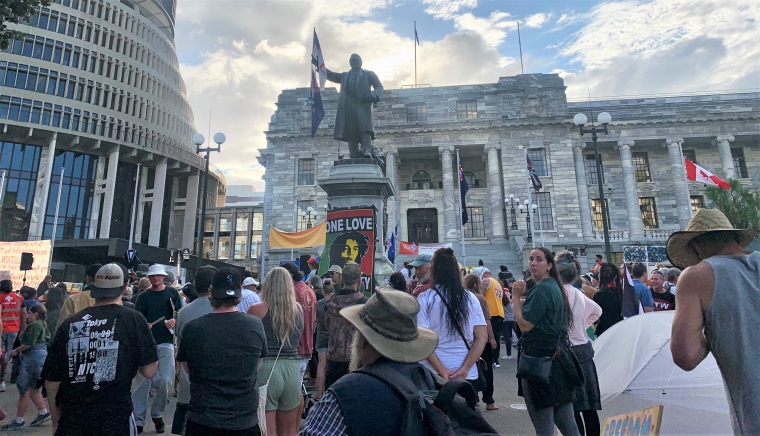
On Monday I came close to confronting a protestor, sitting smugly in a fold-out chair next to police officers at the outer edge of the occupation, blasting a siren from a speaker… just because.
As a journalist who works in the Parliamentary press gallery, which is currently surrounded by people who think Bill Gates, Jacinda Ardern, and the Illuminati have paid me to lie to them, there have been a number of incidents that have made my blood boil.
But there was something about the senselessness of the piercing sound that tipped me over and almost made me cause an incident.
Anyway, I refrained, and as I walked away, I reminded myself - we’ve been through a hell of a time with this pandemic, and the reality is that some people were always going to respond badly.
We have had to forgo many of our rights and freedoms for the greater good - to keep the vulnerable safe and our hospitals unclogged.
The restrictions the Government has imposed on us have been extraordinarily heavy-handed. I think we should acknowledge this. It isn’t normal to socially isolate or be required to have a vaccination to go to work.
But was it right for the Government to implement these restrictions? I believe so - on a high level (we can debate the details).
We lost an elderly family member overseas to Covid-19 around the time Delta was spreading. She died in hospital without her family with her. Another family member in her mid-40s spent weeks in hospital successfully fighting the virus (before she was vaccinated), and a friend in his early-30s, who got Covid-19 at the start of the pandemic, is still recovering. He was only healthy enough to return to fulltime work late last year.
I’m sure people with family and friends overseas have similar stories. But for many in New Zealand, government restrictions have probably caused more grief than the virus itself.
The need is such that the Government is issuing around 30,000 food grants a week. The tourism, hospitality and events sectors are battling. The unvaccinated are largely alienated from society. The closed border has split people from their loved ones. Funerals have had to be attended via Zoom. Restrictions on visitors to hospitals and rest homes have isolated the sick and elderly.
Older asset owners have benefited immensely, while younger people are learning to accept that studying and working hard won’t necessarily be enough to give them the financial security it gave their parents.
We can all find people who are better and worse off than us, but I think we should acknowledge it has been a tough few years for everyone. Our political leaders could do more to simply recognise this.
I’ve had friends battle cancer, suffer miscarriages and traumatic births without the support of family and friends while in lockdown. A friend in Auckland, who most would deem “privileged”, said she felt like she had post-traumatic stress disorder after working a high-pressure corporate job while looking after a baby and toddler at home during lockdown last year.
General discontent and fatigue by this point of the pandemic are inevitable, as are rage and disenfranchisement among some.
In many ways, it would be weird if in a democratic country like New Zealand, there weren’t people protesting. The social progressives of Wellington central need to be realistic about this, and realistic about both the diversity and ugly parts of our society.
Authorities also need to be wary of the fact technology has evolved more quickly than the human brain has in recent decades.
Just because we’re all able to create content and circulate it online, doesn’t mean to say we’re equipped to safely manage this freedom.
Our emotions and insecurities still get the better of us. For example, we might feel more inclined to seek acceptance from a toxic group online than face loneliness. Or we might seek to validate our feelings by buying into a lie rather than confronting an uncomfortable truth.
Technology is a powerful tool that can be weaponised.
It’s worrying nefarious groups are causing instability by preying on the vulnerable, using algorithms to bombard them with disinformation.
The concept of fragmented realities - people understanding the same event or situation to mean two completely differently things - is scary.
All it takes is for one person with a deranged view of the world to inflict serious harm. Some of us in central Wellington are on high alert at the moment for good reason.
The police clearly have a tough job on their hands, allowing people to exercise their right to protest while cracking down on violent and anti-social behaviour by some.
Applying a sinking lid approach - suffocating the occupation by stopping protestors from taking new ground and preventing new arrivals from joining - seems sensible and should’ve been done earlier.
It’s difficult to see how the police can reason with a fragmented crowd, which lacks leadership. Furthermore, many protestors appear beyond reasoning with. They don’t just want the mandates to go, they want to “overthrow the government”. And then what?
Those calling for the police to use force - batons and teargas - should think through the consequences of this. Kids, cops and the elderly at the occupation would be hurt. This would also create a spectacle, which would fire-up those who already don’t trust the state and prompt them to set up camp elsewhere.
I don’t think we should look at this occupation and think vaccine mandates have divided society. They haven’t. New Zealand’s vaccination rate is remarkably high.
We can debate the merits/flaws of the various restrictions, but most people understand the response needs to evolve as the risk profile changes, and one way or another, we need to ensure we have capacity in our hospitals to care for cancer patients, etc, as well as people with Covid-19.
A destabilising event like a pandemic was always going to exacerbate existing inequities in a society; those at the fringes were always most of risk of being triggered.
The best we can do as individuals is try to be empathetic and pragmatic (I will have to keep reminding myself of this as I walk through the occupation).
As for our political leaders, it’s best they acknowledge how tough it has been and focus their attentions on some of the drivers behind existing inequities. The occupation shouldn't be framed as a symbol of sudden division in New Zealand.
We welcome your comments below. If you are not already registered, please register to comment
Remember we welcome robust, respectful and insightful debate. We don't welcome abusive or defamatory comments and will de-register those repeatedly making such comments. Our current comment policy is here.