
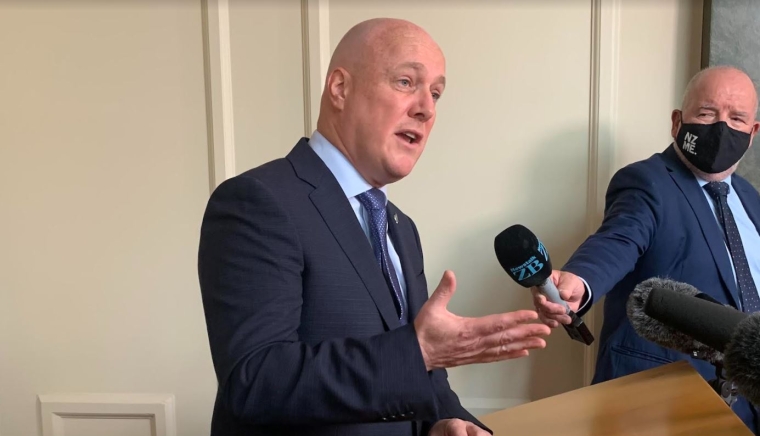
National is promising to simplify the Reserve Bank’s (RBNZ) job if elected into government next year, so it only needs to target inflation when setting monetary policy.
National leader Christopher Luxon told Bloomberg he wants to remove the requirement for the central bank’s Monetary Policy Committee to target “maximum sustainable employment”.
The Labour-led Government created the RBNZ’s dual mandate in 2018, following a review of the Reserve Bank Act 1989.
Luxon also told Bloomberg the party is committed to removing a line from the Monetary Policy Committee’s remit, requiring it to “assess the effect of its monetary policy decisions on the Government’s policy to support more sustainable house prices”.
The Government made this change in February 2021. It arguably hasn’t altered the way the committee has set interest rates, but has seen it detail the impacts its moves have on house prices in more detail in its quarterly Monetary Policy Statements.
Asked to verify and elaborate on his comments to Bloomberg, Luxon told interest.co.nz, "The government should direct the Bank to go back to focussing on its core mission of price stability, like it did (with reasonable success) for most of the last 30 years.
"There’s been too much mission creep at the Bank, which is to be expected with the Government continually meddling with its objectives and trying to pass responsibility for its own failures onto the Bank.
"Giving the Bank multiple, potentially conflicting objectives makes it harder for the Bank to do its core job of controlling inflation, and harder for the Government and the public to hold the Bank to account.
"Things like removing the barriers to building houses, supporting businesses to create jobs, or ensuring the welfare system is focussed on getting into work are all issues for the Government to address, not monetary policy."
Luxon's comments come as National MPs have focused their energy this week in Parliament on attacking the Government over the rising cost of living.
Luxon's comments echo English's
Former National prime minister and finance minister Bill English, in a March 2021 interview with interest.co.nz, accused the RBNZ of overcooking its response to Covid-19 by loosening monetary policy too much.
“I’m not a fan of giving central banks several targets,” English said.
“It makes their job pretty difficult and it makes it harder to predict how they’ll behave… It sort of washes into the political issues when you’re dealing with inflation and employment and housing…
“Sometimes politicians can get a bit too reliant on central banks.
“There are some things they [central banks] can do, and some things they’ve done pretty well. Either they or the politicians are expecting them to achieve more and more objectives - whether it’s now moving into climate change - it creates uncertainty.”
95 Comments
Good move.
Luxton, if you're at all reading, please for the love of God stop with this madness of trying to disincentivize housing and instead give us some incentives for investing in other asset classes!
An adjustment of the PIR rates will do more to help housing and our young than any Brightline test.
Hello, yes, please also look at the tax treatment of 'foreign investment funds'.
The next steps should be to reduce the target inflation range. The first step would be to reduce it to a range of 0-2% which was where it was initially set in the 1990s. Until that happens, we will continue to work within a 'funny money' policy that encourages investment in non productive financially leveraged assets.
KeithW
Agree
"non productive financially leveraged assets" = residential property ?
Is there anything to be said for how we measure inflation too? I don't believe many of us believe the inflation numbers we're given. Presumably the basket is made up of Warehouse Veon HDTVs and not actual food.
Yes important point. I personally think house values need to be in the basket.
Oh god no. Too late for that now they are too high.
Why not, add them in and if they crash it's deflationary etc.
Until that happens, we will continue to work within a 'funny money' policy that encourages investment in non productive financially leveraged assets.
Spot on. But Luxon doesn't seem to get it by removing any focus on housing. If they revised the CPI accordingly, perhaps that would help.
I agree: 0-2%, as it was originally. Luxon makes sense. Let the RBNZ control inflation, and let the Government govern, which will mean taxes and policies that encourage investment in productive enterprises, instead of everyone playing Musical Houses.
Yes but the risk weightings on credit creation are entirely different than for the bubble.
You're right. You should write to Luxon. He might actually listen to you.
Yes in 2 weeks our OCR will be adjusted to just 1% with inflation at 6%. Still nowhere near the mandate requirement.
I agree 100%. Well said. Orr should also be sacked immediately, with somebody more balanced and competent put in his role.
While inflation is happening Globally, National is going to blame it on Labour, pretty good strategy 18 months out from an election where inflation/interest rates will be hot topics
As National did in 1975. Not sure that lightening is going to strike twice though. Conditions today are quite different.
The reason it is happening globally is because of the same funny money policies across the developed world and closed thinking among global central bank comrades who have all been taught to think the same way. My monetary focus going forward is on influencing the policy debate, recognising that all mainstream parties have contributed historically to where we are now. It was National who shifted from 0-2% to 0-3% in 1996, and it was Labour who much more recently included employment as another issue to be considered. I would hope that eventually all parties would see the fundamental flaws within funny money policies. Of course employment is vey important, but monetary policy is not the way to manage that.
KeithW
NZ imports immigrants like china imports raw materials. Iron ore, logs etc
There is no shortage of work in NZ. We are importing more and more workers from overseas. Skill shortage visas are basis of our immigration for decades. So why do we need employment as a basis for any monetary policy unless the were some vested interests.
There should be an inquiry into how this government plundered so much money on useless policies under the disgustle of covid. It's all my tax paid money and they have used to without any accountability. They should be help responsible and prosecuted if found to have wasted due to negligence.
The fundamental issue for our reliance on migration is the shift in focus among NZ employers from training workers to hiring pre-trained employees.
For example, despite what the industry wants everyone to believe, there is no shortage of Kiwis graduating with STEM degrees, especially T & E. Employers offering entry-level opportunities to graduates are a few large consulting firms.
Thanks to our broken migration policy, local grads also have to compete with experienced migrants desperate to get their foot in the door for these handful of opportunities.
Yeah, I think this is underestimated by people who haven’t been new entrants to the job market within the last decade or so. Employers are militant about experience over qualifications or potential. A lot of the time jobs just end up going to whoever is most willing to lie on their CV. HR people can never tell, since they don’t have any actual expertise in the industry. Destroying the HR industry would probably usher in a golden age of innovation and productivity…
Amen, I said the same last week. New Zealand needs an unemployment register, from which employers must select employees with skills sets closest to those they require. They should be forced to take on Kiwis apprentices and upskill them into roles. If they can prove, from stringent tests, that they are unable to find even one person with the potential to be upskilled into the roles they require, then they can apply to import one from overseas. It is far too easy and proof positive that there is no patriotism in New Zealand capital when they expend little to no effort improving the lot of unemployed Kiwis.
Ngk,
"the disgustle of covid." What a wonderful word. I hope to see it in the dictionary soon.
Even the Federal Reserve has goals around employment, though numbers not specific, but I guess we can ignore that here in NZ.
They also have Trump and drive-by shootings.
I guess wishing we did not have the equivalents thereof here is myopic of me.
Good work. At least some common sense prevailing from someone who understands what the working class pay day to pay day survivor wants from the government.
The current government is all about hand waving gesture and hugs. But i need to feed my family and hugs don't put food on my table.
I want the costs to decrease so i can feed them well.
Why not look to raise your income or lower your costs. You have far more influence over your own fortunes than the government.
Really.. You think that's easy?
And you are telling me that what the government polices are doing to our lives is ok and we should just take it. I guess you are probably a spoilt child if a rich occupier. Never knows how poor survive and don't have much hours in a day after two jobs to do a third one.
Easy to talk than walk in the shoes of a hard ( including smart) working man and a father.
I never said it was easy, it's just the option most likely to improve your circumstances. Could take years even.
I know it's not easy: I've been poor more than once through my life, with family responsibilities no one else was going to step up to take care of. And in my 60+ years experience you'll wait forever in vain for any Govt to solve your difficulties.
You really need to do both - raise your topline income AND lower your costs, you need to see daylight between these numbers (family microeconomics are no different from any other business).
One day at a time until you can breathe enough to think about one week & then one month. Once you can see a further horizon you will see more opportunities.
The most important thing of all is having a partner who is fully committed to the same goals & strategy. I had that for quite a few years but then lost her along the way as we became more financially successful.
It's irksome that our education system is designed to churn out workers instead of people who are able to author themselves a successful work life including managing their financial affairs.
Sorry to hear your split. My partner and I worked out that a meal is as good as a feast so are making the most of our faculties while we have them, instead of retirement when all the bits stop working or fall off.
Pa1nter,
" instead of retirement when all the bits stop working or fall off." I still see red every time I see statements like this.
There are those who can't imagine not working and those who can. I am one of the latter. I thoroughly enjoyed what I did, but retired completely at 57-almost 20 years ago- and have never once regretted it. What I did for a living did not define me. The first thing we did was to move country, from Scotland to here and build a new life.
Of course, I accept that I was fortunate in being able to afford to retire early and many do not have that option.
"I guess you are probably a spoilt child if a rich occupier."
Hard to feel any sort of sympathy when this sort of garbage is posted on here. I would hazard a guess that most people posting on Interest.co.nz are or have been hard working men and women doing the best for their children.
This isn't the only time that things have been tough.
You can either listen to advice posted on here(which by and large is positive)and try and take things on board or continue to blame others for your own predicament.
Unfortunately having read a few of your posts I think it might be the latter.
“Why not look to raise your income or lower your costs”. Oh if only it was that easy 😂. Pretty brazen comment when you have no idea of any commenters actual situation. Along the same lines as “Stop buying coffee everyday and you to can afford an $900k house in Auckland”.
Well yeah, in essence, it's a fundamental of financial existence, ensure your incomings exceed your outgoings. If what you're doing isn't accomplishing that, then you will need to change one or many parts of your life.
The alternative is to complain and go backwards.
It is about stopping buying that coffee everyday. If you cannot even stop buying that coffee its really just highlighting the tip of the problem iceberg. All those "Must haves" that are not must haves really add up.
Ah yes, I'll stop buying the 30 coffees a day I don't buy. That'll make the difference.
Maybe the problem is that many in previously safe middle-class professions can no longer afford a house despite living on the bones of their arse for year after year?
Maybe the problem that's is actually that a generation of dickheads have priced shelter out of reach for many ordinary Kiwis?
Good to hear some feedback from a Labour supporter, not surprising it went straight over the top of your head.
I just went and bought a really good espresso machine. Coffee beans arent cheap though, thinking of buying a coffee plantation next.
What if you don't like coffee and never bought one period let alone every day , but instead like that H2o that comes out of the tap .
And here I was thinking I wasn't voting for National
Doesn't it at least make you think how different things would have been with Bill English at the helm ? He was on about loose monetary policy back in March 2021. The current lot have screwed the pouch and the damage is irreversible.
I am no Nat fan boy but I always rated English highly.
Usually like your comments but I can’t agree with this. He should have invested in infrastructure after the GFC, govt should invest in the bad times and save in the good times. Now the govt are having to invest in a period of very low unemployment and overstimulate the economy. I really think that error from English was unforgivable.
Sometimes I feel that our political cycle is mismatched with our economic cycle. Perhaps, a big spending Labour Government was required post-GFC and in the past few years a National Government with effective operators who can get things done was required.
Didn't they invest massively in roads?
It would have been nice if more of that investment had gone to PT.
Waterview and Waikato expressway were labours. I guess transmission gully although that is a PPP (crazy with such low interest rates) and maybe some around Tauranga, but nothing outlandish. They needed to build some hospitals etc.
All governments have been hamstrung by the Public Finance Act, which effectively forces them to run surpluses. We should be able to take on debt to build important infrastructure that will deliver long term payoff to justify the debt. Bernard Hickey did a good article on in :
https://thekaka.substack.com/p/an-intergenerational-wellbeing-crime
His rating went right down with me when he denied there was a housing crisis. Crisis I believe was either by Labour or MSM. I would have been comfortable with BE saying we have serious housing problem and we are addressing it as follows. Once you say there is no crisis you consequently don't have to say what needs to be done.
I feel this is one of the key areas that toppled the Nats. Not that Labour have done anything about it.
There is no one magic bullet for residential housing. There are at least five, each with varying percentages.
Q: What happened to the so called housing crisis?
A: I reject the premise of that question.
Never thought anybody worse than Key would come along.
But here we are.
Key was substantially better than Clark, and infinitely better than Collins.
I see all the negatives of Clark in Ardern, with none of the positives. Ardern is nothing but unbridled irrational egotistical idealism, and that is the last thing you want in an MP, let alone a PM.
Key's legacy is a failed flag campaign. Ardern's legacy wont be anything more than her ability to generate a well choreographed media soundbite.
Hey, that is a bit tough on Key. What about the job summit and the cycle trails?
What about the catching up with Australia by 2022? Or the tax review they shelved?
Yes i was part of the ING/ANZ Friozen Funds group when Key suggested we stop our protest , i wonder why that was ?
That answer, I dont know how many times i have heard the current bunch state - I dont accept that. Alternative facts are alive and well in the halls of parliament
While they are at the reserve bank to focus on inflation , they should get them to dump the woke policies and start reducing their overheads (staff) to go back to the basics of their job they are employed to do ie control inflation .
Yes I would like to see the Nats slash the staffing levels of all the agencies and hugely tighten their remit (last thing we want is for staff numbers to be slashed only for many of them to come back as contractors).
I understand there's about 40,000 public servants in Wellington. Assuming an average salary of 100k, cutting 10,000 of them would save the tax payer more than $1 billion per annum.
That's a lot of $ to train and hire front line servants such as teachers, nurses, doctors, and police...
Exactly. Rather than wishy washy policy advisors galore
Easy as that. Sit back and watch those savings grow. Seek tomorrow.
Ad 1: Well respected Govt agency requires project chairr to sit on the newly formed "Public sector workforce working group". This is a fixed term position for 18 months. Salary range is $500k.
Ad 2: Well respected Govt agency requires project manager to sit on the newly formed "Public sector workforce working group". This is a fixed term position for 18 months. Salary range is $200-250k depending on experience.
Ad 3: Well respected Govt agency requires project coordinator to sit on the newly formed "Public sector workforce working group". This is a fixed term position for 18 months. Salary range is $50-75k depending on experience.
Ad 4: Well respected Govt agency requires 2x Senior Policy advisors to sit on the newly formed "Public sector workforce working group". This is a fixed term position for 18 months. Salary range is $125-175k depending on experience.
Ad 5: Well respected Govt agency requires 10x Policy advisors to sit on the newly formed "Public sector workforce working group". This is a fixed term position for 18 months. Salary range is $100-150k depending on experience.
Ad 6: Well respected Govt agency requires Media Relations Manager to sit on the newly formed "Public sector workforce working group". This is a fixed term position for 18 months. Salary range is $150-200k depending on experience.
Painfully accurate!
Policy advisors rarely break $90k. It's the Principal Advisors that can break $150k
CPI is a poor measure of inflation.
Yes it is but only as it stands. Simply change the formula used, its clearly wrong. How anyone thought house prices rising 36% in a single year could have zero impact on inflation is beyond me.
Good move. Getting rid of the fluffy house sustainable impact thing is a good move. Bit too late to impact access any impact now AFTER you've pushed the print-money-overdrive button and destroy the hopes of dreams of thousands upon thousands of kiwis.
Good move by National. But CPI needs to be updated to include house prices and rents to a higher degree, maybe to the degree which they actually affect people, not some tiny percentage.
Luxon is on a roll here. I was listening to RNZ interview people about the Treaty of Waitangi and my god, Luxon was the best of them. He really seems to be in touch with the issues, or at least sounds like he does. Seems like National is swinging way left, while Labour swings way right.
Yes, he's impressed me.
If an election was tomorrow, I would vote National.
I do want to see their wider policy platform, though.
What exactly did the safe pair of hands of National achieve in their last 9 year term? Or do you prefer Gov'ts that do nothing over ones that stuff things up. Why anyone would vote for National or Labour after the last two decades is beyond me....... Great that my property values have gone up, but infrastructure is fraying everywhere and inequality is growing. Different thinking is required.
Good. And while you have the tanks in there knocking out mandates, remove the inflation one too and let money find it's own price. RBNZ can then dry up and blow away.
On 20 Jul 21 Jennee Tilbury wrote an article headed “Grimes: Ditch the employment target, introduce a house price target” - see link below.
At the time I commented that Arthur Grimes had hit the nail on the head. Too much focus on employment & lack of focus on house prices has led to a well-being disaster. Renters are the big losers as they have been totally ignored by the government.
The current government has created many law changes that will continue to drive up rents and reduce rental supply. More renters will be forced to find alternative accommodation. Emergency accommodation will soon reach its limits in many cities. This will lead to greater misery & a worsening well-being disaster.
It is great that National is focussing on fixing the economy. They couldn’t do any worse than what this government has done with housing prices over the last 12 months. Now to cap it off Labour have requested a report which is due back this week to fix the mess that has been created. They are looking at rent caps or indexing rents.
https://www.interest.co.nz/news/111369/inflation-targeting-architect-ar…
"They couldn’t do any worse than what this government has done with housing prices over the last 12 months"
This is the same feeling, one had under National but look what happened. Jacinda Arden came to power and has done 10 Times more harm than National, so never underestimate this politicians.
So that would equal interest rates at 2% over the rate of inflation. So approx 8%.....?
Yeah I'm abit confused, if the RBNZ was to right now solely focus on inflation wouldn't it bring the economy on its knees - high mortgage interest rates, unemployment etc...
The proposal to remove the employment mandate from RBNZ will only return things to where they were until a few years ago - when the current Govt changed RBNZ charter .
Do not recall sky falling ( " high mortgage interest rates, unemployment etc...") during the last term of National .
where were you in 2008?
You mean at the end of Helen' last term ?
yes the OCR now would be about 3.5 or 4%
I think what we need to realise is that central banks have no desire to reign in inflation.
They will only do so if the political pressure becomes so extreme that they are forced to act - ie widespread revolt/social instability.
In the interim, they can run monetary policy with severely negative real interest rates…that takes from savers and protects the over leveraged. Remember Orr saying to banks to lend, lend, lend to avoid the country falling into a depression? Now those overleveraged who have saved us from a depression need to be protected by running negative real rates (about -5%!)
Exactly. What on earth do these people do that justifies their salary, that couldn't instead be executed by a few lines of code .. a smart contract.
1000 times better thought process in comparison to queen Jacinda.
Employment is already at it's peak due to border closure, if RBNZ thinks it's because of them then it's wrong. Just because supply is less everybody has something to do, except those who don't want to work.
Inflation is the core issue and if RBNZ wants to get away by saying it's worldwide then at least they have to do something to control it. Now they can't say it's because of Saudi's petrol price or shipping cost of china increase, if this is the excuse then let Saudis and Chinese run the country.
“National commits to restoring inflation as the Reserve Bank's sole monetary policy target, removing the employment target and the requirement for the Bank to assess the impacts of policy changes on house prices”…..
An idea that is so bat s&*t crazy, it just may work 😂
Luxon must be being advised by someone who hasn't read anything on macro economics since the 2nd year of an economics degree that they only passed because their girlfriend was studying maths.
Whatever your political persuasion, there is general agreement that the main lever that the central bank has to manage inflation is the overnight cash rate - the OCR. There is also clear agreement that the OCR lever works primarily by influencing the demand side of the economy. The central bank pushes the OCR lever up and this generally reduces the disposable income of people with mortgages and reduces business confidence. This reduces aggregate demand in the economy (meaning less consumption), and this leads to less work to do - i.e. less employment and more competition for jobs (pushing wages down). Whether or not any of this actually reduces inflation is far less clear - it depends on whether the reductions in demand impact on the underlying causes of inflation. How much would the OCR have to go up to reduce the price of petrol or drive reductions in the price of the building materials sold by our favourite duopoly (Fletchers and Carters)?
Anyway, my point is that the central bank's 'dual mandate' is not two distinct targets - not two jobs that it has to find time to do. The dual mandate exists because, under current policy settings, the bank is charged with finding the sweet spot between maximum sustainable employment and inflation. If a National Government wants to take ownership of the employment target - and leave RNZ to fight inflation, we could potentially end up in a tug of war between the Govt trying to create jobs (I hope) and the bank pushing up rates to reduce jobs. At least that would be mildly amusing.
Overnight Cash Rate ? Thats pretty funny and kind of suits our fly by night government but its the Official Cash Rate and even this is a bit old school as I believe its name has changed to MPR. Nothing like worrying about the name of something more than actually doing the job.
Forgive me, I went back in time for a minute. The OCR started life as the interest rate for overnight transactions between banks. The 'overnight cash rate'.
No mention of “no need to repay the loan” interest only loans or the tranche of other benefits that explain why he’s got seven houses.
he’s just a Judas for the banks
not really serious of solving the problem but keen to look like he’s doing something
I suspect he was earning enough when Air NZ was pumping to more or less to buy those houses. That said Nats are the ponzi pump party, but really, have Lab been any different?
Yep average man they are all as bad as each other.
Only raising interest rates and crashing the party will effect change.... and man it’s going to be painful for some.
It is clear that both the major parties do not want the Reserve Bank to be overly independent.
Lol, love the headline... you mean getting the RBNZ to manage financial policies (only) like it was intended to from the start? hey, great idea..!
um, I actually think it was designed that way for a reason from the start...
why the RBNZ has to manage employment is beyond me - that is supposed the be the job of government - Labour has become a joke...
Problem is CPI measuring inflation is a dud statistic that is broken - so if your measuring performance against a poor KPI then it becomes meaningless....
While the Labour Party has done some hideously woke things in recent years, changing the RB focus to include employment is one of the things that the Labour Party got right.
As a society we need all (or nearly all) people to be productively employed, and also inflation to be under control.
Also, we need wages to increase in real terms over time in order to get it back in relativity with the cost of housing, and to compensate for the reduction in the real value of wages over the last 40 years.
There was a time when a single wage could support an entire family and only 1 of the two parents had to work outside of the home. We need to go back to enabling a parent to be at home with their children if they want, rather than both parents having to be at work just to keep their heads above the water.
Why should housing and land be so expensive in real terms that they cannot afford to have the section much bigger than the size of the house itself. Where will the children play?
As of today, with this policy announcement, National got my vote.
I know employers would like to see the unemployment rate much higher but with 3.2% unemployed would Nationals change make any difference.
Luxton is a clone of key , talks the same.
almost sounds the same, because he spent 6 months training with john key.
Maybe give David Seymour a vote, because he has been trying hard, its hard for small parties.
It may help keep both national and labour honest at the same time.
We welcome your comments below. If you are not already registered, please register to comment
Remember we welcome robust, respectful and insightful debate. We don't welcome abusive or defamatory comments and will de-register those repeatedly making such comments. Our current comment policy is here.