
By Chris Trotter*
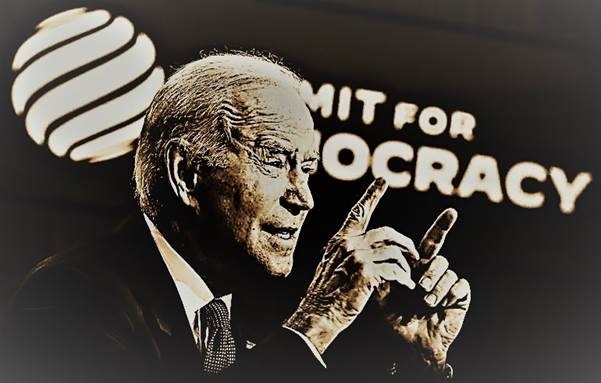
President Joe Biden has just wound up his virtual “Summit For Democracy” and, frankly, I’m none the wiser. The underlying premise of what looked suspiciously like an anti-Chinese, anti-Russian, propaganda exercise: that democracy is threatened by the advance of authoritarianism; was poorly defended by the American President and his supporters.
Our own Prime Minister (whose participation in Biden’s summit was, for a few encouraging moments, a matter of some doubt) certainly failed to advance a credible argument that democracy was under attack. Indeed, her most serious critique was reserved for the disinformation spread by the leading social media platforms. That all of these are based in the Land of the Free and the Home of the Brave, did little to dispel the intellectual confusion characterising the entire summit.
How much more helpful it would have been had Jacinda Ardern chosen to broaden the debate by comparing the present historical moment with that of the 1930s.
Ninety years ago, Democracy, as a political system, was unquestionably under unrelenting ideological attack. From the radical Left came the critique that the democratic system was nothing more than a smoke-screen designed by the ruling classes to hide the true power relationships of capitalist society – which were economic, not political. In the oft-quoted observation of the French writer, Anatole France: “The law, in its majestic equality, forbids the rich as well as the poor to sleep under bridges, to beg in the streets, and to steal bread.”
The Right lamented the weakening effect of democratic party politics on the expression of the national will. The unity of the people and the power of the state could only be undermined by Democracy’s relentless focus on the rights of the individual. The slogan of Benito Mussolini: “Everything in the State, nothing outside the State, nothing against the State.”; summed up the political objectives of the radical Right admirably.
Crucially, these anti-democratic ideas were not the preserve merely of party activists, academic authors, newspaper columnists, and radio personalities – the 1930s equivalent of today’s social media communicators. The assault upon Democracy was led by substantial nation-states.
The Soviet Union, through its mouthpiece the Communist International or “Comintern”, heaped nothing but scorn on Western “bourgeois democracy”. It was condemned for offering no credible response to the poverty and despair unleashed by the Great Depression. Against the dictatorship of Capital, the Comintern offered not democracy, but the dictatorship of the working-class. Its clinching argument: “There are no unemployed in Russia!”
Germany, under Adolf Hitler’s National Socialist German Workers Party – the Nazis – pretended not to feel the loss of the parliamentary democracy that had been swept away by the “National Revolution”. Gone was the vacillation, weakness and political gridlock of the hated Weimar Republic, and in its place stood the volksgemeinschaft – the national peoples community – which was credited with restoring order, unity and prosperity to the German nation.
How do Stalin’s Soviet Union and Hitler’s Germany compare, as anti-democratic proselytisers, with Vladimir Putin’s Russian Federation and Xi Jinping’s Peoples Republic of China – supposed leaders of the authoritarian crusade against which the “Summit For Democracy” set its face?
Frankly, today’s authoritarians aren’t a patch on their 1930s predecessors.
If the Russian Federation had genuinely turned it face against Democracy, deriding it as a failed experiment imposed upon the Russian people by the rapacious nations of the West, why would its leader devote so much time and energy to maintaining the pretence of leading a democratically-elected government? Would someone cast in the mould of Joseph Stalin really feel obliged to rig election after election in the manner of President Putin? Is it not more accurate to observe that the sins committed against democracy in Russia are, in fact, proof of its enduring hold upon the imagination of the long-suffering Russian people?
What about those 100,000+ troops massed along Russia’s border with Ukraine? How “democratic” is that? A better question might be: How would the Russian people react if their President did not do all within his power to keep the military forces of Nato as far from Russia’s borders as possible? If Russia and its allies had military forces ranged along both the Canadian and Mexican borders, and its navy was galivanting around the Gulf of Mexico, how bellicose do you suppose the American people would expect their president to be?
Just for the record: the last time so many foreign troops were massed along the Russian border was June 1941.
Even accepting that the Russian Federation is a deformed democratic state, the same, surely, cannot be said of the Peoples Republic of China? Is it not the case that President Xi Jinping has openly boasted the superiority of “Socialism with Chinese Characteristics” over the failing democracies of the West? Hasn’t he contrasted the extraordinary economic growth of China, and the dramatic improvement in Chinese living standards, with the grotesque inequality and moral disintegration of neoliberal capitalism? For those countries still struggling to join the rich nations’ club, President Xi’s characterisation of authoritarianism as the fast-track to prosperity, must be tempting.
Not least because so many of those aspiring nations are only too aware that the phenomenal growth experienced by China was set in motion by the enthusiasm of Western investors for a nation state that did everything within its power to crush “bourgeois democracy”. The fact that this prime destination for foreign (especially US) capital did not permit a multi-party system, free and fair elections, a free and outspoken news media, or, most importantly, an independent trade union movement, was precisely the reason why they were so keen to relocate their factories in Chinese territory.
China’s great sin isn’t that it maintains rigid control over the lives of its people; or that it represses the Uighurs of Jinjiang Province. (After all, the United States, the UK and Australia invaded, mangled and economically crippled Iraq in the same cause – i.e. combatting “Islamic terrorism”.) No, China’s great sin is that she refuses to allow contemporary Western capitalists to dictate her future in the same way as their nineteenth and twentieth century predecessors.
Viewed from this perspective, President Biden’s “Summit For Democracy” (to which, confusingly, the Philippines were invited, but Singapore was not) begins to look like those great evangelical gatherings of two hundred years ago, where one distressed clergyman after another rose to speak of the unfortunate millions of Africans and Asians dwelling in the darkness of religious error, their souls in peril, and urgently in need of the liberating word of God – followed, after a decent interval, by the not-so-liberating instruments of Mammon.
The great advantage of the Christian missionary movement was that the paradise it promised lay not in this world, but the next. The insurmountable problem facing Biden’s democratic capitalist missionaries, is that in order to fill the cups of the oppressed with freedom, they will first be required to empty their own pockets.
And where’s the profit in that?
*Chris Trotter has been writing and commenting professionally about New Zealand politics for more than 30 years. He writes a weekly column for interest.co.nz. His work may also be found at http://bowalleyroad.blogspot.com.
We welcome your comments below. If you are not already registered, please register to comment
Remember we welcome robust, respectful and insightful debate. We don't welcome abusive or defamatory comments and will de-register those repeatedly making such comments. Our current comment policy is here.