

2024 will bring deposit insurance to New Zealand on a formal non-emergency basis. Most other Western countries have a scheme like this.
The arrival here has the possibility of some transition distortions. Banks will be charged a fee for the coverage, and when insured by the Government, those deposits covered become "risk-free" and are likely to offer lower interest rates (or where no interest is paid, new or sticky fees). Banks don't see themselves as charities and will find ways to pass on costs - just as they do in other jurisdictions who have similar coverage.
And we should all understand, this is not real insurance. No private insurer anywhere in the world will provide this coverage. This is a taxpayer benefit for savers. And savers tend to be well healed and politically connected. It is a middle-class welfare benefit. To mitigate the obvious moral hazard, a modest upper limit will be imposed applying to all balances at an institution.
One of the ways the Reserve Bank is preparing for this introduction is by providing increased transparency for banking system deposits and savings. They have released a series of new disclosures on a system-wide basis. The following explainer describes the new data and analysis. At this time, this transparency does not extend to their Dashboard resource (Key Bank Metrics). But it should. After all, taxpayers will be backing up banks with the "guarantee" and depositors should get this type of transparency by individual bank. In the meantime, here is the Stats Insight released Christmas Eve. We will be following subsequent developments in this data monthly.
The original is here.
STATS INSIGHT
Bank Deposits – November 2023
• Term deposit growth has been strong since the beginning of 2022, with just over half of all household deposits currently locked in on term deposits.
• Most household term deposits are due to reprice within a year, however there has been a growing proportion of deposits locked in on rates longer than 4 years.
• There are over 17 million deposit accounts held by registered banks in NZ, with 15.7 million of these held by resident or non-resident households.
• The average household transaction balance at end Nov-23 was $4,875, while the average savings and term deposit balance was $13,150 and $88,817 respectively.
Note that there are slight differences in the totals for on call (transaction & savings) & term deposits with the breakdown published in our S40 table. Also please note that deposits by size data only reflects deposits held in NZD. Please refer to our technical note for more information.
21 December 2023
Deposits by repricing
As at end Nov-23, about 54% of all deposits held by registered banks were on call. For household deposits only, this proportion was about 48%, down from a peak of 62% at end 2021. Deposits have been shifting from on call into term deposits since the beginning of 2022, when interest rates began to rise from historic low levels. Household term deposits traditionally are set for less than a year, however there was a visible shift into longer term rates between mid 2022 and mid 2023. The level of deposits more than 4 years from repricing reached a historically high level of $2b in Aug-23, making up 0.8% of all household deposits.
Business deposits have seen a similar trend, with the >4 years term deposit bucket also reaching historically high levels in Sep-23, although only forming 0.2% of total business deposits. Business deposits largely remain on call, with 68% on call at end Nov-23. This is down from 78% on call at the beginning of 2022.

Deposits by size
As at end Nov-23, there were over 17 million deposit accounts held by registered banks in NZ. Of these accounts, approx. 15.7 million were from resident or non-resident households. Nearly half of these household accounts (7.4m) were transaction balances with a balance of less than $10,000. These balances equated to $7.8b, or about 3% of the total value of NZD household deposits.
There were 6m household savings accounts and 1.6m household term deposit accounts at end Nov-23. The number of term deposit accounts has risen 49% since the start of 2022, up from 1m.
The average household transaction account balance was $4,875 at end Nov-23, which was down from a peak of $7,246 in Dec-21. Meanwhile the average savings and term deposit balances were $13,150 and $88,817 respectively. Most household term deposits are between $10,001 - $100,000 in size, but there has been strong growth in the number of term deposits less than $10,000 since the beginning of 2022, with growth in this bucket outpacing other bucket sizes. This reflects the number of balances less than $10,000 that sit in transaction and savings balances. This has also helped drive the average term deposit size down from a peak of $91,810.
The number of household deposit accounts with a balance greater than $1m across all deposit types saw strong growth post covid, with annual growth peaking at 20.3% in Mar-21. However annual growth has since fallen to 2.1% at end Nov-23. There are currently 17.7k accounts with a balance greater than $1m (note that this number does not represent the number of millionaires in New Zealand).


Depositor Compensation Scheme vs Deposits by size data
The implementation of the Deposit Takers Act 2023 introduces a new Depositor Compensation Scheme (DCS), which in the event of a deposit taker failure, will ensure depositors are eligible for compensation of up to $100,000 per depositor, per institution.
In our new S45 web table, we break down the total value of NZD deposits into three different deposit types (transaction, savings and term), and then by the total value of deposits which fit into bands based on the size of each deposit.
The total value of deposits covered under the scheme cannot be calculated from this table, as compensation under the scheme will be based on a single customer view as opposed to a single account view. The S46 web table displays the total number of accounts held by registered banks.
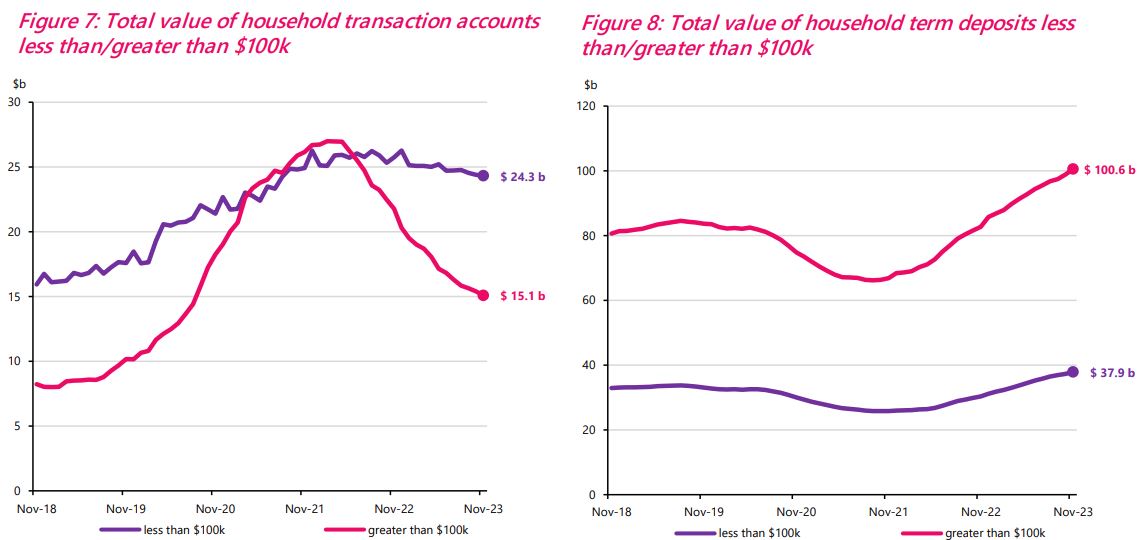
When looking at the value of household deposits less than/greater than $100k, we can see transaction balances greater than $100k have been declining sharply since Apr-22, after seeing strong growth between covid and this period. A lot of these balances likely shifted into term deposits, which have seen strong growth over this period.
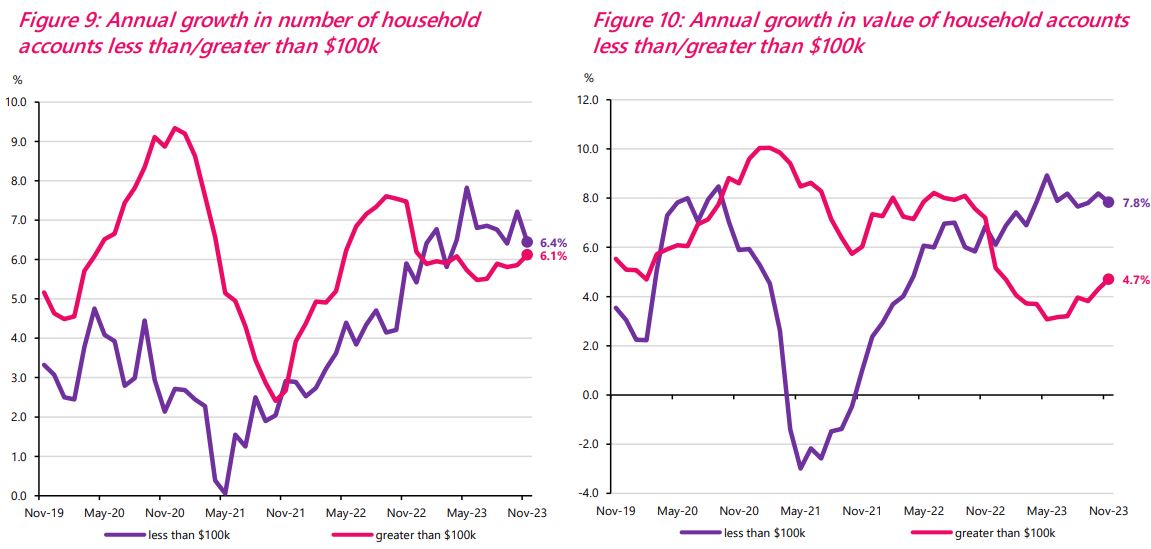
Annual growth in both the total number and value of deposits greater than $100k started to decline at the beginning of 2023, however still remains quite strong.
About the Stats Insight
The data used in this insight is sourced from the Reserve Bank’s Bank Balance Sheet Survey. All New Zealand registered banks are included in the survey. Data is collected monthly and published on the last working day of every month.
Transaction balances include balances where the purpose of the account is primarily for making transactions or everyday banking by customers. Savings balances include balances where the purpose of the account is primarily for saving. For some balances disincentives may apply if used for transaction purposes; that is, a penalty may apply such as loss of bonus interest. Term deposits are customer time or term deposits with a maturity of greater than one day. Deposits on call include all deposits with balances which are either readily available to be withdrawn or can be withdrawn at short notice. All deposits not bearing interest are also grouped together with on call balances. Deposits on call does not equal the sum of transaction and savings balances due to some savings account products being reported as term deposits separately within the bank balance sheet return. Data on household deposits includes both resident and non-resident households. Deposits by size data includes NZD deposits only.
Deposits data is published in the following tables:
• S40 Banks: Liabilities – Deposits by sector
• S41 Banks: Liabilities – Deposits by industry
• S42 Banks: Liabilities – Deposits by repricing
• S45 Banks: Liabilities – Deposits by size (value)
• S46 Banks: Liabilities – Deposits by size (number)
For more information, please contact: stats-info@rbnz.govt.nz
We welcome your comments below. If you are not already registered, please register to comment
Remember we welcome robust, respectful and insightful debate. We don't welcome abusive or defamatory comments and will de-register those repeatedly making such comments. Our current comment policy is here.