
By Chris Trotter*
There's a story about Mike Moore. What am I saying – there are hundreds of stories about Mike Moore! He was the sort of man who generated stories wherever he went. And if enough stories weren’t being generated, then he wasn’t above generating a few new ones on his own account. This story, however, concerns the powerful Australian television series “The Dismissal” – which dramatized the sacking of Gough Whitlam’s Labor Government in 1975. Whether or not it’s true, I cannot tell you. But if it isn’t – it ought to be.
Mike Moore was determined to remind his colleagues about the dangers that lay in wait for Labour governments. He wanted them to understand the power of the forces that could, at a moment’s notice, be mobilised against them if the interests of the people who really mattered were threatened. How vital it was to keep business on your side. How much damage the news media could inflict upon a government it didn’t like. Most importantly, he wanted to remind them of the dangers posed to labour governments by stubborn idealists: politicians who refused to be guided by principled pragmatism and common sense. Demonstrating unity of purpose and remaining a team – that was the trick.
So he sat all his caucus colleagues down and made them watch every one of The Dismissal’s six, hour-long, episodes.
Apocryphal or genuine, the story is telling. Not least because, as the 1984 general election loomed ahead of it, the New Zealand Labour Party was riven by division and dissension. Labour’s young president, Jim Anderton, was rallying the party’s left-wingers against the caucus faction which had made David Lange the Leader of the Opposition, and which seemed to be preparing to pull Labour sharply to the right.
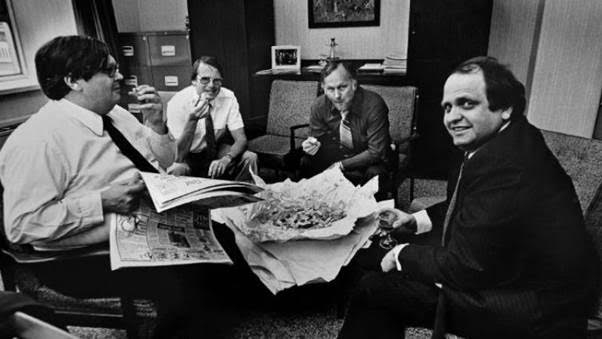
One of the most arresting photographs ever published of Mike Moore dates from around this time. It features the notorious “Fish-and-Chip Brigade” – Lange, Moore, Michael Bassett and Roger Douglas – tucking into takeaways in the aftermath of their first (unsuccessful) attempt to topple Lange’s hapless, but much loved, predecessor, Bill Rowling.
Moore’s face is a picture of nervous guilt and tightly-controlled fear. His expression is reminiscent of a child caught with his hand in the biscuit-tin. Moore knows that what he and his co-conspirators are planning will transform the Labour Party – and New Zealand – forever. He’s aware that the policies Lange is being primed to introduce are being field-tested by those industrial-strength left-wing bogeypersons, Margaret Thatcher and Ronald Reagan. (Which is why neither he nor his companions will openly declare their true intentions until it is too late for anyone to stop them.) Moore doesn’t care. Which is why, behind the guilt and fear, it is possible to also detect defiance.
Moore in the early 1980s was convinced there were no other viable alternatives for keeping Labour in the political game. The policies of the Fish-and-Chip Brigade were the only policies the powers-that-be would accept. If the party attempted to lead the country leftwards, then it would suffer the same fate as Whitlam.
Hence the screening.
Moore may have preached principled pragmatism, but the pragmatism he practiced was utterly ruthless. For pretty much the whole of his political life he was willing to apply the hardness and cynicism acquired in the course of an unsentimental working-class upbringing in the dirt-poor North, to the grim task of dismantling many of the New Zealand working-class’s most important achievements.
He did it for their own good – of course – because the world was changing and what had worked in the 1930s and 40s could no longer be made to work in the 1970s and 80s. Did he understand how important this uncompromising working-class persona was to the success of Roger Douglas’s revolution? How useful it was to have someone who could defend radical free-market capitalism in the absolutely authentic accents of a working-class Kiwi bloke? I suspect he did – especially when so many of the opponents of Rogernomics were university-educated “socialists” from the professional middle-class – with the vocabulary and diction to prove it!
God, how Moore loathed these people! Certainly, his contempt for left-wing intellectuals inspired some of his most memorable quips: “They’re the sort of people who tuck their singlets into their underpants!” And, “You never saw any of these people when it was time to stack the chairs and sweep the Trades Hall floor after a union meeting.” (He liked to tell people that was how he got to know the gruff old trade union boss, Jim Knox.)
But that animosity was also the product of self-loathing. Because the same intellectuals and university common-room socialists he derided never attempted to hide their own cold contempt for this pudgy little panda-bear of a guy, who had left school at the age of 14, and yet was willing to sell his soul for the opportunity to fly business-class and sip expensive whiskey with the Devil’s Armani-suited henchmen in the low-lit lounge bars of the world’s best hotels. To say Mike Moore had a chip on his shoulder was a considerable understatement. More like a bloody tree-trunk!
Even the eight weeks he got to spend as New Zealand’s 34th prime minister (not bad for a former printer and freezing-worker!) must have been tainted by the knowledge that the likes of Geoffrey Palmer and Helen Clark had only encouraged him to take on the job because they needed a “working-class battler” to save the Labour Party from being completely wiped-out in the 1990 general election. It is easy, therefore, to imagine Moore’s fury and feelings of betrayal when, three years later, Helen Clark and her allies, in the days immediately following the election he came within a few hundred votes of winning, unsentimentally slit his political throat.
It makes you wonder what might have happened had Moore followed a different path. If, instead of taking a sobering lesson from Whitlam’s fate, he’d been enraged by it. If, instead of helping Roger Douglas, Richard Prebble and Michael Bassett dismantle the achievements of the First, Second and Third Labour Governments, he had joined Jim Anderton in taking up the cudgels against them. There were occasions when you got the distinct impression he was thinking about it – like the party conference where he elicited left-wing cheers by mischievously urging delegates to: “Vote Treasury – and cut out the middle-man!” Or when, far too late, he threw his weight behind an Aussie-style “Compact” with the Council of Trade Unions.
It’s all the things that didn’t happen for Mike Moore that makes him a tragic, rather than heroic, figure. Encapsulated in his career is the perennial dilemma of all intelligent and ambitious workers under Capitalism. Strive too hard and too successfully on behalf of your class, and you will be destroyed. Pursue only those things most likely to bring your personal advancement and influence, and you will be despised.
Always a champion of export-led growth and trade liberalisation, Moore rose to become Director-General of the World Trade Organisation – only to preside over the “Battle in Seattle” and the failed Doha Round. For five years this former Labour Prime Minister was New Zealand’s Ambassador to the United States – but only thanks to the National Party. Had he allowed himself to be knighted, his motto would undoubtedly have been, “World Peace Through Free Trade” – if only that arch-capitalist, John D. Rockefeller, hadn’t already made it his own.
*Chris Trotter has been writing and commenting professionally about New Zealand politics for more than 30 years. His work may be found at http://bowalleyroad.blogspot.com. He writes a fortnightly column for interest.co.nz.
We welcome your comments below. If you are not already registered, please register to comment
Remember we welcome robust, respectful and insightful debate. We don't welcome abusive or defamatory comments and will de-register those repeatedly making such comments. Our current comment policy is here.