
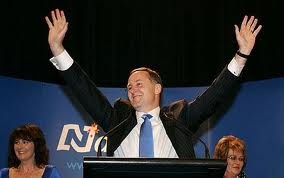
Prime Minister John Key has delivered an extremely upbeat view on New Zealand's economic prospects over the next 20 years, saying the period could see the strongest growth in the nation's history on the back of strong links to rising Asian economies.
In a speech to the Wellington Employers Chamber of Commerce, Key said growing Asian countries would mean sustained demand for New Zealand commodities, with prices for those commodities to stay strong for "a very long period of time."
That would underpin growth over the medium-term, which could be stronger "than any other point" in New Zealand's history.
The biggest risk to that growth would be a derailment of economic growth in China, which many commentators are saying could be overheating as inflation pressures rise.
However, Key said his view was China would sustain its growth.
Slams capital gains tax
Key also took the opportunity to hit out at Labour's upcoming announcement on a tax policy next Thursday, which is tipped to include a policy to introduce a 15% capital gains tax on property other than the family home. One News reported the 15% figure last night. It was understood the tax would be applied to investment properties.
The Green Party has been advocating a capital gains tax on all assets other than the family home, which could eventually raise NZ$4.5 billion a year. However the tax rate in that scenario would have to be about 30%.
After his officials spent the evening trawling through the Tax Working Group's report, Key told his audience a 15% capital gains tax on just investment properties would raise about NZ$700 million a year, and that would be realised over 15 years as the properties were sold, citing experience in Australia where it took about 15 years after introduction for capital gains tax revenues to peak.
Tax Working Group figures showed a 28.5% capital gains tax on investment properties could potentially raise NZ$1.4 billion a year when revenues peaked.
In order to raise NZ$4.5 billion a year without including the family home, a capital gains tax would have to be applied at 30%, and on all assets including shares, rural property and commercial property, Key said.
'NZ$11 billion hole'
It was not credible for any political party to go into the election without a set of books that added up.
“We know, through our budget process, that we can get [net] debt to top out under 30% of GDP, we know that we’ll be back in surplus in the worst case scenario by 2014/15, but probably 2013/14, in which case there’ll only be three countries in the developed world in that position – us, Korea and Australia,” Key said.
“Our books add up. As part of that there’s a range of different things we do, from adjusting the rules around KiwiSaver, and reigning in the generosity of things like Working for Families, right through to the mixed ownership model," he said.
“So yesterday, Labour came out and basically said, reluctantly, that they’re going to put a capital gains tax on, and that it would apply at 15% was the rate the hawked off around the Parliamentary Press Gallery I’m sure. They told everyone it would generate NZ$4.5 billion of cash."
Key pointed to the Tax Working Group’s report given to the government a year ago.
“They didn’t recommend capital gains tax, and neither did the 2001 McLeod tax review. We’ve had two major tax reviews in New Zealand, and both of them rejected capital gains taxes. They rejected them on the basis of the fact that they’re very complex, there is a lot of tax structuring that ultimately becomes involved, people don’t sell assets, because people only pay capital gains tax on realisation," he said.
On the numbers, Key said the report showed NZ$4.5 billion could be raised if there was a 30% capital gains tax rate.
“And not just on investment properties, but on farms, on all shares, on all industrial and business property, on everything, and you get it in 15 years’ time," he said.
"So if you have a 15% capital gains tax on investment properties, you earn NZ$700 million in 15 years. So for the next three years, if they don’t sell assets, as they’re arguing they won’t, if they do have a NZ$5,000 tax-free threshold, as they’re arguing they will, and they do take GST off fruit and vegetables, they are NZ$12 billion in the hole for the first three years of that theoretical government, with no cash coming in at all."
Raising the top personal tax rate from 33% to 39% for incomes over NZ$100,000 would bring in NZ$1 billion over three years, Key said. That would leave Labour NZ$11 billion in a hole without having started their election campaign.
One of the reasons the National government rejected the capital gains tax idea, was that it was not the panacea to rising house prices, Key said.
“If anybody thinks it is, they have to go and have a look at Australia, the United States and the UK. Because all of them have a capital gains tax, and all of them experienced a substantial increase in property prices. It does not stop those cycles, actually," he said.
(Updates with further comments from Key, figures on capital gains tax).
We welcome your comments below. If you are not already registered, please register to comment
Remember we welcome robust, respectful and insightful debate. We don't welcome abusive or defamatory comments and will de-register those repeatedly making such comments. Our current comment policy is here.