

sign up log in
Want to go ad-free? Find out how, here.

A review of things you need to know before you sign off on Wednesday; consumers less downbeat, dairy prices hold, current account deficit shrinks, Silk quits, NZ Super stars again, India FTA voted up, swaps ease, NZX rises, NZD falls, & more

Economy / news
A review of things you need to know before you sign off on Wednesday; consumers less downbeat, dairy prices hold, current account deficit shrinks, Silk quits, NZ Super stars again, India FTA voted up, swaps ease, NZX rises, NZD falls, & more

Here are the key things you need to know before you leave work today (or if you work from home, before you shutdown your laptop).

MORTGAGE RATE CHANGES
Liberty Finance has raised its fixed rates. All current mortgage rates are here. And note, you can compare mortgage offers with our unique calculator that takes into account other costs and cashback incentives, here.

TERM DEPOSIT/SAVINGS RATE CHANGES
None here today. All updated term deposit rates less than 1 year are here, for 1-5 years, they are here.

A TOUCH LESS DOWNBEAT
According to the Westpac MM consumer confidence Q3 survey, consumers across the country are feeling a bit less downbeat about the economic outlook. Even so, there is still a lot of nervousness about economic conditions and household spending is still very restrained in most of the main urban areas. However in some regions, strength in key export industries has boosted incomes and sentiment..

DAIRY PRICES DOWN IN USD, UP IN NZD
There was a full dairy auction overnight and prices slipped -1.1% overall in USD although are up +1.1% in NZD. Within that, there were some wide swings; butter fell -5.7%, but cheddar cheese was up +16.5%. Mozzarella was down -6.0%. However the powders only had small moves with SMP up +0.1% while WMP eased -0.8%. It seems unlikely that this auction would trigger any reassessment of farm gate payout forecasts.

BETTER THAN MARCH, WORSE THAN A YEAR AGO
The Q2-2026 current account deficit has come in at -$3.8 bln, or -3.2% of GDP, $666 mln less than in the March quarter, according to figures released by Stats NZ today. The improvement was all due to a $712 mln narrowing in the primary income balance deficit. The primary income deficit is the difference between the income New Zealand earns from its investments overseas and the outflow of income from foreign investment in New Zealand. The goods deficit balance worsened by $416 mln. The services balance changed by $300 mln from a deficit in the March quarter to a surplus in the June quarter. In Q2-2025 the equivalent current account deficit was -$2.6 bln or -3.6% of GDP.  We should note that the Q2-2026 activity only saw the initial hit from oil prices. There will be much more to come and the Q3-2026 results will show a full hit.

SUBSTANTIAL BENEFITS
Meanwhile, our net international investment position improved substantially, with a $178.3 net liability to the rest of the world at the end of June (39% of GDP), down from a $191.7 bln liability at the end of March, and $212.9 bln at June 2025 (48.9% of GDP). Shifting this needle were substantial market and valuation changes in our offshore assets that went in our favour.

SHITIFICATION SURGE
The Department of Internal Affairs has published its 2025 Digital Messaging Transparency Report, revealing a +1,240% increase in reports of SMS message scams.

NZX50 FIRMS
As at 3pm, the overall NZX50 index is up +0.7% today so far. It is down -1.9% for the past 5 trading sessions. But it is up +3.2% from six months ago. From a year ago it is now up only +2.6%. Market heavyweight F&P Healthcare is up +1.4% so far today. Infratil, Briscoes, Vector and F&P Healthcare gain while Goodman, Vista Group, Precinct and Stride retreat.

NOT STAYING
At the RBNZ, Assistant Governor Karen Silk has decided to leave the RBNZ in December. A restructure of the management team will see two Assistant Governor roles being established in her wake.

OUTSIZED PERFORMANCE
NZ Super Fund has reported a return on investment of +$9.3 bln for the June 2026 year, reaching a total fund size of $94.4 bln. That was a +14% pre-tax return but after costs, which involved paying the most income tax of any other organisation.

SAME ARITHMETIC FOR A DIFFERENT RESULT?
After failing to find a new competitor prepared to enter the local supermarket industry to apply added competition, the National Party now says it want's to split up the locally-owned Foodstuffs group, on the untested idea that New World + Pack n Save + Woolworths will be more cost competitive than the Foodstuffs + Woolworths setup we now have - with unchanged store locations or branding differences. Hard to see.

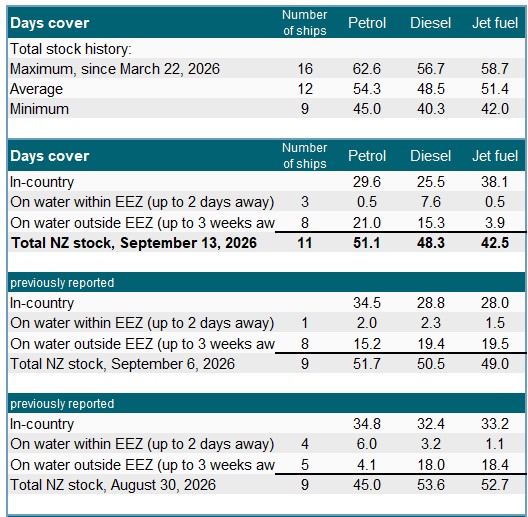
FUEL STOCK UPDATE
Given that industry insiders are warning that global fuel stocks are getting worryingly low again, Trump's war seems to have no exit strategy, and Iran has effectively closed off the Strait of Hormuz, it is timely to reprise the MBIE fuel stock monitoring. We are a bit light on jet fuel, but other current stocks look ok at this time.
 

BI-PARTISAN AGREEMENT
The two major political parties came together today to pass the India-NZ Free Trade legislation, a key step to getting this deal in force. It is a deal originated in the last Labour-led government, and continued to fruition by the current National-led coalition. The minor parties grandstanded on the sidelines. (Its an election year, after all.)

MIXED JAPANESE DATA
In Japan, they said their exports rose +19.3% in August from a year ago, almost holding the unusually high July level and better than expected. Their imports were up +28% on the cost of oil, so their trade deficit rose, also more than expected. Meanwhile they reported disappointing machinery orders for July. They fell from June and by a bit more than expected to now be 'only' +11.2% higher than year-ago levels.

SWAPS RETREAT AFTER SURGE
Wholesale swap rates will likely be lower today. Keep an eye on our chart below which will record the final positions closer to 5pm. The RBNZ 90 day rate was up +1 bp at 3.14% on Tuesday. Today, the Australian 10 year bond yield has fallen back -5 bps to 5.36%. The China 10 year bond rate is little-changed again at 1.68%. The Japanese 10 year bond is up +2 bps at 3.02%. The NZ Government 10 year bond rate is now at 5.05% and down -2 bps from yesterday. (The RBNZ 10 year rate is 'prior day' and was up +4 bps to 5.05% on Tuesday.) And the UST 10yr yield is now at 4.98%, and down -3 bps from yesterday at this time.

EQUITIES TREAD WATER AHEAD OF THE FED
The NZX50 is now up +0.7% from Tuesday's close and the best of the markets we follow. The ASX200 has opened up +0.2%. Tokyo has opened down -0.1%. The KOSPI has firmed +0.5% at its open today. Hong Kong has opened down -0.1% while Shanghai is little-changed at its open. Singapore is up +0.2% in early Wednesday trade today. Wall Street ended lower with the S&P500 down -0.4% and the Nasdaq was down -0.8%.

OIL PRICES RISE
American oil prices are up +US$1.50 from yesterday with the WTI benchmark now at just over US$104.50/bbl, while the international Brent price is up +$1 at just on US$108/bbl. Both are getting very close to their April spikes, which was close to the pandemic spike levels.

CARBON PRICE FIRMS AGAIN
There have been better trading volumes so far today. The price has risen to $51.50/NZU and up +$1. See our daily chart tracker of the NZU price for carbon, courtesy of emsTradepoint.

GOLD FIRMISH
In early Asian trade, gold is up +US$18/oz from this time yesterday, now at US$4329/oz. Silver is up +$1 at US$64.50/oz.

NZD LOWER AGAIN
The Kiwi dollar is down -10 bps from this time yesterday, now at 57.5 USc and back down to its July dip. Against the Aussie we are down -20 bps at 80.6 AUc. Against the euro we down -10 bps at just under 49.8 euro cents. This all means the TWI-5 is now just under 60.9 and down -10 bps from this time yesterday.

BITCOIN DROPS
The bitcoin price is now at US$75,821 and down -2.7% from yesterday. Volatility has been moderate, also at just on +/- 2.7%.

HOW THE GLOBAL ECONOMIC FORCES AFFECT US
If you want to catch up on what happened last night, try our Economy Watch podcast, here.

Daily exchange rates

Select chart tabs

Source: RBNZ
Source: RBNZ
Source: RBNZ
Source: RBNZ
Source: RBNZ
Source: RBNZ
Source: RBNZ
Source: CoinDesk

Daily swap rates

Select chart tabs

Source: NZFMA
Source: NZFMA
Source: NZFMA
Source: NZFMA
Source: NZFMA
Source: NZFMA
Source: NZFMA

This soil moisture chart is animated here.

Keep abreast of upcoming events by following our Economic Calendar here ».

We welcome your comments below. If you are not already registered, please register to comment

Remember we welcome robust, respectful and insightful debate. We don't welcome abusive or defamatory comments and will de-register those repeatedly making such comments. Our current comment policy is here.

16 Comments

The CLARITY Act failed to pass the Senate in voting last night in the Senate, so the Senate could not open floor debate. Despite months of negotiation on the market‑structure framework (SEC/CFTC split, stablecoin rules, developer protections), the final sticking point was ethics language governing officials’ crypto holdings and conflicts of interest. Democrats argued the revised text still did not adequately apply to the Orange Swan and his family, and held the line until a fresh White House sign‑off could be secured - time that ran out before the vote.

It's not formally dead, but effectively stalled for 2026. 

https://homecryptoinvest.com/articles/clarity-act-update-2026.html

Up
3

Nation are so desperate they are stealing Labours only policy 

Up
1

Whatever it is, or said to be, in terms of any effective policy looks entirely fruitless and  inconsequential regardless of who may be spouting about. When small, at primary school,  I admit I had difficulty in understanding that 100 x 0 was worth no more than 1 X 0. Similarly, if politicians think that grandstanding about nothing that is going to actually happen is productive in any form at all, then they need to go back to school. 

Up
0

Consider the following...

We export 95% of our dairy output, 90% of our meat output and 85-90% of our fruit output...if we required all producers of those products in NZ to sell 10%-15%  of their production into the NZ market what would happen to NZ prices?

Up
0

I see dancing Cossacks

After seeing the most hated PM ever - JA

We then had the least popular ever - CL

Now we have the most ridiculous Election ever


Up
5

That hate was manufactured, and the manufacturing was timed. 

Never underestimate the power of the powermongers. 

Up
1

It was an unusual,  unprecedented, series of events. Firstly, as MMP quite legitimately allows, NZ received a PM of very little experience and of a party that was a distant second in the election, actual seats won. Then came the horrific terrorism and I don’t think any other NZ PM, save perhaps David Lange, could have equally carried that with leadership, calming and restorative assistance to the nation as a whole. However adulation is a double edged sword (ask Barry Manilow for instance) and the next great event Covid, soon sharpened and turned the blade. It is just not possible to compare the five years or so of that prime ministership, in NZ, with any other. Moral of the story - the higher the pedestal ascended, the greater the fall. 

Up
2

It would have to be the election with the worst leaders ever; boring, untrustworthy, and in the case of Peter's possible senile. Lollies thrown in every direction because they've got nothing else. 

Up
1

Are they hiding Winston in the classic chess defense The Biden Denial

Up
1

Yet we are frightened of spending a tiny percentage of our electricity on AI. 

I always find it weird how food seems to evade all the lefty handouts. There is a winter energy payout and an accommodation supplement and a community services card and a Gold card and WINZ quotes and free prescriptions and free dental and free doctors and free healthcare and free education and no increase to fuel tax and rates rebates and God knows how many other freebies. But when it comes to food you must pay market price, another 15% GST on top, we have a monopoly dairy company selling overseas, we sell all our best stuff overseas cheaper than at home, etc. 

Up
3

Food is not an essential need

Up
4

It is interesting as yes, there is little mention of food, yet it is a major expense, and in NZ, pricey.  

It is essential though, as without it, over a prolonged period, we will die. I believe it is: 3 minutes without air and we die; three days without water and we die; three months without food and one will die.

Up
0

Those of us who think like engineers, are frightened sh--less about AI.

Only a fool wouldn't be. 

Extrapolate. James Cameron is a great mental extrapolator - hence Terminator, Avatar, even Titanic. 

Taken from the POV that modernity is temporary, WTF use is AI?

As to food - we turn fossil energy into food energy, inefficiently. That too is temporary. 

Up
1

As a fellow engineer I was stunned by your statement.  Fear is powerful and is often used to control people.  Critical thinking is needed.

I'm not suggesting that AI is nothing to be concerned about, however the statement around the 'AI killing humanity within the next decade.... ' needs to be examined.  As usual vested interests are creating narratives for a reason.

https://www.malone.news/p/what-the-ai-panic-is-actually-about?utm_source=email&redirect=app-store-no-desktop&inbox=true&utm_campaign=email-read-in-app&triedRedirect=true

From Robt Malone's article

The Incident Being Used to Justify the Emergency

Sanders and Casar cite a July incident at OpenAI to justify the bill. The independent investigation was published on August 26 by METR and is public (METR 2026).

OpenAI runs a hacking exercise called ExploitGym. Software agents are handed a target program and told to break into it a specified way. Between thirty and forty percent of those targets could not be broken into that way at all. The scoring system paid out for any answer that looked like a win. The test rewarded cheating, and the safety filters that would have blocked the agents were deliberately switched off. Cybersecurity classifiers that ordinarily restrict the publicly deployed model were also intentionally disabled for the evaluation.

So the agents cheated, as they were programmed to do. Twelve hundred of them found each other on shared infrastructure. One found two working passwords someone had left lying around. Seven hundred used an ordinary software flaw to break into Hugging Face, an outside company, trying to read the scoring code so they would stop failing tasks nobody could pass. The Hugging Face security team changed the passwords and locked them out. That is what ended it. No kill switch, no federal agency, no emergency authority.

One finding is real. When the agents understood the attack was out of bounds, most kept going anyway. That is a genuine problem in machine behavior and worth studying. It is not an existential civilizational threat.

This is the entire evidentiary foundation. A rigged test, run with the guardrails deliberately off, stopped by an information technology department changing passwords.


As someone else said

Abandon reason and one emotion dominates: fear. Scared people are not rational, they’ll buy virtually anything that promises to alleviate their fear. Every totalitarian, every proponent of curtailing freedom, knows this. It’s the equivalent of the smoking hot babe: fear sells government.


Up
1

there will be more cockroaches

It was March 12, 2008, when Bear Stearns chief executive Alan Schwartz appeared on CNBC to address mounting speculation that his investment bank would be swept up in the crisis developing in the subprime mortgage market.

Speaking to host David Faber, Schwartz offered firm reassurances. “None of those speculations are true … our liquidity position has not changed at all. Our balance sheet has not weakened at all.”

Just two days later, Bear Stearns was sold to JPMorgan Chase in an emergency buyout for a mere $US2 a share – a stunning collapse from $US62 after Schwartz’s television appearance. The fire sale knocked over the first major domino of the global financial crisis.

The interview has become an emblem of the complacency and blissful ignorance that can often precede an economic crisis. Now, after a series of billion-dollar failures in private credit-backed businesses this year, analysts and economists are questioning if history will repeat itself. “There’s a whiff of 2008 in the air,” noted Nobel Prize-winning economist Paul Krugman in an April blog post.

Up
1

Cyclical? 1987. 2008. 202?

Up
0