

Here are the key things you need to know before you leave work today (or if you work from home, before you shutdown your laptop).
MORTGAGE RATE CHANGES
Bak of China raise fixed rates today. All current mortgage rates are here. And note, you can compare mortgage offers with our unique calculator that takes into account other costs and cashback incentives, here.
TERM DEPOSIT/SAVINGS RATE CHANGES
BNZ raised its 1, 9 and 12 month TD rates today which took its one year TD rate to 4.05%, the highest of any bank at present (other than ICBC). Bank of China also raised TD rates. All updated term deposit rates less than 1 year are here, for 1-5 years, they are here.
FUEL IMPORTS MAKE US -$1.2 BLN WORSE OFF
Our July exports were up almost +14% above year ago levels and up +$881 mln, pushed up by strong rises for meat (+$251 mln), dairy (+117 mln), fruit (+$91 mln) and aluminium (+$59 mln). Plus there was a gratifying rise in many other products as well. But this was all overshadowed by what we had to pay for fuel (+$932 mln). That meant our imports rose +$1.187 bln from a year ago and up by +28%. The net result is a much worse trade balance for the month at -$1.949 bln, the largest in two years and far above the 2025 equivalent of -$762 mln. Trump's Iran adventure has put us in a net-worse trade position despite the rising export efforts.
MBIE TOUTS OPEN BANKING GROWTH AS PAYMENTS NZ PREPARES TO SHUT ITS API CENTRE
The Ministry of Business, Employment & Innovation says 408,000 transactions worth $130 million occurred using regulated open banking services in July, up from 294,000 transactions valued at $92 million in May. (The Reserve Bank says about $2 trillion of retail payments flow between NZ banks annually). MBIE says 14 organisations have been approved to carry the Consumer Data Right Accreditation Trust Mark so far. Meanwhile, Payments NZ says its API Centre will cease operating at the end of September, with responsibility for open banking standards management transferring to MBIE. Payments NZ says in July some 221,000 customers authorised one or more payments or data-sharing consents, with data requests topping 19 million for the first time.
WE ARE STILL BUYING, BUT FOR HOW MUCH LONGER?
Rabobank is tracking consumer tolerance for higher and higher beef mince prices. So far demand is holding but they warn consumers will likely change preferences at some point soon.
THE AVERAGE MISSES BOTH PERSPECTIVES
The RBNZ runs a GDP Now model and this week their update shows little change for the Q3-2026 result at just under +0.9% growth from Q2. For Q2-2026 they are still showing +0.1%. We should be thankful neither are negative. But for many city dwellers this is likely to feel negative. But if you are rural or in a South Island town tied strongly to the rural sector, things will look better to you.
BUSINESSES SEE INFLATION COOLING SLIGHTLY
Following earlier surveys in September of the professional financial types, and consumers, today the RBNZ released its survey results for the business community. This cohort sees 3.0% inflation one year ahead, down from 3.7% in the June quarter. They see wage growth at +2.8% one year ahead. And they see the jobless rate at 5.2% in a year, down from 5.5% in the prior quarter. These results will comfort the RBNZ.
SPENDING UP, BALANCES DOWN
Credit card billings were up +3.3% in July from a year ago, leaving the average of the 3.0% in the past three months in place, which is better than most of the period since 2023. But we are lowering our credit card debt. This fell -2.6% from a year ago.
NZX50 FLAT TODAY FOR A SMALL WEEKLY GAIN
As at 3pm, the overall NZX50 index was little-changed today, and up +0.83 for the past 5 trading sessions. It is up +3.7% from six months ago. From a year ago it is now up +5.5%. Market heavyweight F&P Healthcare is up +0.4% so far today. Stride, Heartland, Spark and PFI gain while Mercury, Turners, Summerset and Auckland Airport fall.
JAPAN GETS READY FOR ANOTHER RATE RISE
CPI inflation rise to 1.9% in Japan in July, their highest since December 2025. (Food prices were up +3.5%.) While the headline rate and the core rate both remain below the Bank of Japan's 2% inflation target, the rising trend may be enough for them to raise their 1% policy rate at their next review on September 18, 2026. They have other reasons to raise their policy rate (like, defending the yen, yielding to the US, needing to get back to 'normal' at some stage, etc.) so this may swing it.
JAPAN RISE CONFIRMED, CONTINUES IN AUGUST
Japanese business activity is expanding at its quickest rate for six months in August, according to the 'flash' PMI data released today. There were good gains for the factory sector, and these were bolstered by modest gains in their services sector. Of not was a steeper rise in new orders. Cost pressures continued to ease from June's recent record, but remained sharp overall, leading to another near-record increase in selling prices. Businesses are finding they can pass on the extra costs.
HOLDING A MODEST EXPANSION
According to the S&P Global 'flash' PMIs for August, growth in the Australian private sector is softer this month as the cost environment becomes more challenging in both the factory and services sectors. But both are still expanding. They are still getting rising new orders (in both sectors), but cost pressures have picked up in August. However the ability to pass those extra costs on retreated to its weakest of 2026.
SWAP RATES FIRM
Wholesale swap rates will likely be firmer today. Westpac suggested this week that swap rates have the potential to rise further, until early 2027. Keep an eye on our chart below which will record the final positions closer to 5pm. The 90 day bank bill rate was unchanged at 2.99% on Thursday. Today, the Australian 10 year bond yield has risen +4 bps to 5.03% from this time yesterday. The China 10 year bond rate is holding at 1.69%. The Japanese 10 year bond is now at 2.88% today and up +4 bps. The NZ Government 10 year bond rate is now at 4.75% and up +3 bps.. (The RBNZ data is now 'prior day' with the Thursday rate down -2 bps at 4.69%.) And the UST 10yr yield is now at 4.70%, and back up +7 bps from this time yesterday on the market panning of the US Treasury buy-back plan.
EQUITIES MIXED
The NZX50 is again little-changed from Thursday's close. The ASX200 has opened down -0.3%. Tokyo has also opened down -0.3%. The KOSPI has recovered another +0.9% today. Hong Kong has opened up +0.7% but Shanghai is only up +0.1% at its open. Singapore is also up just +0.1% in early Friday trade today. Wall Street ended its Thursday session with the S&P500 down -0.9% and the Nasdaq composite was down -1.0%.
OIL PRICES RISE
American oil prices are up +US$2 from this time yesterday with the WTI benchmark is now just over US$86.50/bbl and a one month high, while the international Brent price is still just under US$93.50/bbl and up +US$1.50.
CARBON PRICE HOLDS
We see very few trades again today but the price has held at $53.50/NZU. See our daily chart tracker of the NZU price for carbon, courtesy of emsTradepoint.
GOLD UP AGAIN
In early Asian trade, gold is up +US$45/oz from yesterday, now at US$4534/oz. Silver is up +50 USc to US$69/oz.
NZD FIRM
The Kiwi dollar is up +20 bps against the USD from this time yesterday, now just on 59.7 USc. Against the Aussie we are unchanged at 83.6 AUc. Against the euro we are also unchanged at 51 euro cents. This all means the TWI-5 is now just under 63.2 and up +20 bps.
BITCOIN JUMPS AGAIN
The bitcoin price is now at US$74,480 and up another elevated +7.7% from yesterday. Volatility has been very high at just on +/- 4.8%. Trump is making moves to benefit the industry (and himself). And getting this industry's leaders to fund crypto-friendly GOP candidates in the upcoming elections.
Daily exchange rates
Select chart tabs
Daily swap rates
Select chart tabs
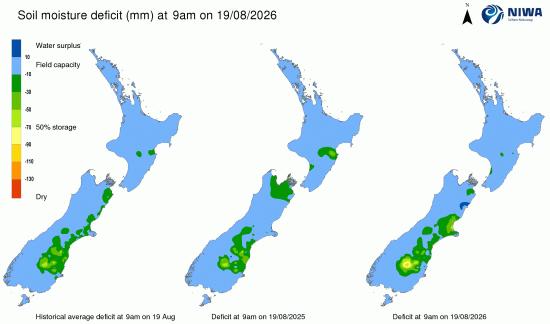
This soil moisture chart is animated here.
Keep abreast of upcoming events by following our Economic Calendar here ».
23 Comments
Walmart fell over -9% in its biggest daily drop since 2022 after reporting weaker than expected earnings on a slowdown in consumer spending. The stock erased -$80 billion in market cap.
The company told investors it will use the $2.9 billion it received in tariff refunds to invest in “price investments,” or price cuts, for consumers to help spur spending.
Lower-end consumers are getting squeezed while the higher-end consumer keeps spending. Walmart has to pivot to higher income shoppers to maintain / drive growth. But this is also odd: higher income people are going to Walmart.
https://edition.cnn.com/2026/08/20/business/walmart-tariff-refund?Date=…
Why is it odd that higher income earners are shopping at Wallmart? Doesn't everyone appreciate a sharp price?
My understanding about wealth accumulation is wisely shepherding one's finances to create surplus for investment.
Grandiose displays of wealth are more about ego and status perception, I reckon.
Essentially the Walmart brand is targeted at the battlers. It doesn't surprise me that higher income shoppers go there, but it's traditionally not their target shopper. Similarly, Aldi is not targeted at higher income shoppers, but more higher income shoppers are going there. Higher income h'holds across the Anglosphere are also living paycheck to paycheck. They may have the means to buy higher AOV (average order value) than lower-income shoppers.
"Essentially the Walmart brand is targeted at the battlers"
Ironic how the Walmart model of importing cheap junk (copied by Stephen Tindall) destroyed so many small businesses and jobs, creating the battler problem in the first place. Got to love capitalism and the short termist herd mentality it generates.
Was it really targeted at lower income people. Methinks it was targeted at anybody they could get in the door.
Which is good strategy.
These box stores insult their customers and still the training of plebs achieved by saturation media dittys pulls them back. Security at the door. Cameras every aisle. Bag searches Staff with no clue what they're actually selling.......... These businesses expanded the underclass and now they need to function like a prison to operate.
Anybody they could get in the door and more. Thus volume, turnover is the driver and that in turn requires pricing to average out requisitely lower than any competitors running out, in general, the same product lines . Doesn’t always succeed. A while back there was a venture into fresh produce but the customer base didn’t respond. Perishables are a different ball game entirely except of course, the off shoot Sam’s Club retails quite strongly in this sector.
Walmart has historically been especially oriented toward lower- and middle-income households, principally through everyday-low-price positioning, broad grocery and essentials assortment, and locations serving rural, suburban, and price-sensitive communities.
There's a trade off between price and quality though isn't there? Personally I have zero interest in status but haven't been inside a Warehouse for 30 years.
The investment should be in a quality product that lasts, not a "sharp priced" piece of junk that travels from overseas manufacturer, to shed, to consumers, to landfill in a life cycle measured in months.
You have to wonder how different life would be if local shops could still sell stuff. I'd love to be able to walk down to pretty much anything instead of driving everywhere. And imagine if starting a small resale business was still a decent option to people needing work.
You can blame capitalism, but the motorcar has to take the bulk of the blame. Why go to the local shop and pay 10% more when you can jump in the car and drive across town to the larger retailer for almost free.
Quality of goods. Often it's the same stuff, cheap or expensive.
Price can be just about the presentation and premises.
Looking what is available at Wallmart in the USA:
10 x 42 binoculars range from $34 to $4,000. 205/55 r19 tyres range from $70 budget to $274 pirelli. That's hardly comparable with the Warehouse.
You're onto it Jimbo. The private ICE motor vehicle has externalised so much of it's crap onto society including replacing community with asphalt parking lots. People are basicaly lazy. They whine if they can't drive to the door of their favourite generic tilt slab ware house.
I remember when we still had our nursery business, the odd customer would come in and ask advice, then openly say they're off down the Warehouse to purchase the recommended product. A good percentage of the public are just plain stupid. I knew our prices were basically the same or less than the boxes, but they were happy to drive an extra 5, or 10 km and time to find out. "everyone gets a bargin" Either way, we still lost the sale.
Palm tree, we could share a few tales. I was a wholesaler in the trade. One GC had a customer bring their Warehouse purchased pot plants in and ask for them to be re-potted!
This is an interesting discussion, and one I think about often.
A question I ask people: how many electric kettles, scissors, DVD players, cheap pliers, shoes etc. have you bought in the last 20 years? I my case I have gone through about 7 kettles, and a many pairs of crap pliers. Meanwhile I still have the pliers and tools I used as an apprentice, and mum's kettle, well it lasted well beyond ten years, while the other day I sharpened my scissors made in the 70s, and reflected on the 10 or so pairs I have thrown away because they broke.
On an economic perspective though, it keeps China going, but at what cost to the West! Certainly in the UK, 4 million manufacturing jobs lost since 1980, communities wrecked, never to recover and so become heavily reliant upon the state, which results in vast benefit bills, one wonders - what price 'free trade'.
When China entered the WTO in 2000, its carbon emissions totalled 4, gigatonnes annualy. By 2020 this had risen to 12 gigtonnes. Those of the US have been stable since 2000, same for Europe, while India's have risen from 1 gigatonne to 4 gigatonnes.
So, cheap tat from China, and the price - well alongside bloated welfare budgets, one could argue the price is a rush to cut emissions (arguably driven higher by Chinese manufacturing post 2000), which in the UK is proving very expensive (about £100bn a year), although ironically China is winning again - the only EV's that the masses can afford are.....made in China, using coal fired power of course. Meanwhile UK car manufacturing is in steep decline.
Some years ago I met a chap who had worked in the UK assembling TVs. He was laid off post 2000 and became unemployed. Years later I met up with him: he secured a job, at a warehouse, on the site where he used to assemble TVs. He joked - I now work stacking TV,s, made in China. I get paid less than when I assembled them, so claim numerous benefits, but hey, we all get cheaper TV's.
Time to work on the car, using those 1970s tools.
Thanks. Inciteful.
The bitcoin price is now at US$74,480 and up another elevated +7.7% from yesterday. Volatility has been very high at just on +/- 4.8%. Trump is making moves to benefit the industry (and himself).
Read some details about Aaron MacDonald's Futureverse collapse - MacDonald was claiming a USD1 billion+ valuation in 2023. Seems he got carried away with the promise of the metaverse.
And it's wild that Callaghan Innovation had supported Futureverse with “grants co-funding” (also Easy Crypto, which has now been sold to Swytx). I don't think the taxpayer should be funding frivolous stuff like this.
https://www.callaghaninnovation.govt.nz/stories/first-companies-named-i…
They got some hits though.
See Rocket Lab and Pushpay on the list.
And those apples in a tube company
The propaganda surrounding Rockit is dialled up to 11. Why are the growers going under? What Asian consumer wants to pay a premium for apples in a plastic tube when the shopping culture doesn't really want that?
I could never understand the Rockit economic model. But there again I'm still scarred by the great Applefields con job.
South African apples are doing surprisingly well in Asia with zero branding. Competing on their taste and price.
Pretty sure most Asian countries have country of origin labelling? Remember when the industry players strongly opposed that in NZ LoL. They didn't want you to know where that floury apple was from
FUEL IMPORTS MAKE US -$1.2 BLN WORSE OFF
Who up for election is taking notice?
IMO Free public transport becomes an urgent necessity.
A summary of PT policies from ChatGPT:
Parties supporting free public transport:
- Green Party — Yes. The Greens support making public transport free for users. In March 2026 they specifically proposed free public transport as an immediate cost-of-living measure, and their broader transport platform supports making public transport more affordable and accessible. GGreen Party of Aotearoa New Zealand+1
- Labour Party — Partly. Labour's 2026 policy isn't universal free transport: it proposes a $20 weekly cap in Auckland, Wellington and Christchurch and $10 elsewhere. Once you've reached the cap, further travel that week is free. LLabour Party
- New Zealand First — Targeted free transport. NZ First established and supports free off-peak public transport for SuperGold Card holders, but it is not proposing free public transport for everyone. Its current leadership is explicitly critical of Labour's fare-cap proposal. NNew Zealand First+1
- The Opportunity Party (TOP) — There is evidence of free public transport being a local policy priority, particularly in its Dunedin campaign, but I wouldn't characterise that as a confirmed nationwide 2026 party policy without a clearer national manifesto. CCritic - Te Ārohi
Parties that don't appear to support free public transport
National and ACT oppose Labour's cheaper/free-after-the-cap approach rather than advocating universal free fares. ACT has specifically criticised Labour's public-transport fare caps as another costly "free" promise. AACT New Zealand+1
We welcome your comments below. If you are not already registered, please register to comment
Remember we welcome robust, respectful and insightful debate. We don't welcome abusive or defamatory comments and will de-register those repeatedly making such comments. Our current comment policy is here.