

Here are the key things you need to know before you leave work today (or if you work from home, before you shutdown your laptop).
MORTGAGE RATE CHANGES
SBS Bank followed up last week's other rate rises with a tweak up of its FHB First Home Combo rate today. First CU raised all its home loan rates. All current mortgage rates are here. And note, you can compare mortgage offers with our unique calculator that takes into account other costs and cashback incentives, here.
TERM DEPOSIT/SAVINGS RATE CHANGES
Kiwibank upped its one year TD rate to 4%, matching BNZ and the Cooperative Bank (and just below Rabobank). First CU also raised some TD rates. All updated term deposit rates less than 1 year are here, for 1-5 years, they are here.
A GROWTH SECTOR
Overseas student numbers are at their highest level in at least 10 years. The MBE data this is based on doesn't go back earlier than 2016. These numbers of fee paying overseas students plus children of overseas workers attending local schools are up almost +10% from a year ago.
LITTLE FOOD INFLATION
Food prices rose +1.9% in July from a year ago, a much lower increase than the June +2.5% increase, and the expected +2.4% rise. (Interestingly, this is the same result that Infometrics reported for Foodstuffs grocery costs from its suppliers.) Stats NZ said grocery food was up just +1.6% from a year ago.
RENT RISES RARE, RENT FALLS MORE LIKELY
Rising even less were rents. In fact they fell -0.6% in July from June on a 'flow' basis (new transactions) to be just +0.8% higher than year-ago levels. On a 'stock' basis (which includes renters who didn't change properties), the rise from a year ago was just +0.1% and hardly measurable.
FUEL CHANGES VOLATILE
July fuel price changes were all negative from June. For petrol, they were down -5.7% from June, for diesel down -12.1%. Electricity prices even fell in July from June, although only by -0.1%. However that leaves all of these still sharply higher than year-ago levels (petrol up +15.1%, diesel +34.9% and electricity up +9.1%).
A LOW BAR
The latest retail data for July has retailers excited, seeing it as a "welcome bright spot". Typically July is the weakest retail month in the year, but not this year - that wooden spoon goes to June. July came in +1.3% higher than June (a +$90 mln boost), and the 'core retail' subsector was up +2.2% on the same basis. Hospo, durables and apparel all came in better than these overall averages. From a year ago, core retail was up +3.5%, overall retail was up +3.4%, and all electronic transactions were up +3.3%. Of course we need to see these 'gains' in the context of a June CPI up 4.1%. So retailers are allowed to get a bit excited but the core fact is that spending isn't keeping up with inflation, so it is a 'real' backslide.
SUSTAINABLE?
The BNZ/BusinessNZ services PMI report expanded again in July - just. And that is only because season adjustment gave it a boost. The 'actual' reading was negative again and has been every month since January. It's indications contrast with the factory PMIs which are aided by the strong rural sector. But the services sector s.a. growth might be a bit of a phantom - it is positive only because of stock building. New order flows, and employment, are both still weak. More here.
NZX50 RETREATS
As at 3pm, the overall NZX50 index was down -0.5% today and down -0.8% for the past 5 trading sessions. It is up +5.8% from six months ago. From a year ago it is now up +6.3%. Market heavyweight F&P Healthcare is down -0.4% so far today. Gentrack, Mercury, Skellerup and Turners rose, while a2 Milk, Freightways, Summerset and Air NZ retreat.
a2 MILK IN PROFIT STUMBLE
There will be a surge in NZX50 companies reporting over the next two weeks. The first is a2 Milk who reported revenue up +12.4%, but tax paid profit from continuing operations down -5.8%. In addition they were hit by costs of discontinued operations and when that is included, profits dropped by almost half. The ATM share price has fallen -3.7% so far today. About 55% of shareholders are retail, 45% institutional (with no one institution owning more than 7%. a2 Milk may tout its New Zealand supply base but it is run by Australians out of Australia.
APPROVED
The Commerce Commission has granted clearance for Japanese-owned ANZCO Foods to acquire 100% of the shares in locally-owned fellow NI meat processor Greenlea Group.
A TURN UP
In an unexpected positive turn, wool prices turned up last week, called "a major reversal of the sharp downward spiral evident across recent sales". Renewed competition has emerged driving broad-based gains across the strong wool offering.
BOOMING EXPORTS
In Singapore, they reported very strong July export growth, up +24% from a year ago to a new all-time monthly July record of S$76 bln but not quite eclipsing their June levels. This is all based on the export of electronic equipment. Their big export destinations are the US, South Korea, Thailand, Taiwan and India. This exporting strength enabled them to post a very large trade surplus in July.
UNEXPECTED SOFTNESS
Japan reported a softer economic activity expansion in Q2-2026 than expected. Analysts had expected their GDP to grow by +2% and up from +1.9% in Q1. But the data released today only shows a +1.1% expansion. But today's data is preliminary and may well be revised higher.
SWAP RATES UP SLIGHTLY
Wholesale swap rates will likely be firmer in a steepening crate curve today. Keep an eye on our chart below which will record the final positions closer to 5pm. The 90 day bank bill rate was down -1 bp at 2.95% on Friday. Today, the Australian 10 year bond yield has risen +5 bps to 5.03% from this morning's open. The China 10 year bond rate is down -1 bp at 1.68%. The Japanese 10 year bond is now at 2.93% today and up +5 bps and a new 30+ year high. The NZ Government 10 year bond rate is now at 4.75% and up +4 bps.. (The RBNZ data is now 'prior day' with the Friday rate up +3 bps at 4.68%.) And the UST 10yr yield is also now at 4.68%, down 2 bps from this morning.
EQUITIES MIXED
The NZX50 is now down -0.6% from Friday's close. The ASX200 has opened down -0.4%. Tokyo has opened little-changed. Hong Kong has opened up +1.6% and Shanghai is up +0.6% at its open. Singapore is down -0.9% however in early Monday trade today. Wall Street is shaping on the futures market to open firmer with the S&P500 futures up +0.3% and the Nasdaq futures up +0.6%.
OIL PRICES HOLD HIGHISH
American oil prices are unchanged from this morning with the WTI benchmark is now just under US$82.50/bbl, while the international Brent price is just under US$89/bbl and up +50 USc.
CARBON PRICE STALLED
We can't find any trades today, so the price has held at $54/NZU. See our daily chart tracker of the NZU price for carbon, courtesy of emsTradepoint.
GOLD FIRMISH
In early Asian trade, gold is up +US$18/oz from this morning, now at US$4394/oz. Silver is up +US1 at just under US$65.50/oz.
NZD FIRMER
The Kiwi dollar is up +10 bps against the USD from this morning's open, now just on 59 USc. Against the Aussie we are up +10 to just under 83.3 AUc. Against the euro we are also up +10 bps at 51 euro cents. This all means the TWI-5 is now just over 62.6 and up +10 bps.
BITCOIN UP SLIGHTLY
The bitcoin price is now at US$63,346 and up +0.4% from this morning. Volatility has been low at just under +/- 0.6%.
Daily exchange rates
Select chart tabs
Daily swap rates
Select chart tabs
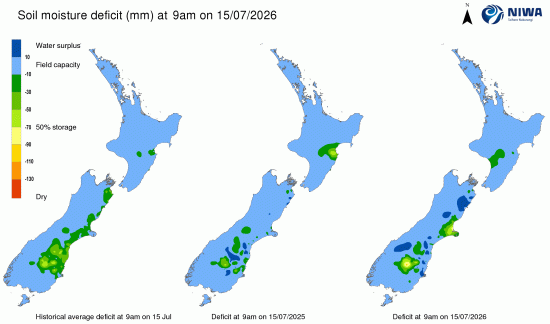
This soil moisture chart is animated here.
Keep abreast of upcoming events by following our Economic Calendar here ».
33 Comments
Still not seeing high fuel prices causing increased food prices. Surely it should have flowed through by now if it was going to?
No. You've been told. Multiple times.
We are watching not just the biggest collection of infrastructure-trashing; we're watching the biggest demand-destruction the planet has probably ever seen. Everything, everywhere, all at once.
The Central Banks must be sh---ing themselves. Back in 2008, I though oil could go to $200/barrel. Not much later, a small cohort globally, of which I am a humble member, realised that it was impossible. Well before that society cannot 'afford' itself. And that is what is happening - have you any idea the increase in the numbers of starving humans, this last few months? Those who cannot afford to get to a doctor, or fill their fuel tanks?
Do you have evidence that food demand in NZ has decreased, or is that an assumption?
Tell us more about "...a small cohort globally, of which I am a humble member", that might explain a few things.
A Trump appointee has approved Trump’s personal crypto firm to operate as a bank. Corporations can conduct transactions in which the Trump family gets a cut.
The public will not have to be informed.
There’s no precedent for this.
World Liberty Financial, the Trump family’s flagship crypto venture, said on Friday that its trust company has received preliminary conditional approval from the Office of the Comptroller of the Currency to become a bank.
https://www.wsj.com/finance/trump-familys-world-liberty-financial-gets-…
Hey why not
The increasing number of youtube suggestions i seem to keep getting presented by the algorithm, is of Americans in NZ talking about why move to NZ and what it is like, to help other americans. Also Americans who have moved to other european countries etc. Seems more and more are bailing on ye ole faithful USA, however the algorithm does slant so fully aware of this fact.
How much of the Singapore growth is generated by transhipping Chinese product to the USA as part of Trump's claimed tariff evasion?
They don't make something out of nothing.
Nor are they self-sufficient in anything.
So there has to have been growth in imports, much of it from finite resource stocks. Both for the making of the exported stuff, and as internally consumed stuff. And their only 'landfill' is offshore; you couldn't make this stuff up.
But as per usual, we only get the record exports - cherry-picking and problem-avoiding, I call that.
Masters at washing Indo and Chinese lucre. Meat relabelled as 'NZ' and shipped around Asia. Water buffalo as NZ sirloin is a SE Asian delicacy.
https://www.businesstimes.com.sg/international/global/singapore-may-be-…
https://themonitor.sg/2017/12/12/beware-new-zealand-not-so-fresh/
The Reserve Bank of Australia’s economists are privately worried that ballooning state debts could constrain governments’ ability to respond to future economic shocks and make the banking and superannuation systems vulnerable to a sudden sell-off in state bonds.
State and territory debt has ballooned since the COVID-19 pandemic as premiers ramped up infrastructure spending, expanded the public sector and rolled out cost-of-living handouts.
Economic shocks aren't the problem.
Physical shocks are.
And they're compounding.
The Reserve Bank of Australia’s economists are privately worried that ballooning state debts could constrain governments’ ability to respond to future economic shocks and make the banking and superannuation systems vulnerable to a sudden sell-off in state bonds.
State govts are more financially constrained that central govts. It doesn't get enough air but the state govts, particularly NSW, Victoria and Queensland, are reliant on the Ponzi. Across states and territories, stamp duty is forecast to average about 15% of own-source revenue in FY2026–27. The share is about 17% in Victoria, 16% in NSW, 15% in Queensland and Tasmania, versus roughly 7% in the ACT and Northern Territory.
https://www.ey.com/en_au/insights/economics/ey-australia-state-budget-m…
Similar to NZ in that their councils, and I assume state govts, got a bit too addicted to the ever growing revenue coming in during their housing boom, and are struggling to wean themselves off of it and dial back the public spending habits.
In NZ The banks denied housing market would fall in 2021, meanwhile in Aussie the banks are trying to outdo themselves about how far the aussie housing market is going to fall....
Japan...."data released today only shows a +1.1% expansion"
and "Japan
's population stands at approximately 122.4 million
, having
dropped by over 3 million people in a five-year span
."
and "30% of citizens aged 65 or older"
Seems even a rapidly declining/aging population can't degrow elsewhere?
Pity our own gormless politicians can't organise higher/capita wealth and healthier environment instead of pursuing mass migration, declining per capita wealth and trashing the landscape?
They build crap loads of stuff, work long hours, yet have a worse GDP per capita than us. That's what a declining population does.
New Zealand and Japan have relatively comparable nominal GDP per capita figures—hovering roughly
between $46,000 and $55,000 USD
depending on the specific nominal or purchasing power parity (PPP) metrics used—with New Zealand frequently ranking slightly higher in per capita terms, despite Japan possessing a vastly larger overall national economy
Japan
ranks as the world's third-largest shipbuilding nation
, anchored by major firms like Imabari Shipbuilding
and Japan Marine United Corporation
. The industry focuses on high-tech commercial carriers, alternative-fuel vessels, and naval defense ships while investing billions to expand global output
we build aluminium sport fishing boats in the 6-8m range and sell them via ITM fishing show on the back of house sales... to traddies
Sums it all up
And I still hear people say they want their kids to train in the trades as thats where the money is. I wonder if Japanese parents have the same aspirations.
They build crap loads of stuff, work long hours, yet have a worse GDP per capita than us. That's what a declining population does.
That's a bit naive. The Japanese economy is massively productive across industrial sectors. Ours is far more based around debt-driven consumption. Japan is not reliant on a housing Ponzi to maintain levels of consumption.
Japan has an infrastructure surplus; we have a deficit.
Richard Werner recently said that Japan would still be competitive if the exchange rate improved from JPYUSD160 to JPYUSD80. Could you say the same about Aotearoa?
Agree. My point is that if Japan's economy hasn't performed that well with a declining population (in terms of GDP per capita), imagine how our economy will perform.
I have friends in Japan. I earn way more than them doing a similar type of job with much cruiser hours. I also have significantly more wealth thanks to my house. None of that is a result of the NZ economy being more productive, it is because of a population pyramid. Without that we don't have much going on.
GDP isn't a valid measure.
As you, perhaps unwittingly, have just pointed out.
Why then, use it?
Japan was well aware that an island nation cannot do global-scale activity, they therefore imported resources and even went to war to get access to same. But they went through the housing bubble, 35 years ago. They are very lucky indeed to be reducing their population because:
Drumroll
The real wealth is per-head access to energy and resources. Some would argue that more people equals more powerful armies thus ownership of said resources - but that is ultimately an own-goal and anyway, doesn't look like big is doing so well, currently... Although make no mistake about it; we are in a fight-to-the-death over what's left.
Are you not old enough to remember the Japanese property, um "bubble" seems like an understatement? The land of the multi generational mortgage? The Japanese economy has been moribund ever since.
"That's what declining population does"?
Well they certainly have an army of suits marching around the streets. Whether they actually produce anything, or just clip the ticket is the question?
Ironically a declining population amplifies any growth in GDP rapidly per capita. Whereas NZ growing population below GDP amplifies impoverishment.
Electricity up 9% yoy? But ministor of energy Brown keeps telling us that electricity prices have dropped since they announced they were persuing a government funded LNG import terminal?
Since the Government announced the LNG facility in February, Brown said wholesale electricity prices for 2028 and 2029 have fallen by around $20/MWh. According to Brown, these price drops represent potential annual savings of up to $800 million.
https://www.interest.co.nz/public-policy/138889/responsibility-keeping-…
yes yes all to do with the LNG terminal, nothing to do with record levels of wind solar and geothermal investment, thermal firming contracts, unusually high hydro levels, or the forecast El Nino that will keep southern hydro lakes full.
Officials should not have withheld a key document behind the government's decision to proceed with a "divisive" LNG terminal, the chief ombudsman has ruled.
The latest version includes a summary slide, labelled 'Key insights', which concluded that access to LNG "shouldn't materially affect average electricity prices".
LNG access "should" reduce prices in the most extreme dry years, the document said.
However, that was only if renewables did not keep up with demand growth, there was further decline in domestic gas supplies - beyond what was projected - or there was a "black swan" event where all of the coal-burning units at Huntly Power Station were out of action.
The Electricity Authority - among others - has attributed the fall in prices to a glut of renewables coming online, with more planned for the near future.
https://www.rnz.co.nz/news/politics/999625/lng-document-should-not-have…
What country would we be buying the LNG from?
aussie has plenty
or we could cut out the liquefaction part and develop our own fields.
"Both Sunda and EnZed are targeting areas with extensive subsurface data and known gas discoveries in the Taranaki Basin off the west coast of the North Island, the country's only producing offshore basin.
"We think it's an interesting discovery and we'd like to work with it," Sunda CEO Andy Butler said.
The country is attractive to smaller explorers at a time when gas policy in neighbouring Australia has sown consternation and confusion in the industry.
"I think probably Australia's domestic gas mess means that capital allocators are looking at New Zealand as a potential alternative," EnZed founder Neil Young told Reuters."
https://www.reuters.com/legal/litigation/new-zealand-gas-exploration-in…
Aussies are short of gas, they can't even afford to buy their own gas it all goes offshore. Good luck securing some of that in a world without Qatar.
They contracted decades worth to China and are now regretting it.
Wholesale prices can drop all they want but if line charges continue to increase (as they are) it amounts to nothing.
And on lines charges.....
How come retailers (gentailers) can use lines charges as a profit line?
Aren't lines charges to maintain the lines network to service the regions they provide the infrastructure? Retailers collect and pass on to the relevant lines company? And it is a daily charge, not transmission hwh based.
Then how come from the same company, there can be a significantly different daily charge between plans? Profit extraction is acceptable? Weren't the banks made to structure fees on actual cost of processing transactions rather than taking a figure out of the air that included a hefty profit margin?
Sam should apply to lines daily charge on electricity bills.
We welcome your comments below. If you are not already registered, please register to comment
Remember we welcome robust, respectful and insightful debate. We don't welcome abusive or defamatory comments and will de-register those repeatedly making such comments. Our current comment policy is here.