

Here are the key things you need to know before you leave work today (or if you work from home, before you shutdown your laptop).
MORTGAGE RATE CHANGES
BNZ announced increases for all its fixed rates to 4 years. Liberty Financial raised their too. Unity Money's floating rate rise became effective today. The Cooperative Bank raised many fixed rates as well. All current mortgage rates are here. And note, you can compare mortgage offers with our unique calculator that takes into account other costs and cashback incentives, here.
TERM DEPOSIT/SAVINGS RATE CHANGES
The Cooperative Bank raised some TD rates. All updated term deposit rates less than 1 year are here, for 1-5 years, they are here.
JOBLESS RATE RISES, BUT WITH MORE CONTEXT
The unemployment rate hit 5.6% in the June quarter, the highest in over a decade. The rates for those under 25 remain very high as young people continue to struggle to find work. But we should also note a couple of context things. First, labour market data is a lagging indicator and not a leading indicator. Secondly, unusually high & rising participation and hours worked both suggests there may be issues with the Q2 data. And thirdly, away from the headline seasonally adjusted data, the actual data isn't as bad and isn't showing deterioration. True, it isn't showing progress either, it's just not getting worse as the headline jobless rate suggests. And lastly, our 'actual' jobless rate of 5.4% is substantially higher than the Australian 4.4%. We are on the back foot in this comparison, and have been for the past two-plus years.
DAIRY PRICES HOLD
There was another full dairy auction earlier this morning and prices in USD were virtually unchanged overall (+0.1%), but they did dip in NZD by -0.9% on the higher currency. Of note is the new season volumes offered, very similar to the same event a year ago. But prices are now a full -10% lower this year than then.
LOWER WITH HEADWINDS
The ANZ World Commodity Price Index fell -3.9% in July from June. This is the largest monthly fall since November 2022. Despite this, the overall index is still up +0.5% from a year ago. The NZD Commodity Price Index fell by a similar amount, down -4.0% for the month. ANZ is warning that a rising NZD might present a stronger headwind in August.
NEW LENDING FLAT, EXCEPT TO DAIRY FARMS
New lending in June was flat overall, with little to note for residential property, commercial property or even other business lending. But there was a huge unusual spike in new rural lending (+$1.0 bln from June a year ago) and almost all of that (+$981 mln) was for dairy farming. The RBNZ says "These increases are likely related to the traditional stock moving day at the start of June." But this is a material shift higher. May+June this year for dairy farm lending is +38% higher than the same two months in 2025, and +110% from the same period in 2024. You have to think it is more than just 'moving day'. Besides, wasn't the unusual April dairy capital payout meant to be used to pay down bank debt?
NZX50 FLAT
As at 3pm, the overall NZX50 index was up +0.1% today after losing some early momentum, and down -0.4% for the past 5 trading sessions. It is up +3.6% from six months ago. From a year ago it is now up +8.1%. Market heavyweight F&P Healthcare is up a minor +0.2% so far today. There are 37 gainers, matched by 37 decliners today. The gainers are led by Summerset, Freightways, Fletcher and Mainfreight. The largest decliners have been The Warehouse, Meridian, Scales, and Briscoes.
BUMPS AHEAD
Our note yesterday that electricity prices have been working normally recently has been called out as premature. And it may have been. Today, prices are tracking similarly to the recent past and in a low band. But Transpower has issued a warning to expect outsized volatility as the current storm works its way up the country. Also, see this.
H5 BIRD FLU UPDATE
After Australia recorded its 'large' mass deaths (80) in South Australia yesterday, the local MPI monitoring is still only two confirmed H5 deaths here. Report any suspicious sightings.
SHARP SLOWING OF MOMENTUM
The private S&P Global (RatingDog) services PMI for China fell back sharply. It is still expanding, but now only just. Total activity and new business both expand more slowly. Employment rose for third month running, the longest sequence since the second half of 2024. And they recorded the weakest rise in average input prices since January. Yes, this survey is better than the contracting official version, but the fall-away was faster in this report.
MORE JULY PMI UPDATES
Singapore's PMI rose faster and near its best-ever, but largely because firms there built stocks to retain resilience. Japan's services PMI expanded at a slower pace in July as cost pressures remain intense there.
NOT FOOLING ANYONE
The US Treasury has managed to take the top off the Japanese yen devaluation track, but it seems only temporarily. The falling yen has made the Americans uncomfortable because it undermines their tariff policy - which likely caused the yen to fall in the first place. It seems likely that the US alone had to intervene to 'fix' the latest perception problem. Japan did earlier in the May and July, but not this time. Bessent may have wasted some serious public money. The yen is falling again today vs the USD.
SWAP RATES RETREAT
Wholesale swap rates may be noticeably lower today, especially for longer durations. Keep an eye on our chart below which will record the final positions closer to 5pm. The 90 day bank bill rate was down -1 bp at 2.94% on Tuesday. Today, the Australian 10 year bond yield is down -6 bps from yesterday at 4.91%. The China 10 year bond rate is down -1 bp at 1.70%. The Japanese 10 year bond is up +3 bps at 2.83% today. The NZ Government 10 year bond rate is now at 4.70%, and down -5 bps from yesterday. (The RBNZ data is now 'prior day' with the Tuesday rate down -1 bp at 4.73%.) The UST 10yr yield is down a sharp -9 bps, now at 4.60%.
EQUITIES VERY MIXED
The local equity market is now up only +0.1%. Meanwhile, the ASX200 is up +0.5%. Tokyo however has opened recovering a sharp +3.0%. Hong Kong is unchanged but Shanghai is up +0.9% at its open today. Singapore is down -0.5% at its open. South Korea is has recovered +3.4% today so far. Wall Street ended its Tuesday trade with the S&P500 up +1.8% and the Nasdaq up +2.6%.
OIL PRICES FALL SHARPLY
American oil prices have fallen a sharp -US$6.50 from yesterday with the WTI benchmark is now just on US$74.50/bbl, while the international Brent price is just over US$78.50/bbl and down -US$6.
CARBON PRICE HOLDS
There have been very few trades so far today and the price has held at $55/NZU. See our daily chart tracker of the NZU price for carbon, courtesy of emsTradepoint.
GOLD MOVES UP
In early Asian trade, gold is up +US$70/oz from this time yesterday, now at US$4129/oz. Silver is now just on US$60.50/oz and up +US$2 from the same time.
NZD HOLDS
The Kiwi dollar is up +10 bps against the USD from yesterday, now at just on 58.8 USc. Against the Aussie we are down -30 bps at 83.4 AUc. Against the euro we are also down -10 bps at 50.9 euro cents. This all means the TWI-5 is now just over 62.4 and unchanged.
BITCOIN FIRMS AGAIN
The bitcoin price is now at US$64,321 and up +0.9% from this time yesterday. Volatility has been low at just on +/- 0.8%.
Daily exchange rates
Select chart tabs
Daily swap rates
Select chart tabs
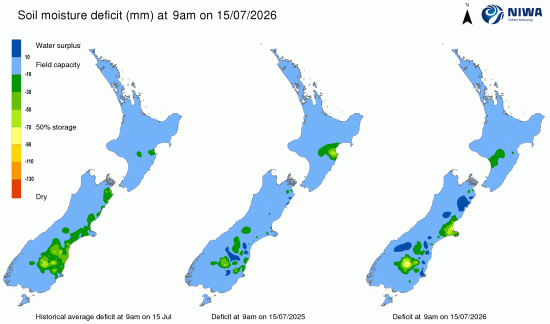
This soil moisture chart is animated here.
Keep abreast of upcoming events by following our Economic Calendar here ».
23 Comments
"Yet this increase in the number of unemployed to 171,000 people, including 94,500 young people and 69,300 who have been unemployed for more than six months, happened during a year when 111,000 new temporary work visas were issued to workers from overseas. It has also happened just before the Reserve Bank decided the labour market was so tight it was creating an inflation problem that needed higher interest rates to create more unemployment to fix."
https://thekaka.substack.com/p/unemployment-worse-than-forecast
It seems to be a continual mind numbing conundrum. NZ requires to import workers to fulfil service and industry functions yet simultaneously has an ever increasing number of citizens who are not working. Appreciate that as an across the board situation the two elements will never exactly dovetail but at the same time is there not a nagging question, in terms of the latter, that identifies those who cannot work as opposed to those who will not work.
or those that cannot get work
Fair point which, in terms of that situation, then open ends itself a bit. In so much those that cannot get work because they are unemployable due to physical or mental restrictions, criminal records, availability in location, virtually unskilled and on but even then that, to be fair, would fall more under cannot work rather than will not work.
Or that they are competing with exploited immigrant labour.
So therefore, as a straightforward comparison, that is one capable worker being equal to another, what that migrant worker earns is less than what the unemployed individual receives from whatever government benefit, or else surely, the unemployed person would seek the working remuneration if it was higher.
No one would work 40 hours for a few bucks more than bludging.
Again it's why I support a UBI. If you work 40 hours on min wage you get the UBI and your wage, as opposed to the current system where you get a few pennies more than a wise beneficiary that's worked the system.
Certainly a valid consideration in that the margin the wage is offering over the benefit for example, might scarcely provide any incentive to undertake the work in the first place But I asked the question mainly because from LmbF’s post it seemed to be that there is both manipulation and opportunism at play at the coal face so to speak. At one end migrant workers being exploited and at the other, shirkers rorting the system, and if so given the investigative powers of government then it is well overdue for a hard look.
Those 'shirkers' arnt being offered the opportunity to turn down employment...most wouldnt if they were offered it, even if the wages were crap...they would still be significantly higher than a precarious benefit that if 18 or 19 they likely wont qualify for anyway.
Or that they are competing with exploited immigrant labour.
With you on this one. I know a couple of folk who were fired from the orchard industry this year after 9+years with the same employer, only to be replaced with RSE workers within weeks at minimum wage. Justifiably wild, and exposes that certain industries have been structured to rely on low wage costs to be profitable.
That's what Foxglove said.
Fact is that this pattern (broadly, unemployed = immigrants) has been more or less evident for many years so it begs the question as to the real effort being made
Difficult to compete with someone who pays thousands up front for a job and then hands back half their hours worked in cash...all while a blind eye is turned.
Why would you bother?
How many of the 111000 temporary work visas last year do you think do that?
Too many....not that we should be handing out 111,000 work visas when we have an underutilisation rate approaching 14%
This has been common in NZ for over a decade
This issue has been going on in the UK for some time, amplified by lockdowns, so the unemployment data now mean little as the UK now has roughly 700,000 18-25 year olds on workless benefits. They are not classed as unemployed as they 'are not seeking work', often as they are subject to mental health issues and 'unable to work'. Then there are the millions of older people on benefits and not seeking work due to 'sickness', they too are not classed as unemployed.
It is the case that many domestic bods find it more attractive to be on benefits than working for £12 an hour at the local coffee shop, indeed, it is increasingly the case that a life on benefits is a career choice as such.
In the UK welfare spending has risen by circa £130bn since 2019 - a near 60% rise. which compares with a near 12% rise over the comparable period to 2019.
I am not sure NZ has such an 'attractive' state support system. If it does, start to worry as once people get used to a life on benefits, they find it difficult to get off it. In the UK once you enter the benefits system, you are alerted to other benefits you can claim, so before long you realise - hey, why work!
As one poor soul noted: 'my business collapsed during lockdown and so I had to access state support: I had no idea of the range of benefits I could claim, now I am hooked.
Insane isn't it.
It's why I support a UBI. Everyone gets the same benefit, if you don't budget and waste it thats your problem, and every hour you work is money in your pocket. Much better than Nanny trying to help you out at every hurdle and penalising you for working.
Can't complain about dole bludgers if there are no benefits but the UBI to be able to claim (with the exception perhaps of permanently ill or injured who cannot access ACC payments).
Its called economic scarring and weve been here before......you'd think we'd learn, but the same old tropes are being trotted out again.
Whatever BBQ you're at or water cooler you congregate at, any discussion re Japan seems to elicit the 'basket case' description.
The Nikkei 225 stock index is up 752% since Shinzo Abe's election in 2012 - that's a 16% per annum. Since Warren Buffett's visit to Tokyo in 2023 sparked global interest in the Tokyo Stock Exchange's push for companies to increase their trading valuations, the Nikkei is up 126%, or roughly 28% per annum. Foreign investors have pumped money into Japanese equities, driving these returns.
Highly recommend Jamie Halse's Senjin Capital for Japan insights
The Nikkei 225 stock index is up 752%
Sounds like they are heading to a place they've seen before...
Depends. For ex, PE ratios on Japanese banks are far more sober than Aussie / Aotearoa.
Buffett bought the Japanese trading companies mainly because they were cheap, durable, and shareholder-friendly. He said their earnings power, dividends, and valuations were unusually attractive relative to the low borrowing costs in Japan, and Berkshire could hold them for the long term.
https://www.cnbc.com/2023/04/12/warren-buffett-why-he-bought-5-japanese…
Last week a new record peak electricity demand of 7,131MW. Today 7281MW. Thu they are forecasting 7500 demand. Make sure your torches are charged.
To be fair prices have been exceptionally stable for most of the year up till yesterday. Perhaps wait till after the cold snap has passed next time :)
We welcome your comments below. If you are not already registered, please register to comment
Remember we welcome robust, respectful and insightful debate. We don't welcome abusive or defamatory comments and will de-register those repeatedly making such comments. Our current comment policy is here.