

Here are the key things you need to know before you leave work today (or if you work from home, before you shutdown your laptop).
MORTGAGE RATE CHANGES
Westpac has raised all its popular fixed rates for terms 1 to 3 years. We have some analysis that suggests broader changes will likely come soon. All current mortgage rates are here. And note, you can compare mortgage offers with our unique calculator that takes into account other costs and cashback incentives, here.
TERM DEPOSIT/SAVINGS RATE CHANGES
Westpac has raised two TD rates for the not-so-popular terms of 18 months and 3 years, but none of the popular ones. But we have some analysis on how household deposits are changing. All updated term deposit rates less than 1 year are here, for 1-5 years, they are here.
THE STARS ALIGN FOR FHBs
Interest rates and incomes are driving home loan affordability, not house prices. First home buyers may be in a sweet spot with the REINZ's lower quartile selling price now lower than it was five years ago.
NZX50 FIRM
As at 3pm, the overall NZX50 index was up almost +0.3% at that point from Friday, and up +0.8% for the past 5 trading sessions. It is up +2.2% from six months ago. From a year ago it is now up +6.9%. Market heavyweight F&P Healthcare is up +0.9% so far today and recovering some of Friday's drop. There have been 37 gainers, led by Spark, Investore, F&P Healthcare, and Ryman. There have been 43 declines, the largest being Radius, Air NZ, SkyCity casino, and Napier Port.
AUSSIE COMPETITION FOR HOME LOANS TO HEAT UP FURTHER
In Australia, the AFR is reporting that HSBC is set to sell its AU$39 bln loan book to US private equity giant Blackstone. AU$36 bln of that are household mortgages (including household-owned rentals). HSBC has not been a star performer recently, losing market share. And AU$39 bln is less than a 1% market share of all Australian bank lending (which exceeds AU$4 tln). Blackstone has no doubt been watching Macquarie's successful market share grab, along with ING's similar but smaller effort, and clearly thinks it could mirror them and take on the Big Four in a similar way.
SINGAPORE TIGHTENS
Singapore has surprised markets with another tightening move, its second consecutive such shift. Singapore regulates its monetary policy via its exchange rate (the S$NEER). It is raising its exchange rate to dampen inflationary pressures. The June CPI inflation rate there rose to 1.9%, its highest since August 2024.
GOOD PROFIT GAINS
China reported strong industrial profit growth in June, up +15.1% from the same month a year ago although this was less than the claimed +18.7% growth rate for the first half of 2026. They say their factory sector profits rose more than 20% on the YTD basis, but companies producing electricity saw their fall more than -4%. Local listed companies did well, but foreign companies hardly made any gains. Local private companies came in in-between.
POLITICS TRUMPS PRUDENCE
The Indonesian central bank chief has been pushed out with two years left on his term. The Indonesian government wasn't happy with the standard approach of the experienced governor, and wanted the central bank to support it's all-out drive for economic growth rather than inflation control. It was a sudden change, but one preceded by the President appointing a family member as a deputy governor earlier in the year (remember Turkey?). Indonesia has been suffering a weak currency due to the political interference.
SWAP RATES RETREAT
Wholesale swap rates will likely be sharply lower today, perhaps giving up most of what they rose on Friday. Keep an eye on our chart below which will record the final positions closer to 5pm. The 90 day bank bill rate was unchanged at 2.90% on Friday. Today, the Australian 10 year bond yield is down -7 bps from this morning at 5.02%. The China 10 year bond rate has held at 1.73%. The Japanese 10 year bond is down -5 bps at 2.77% today. The NZ Government 10 year bond rate is now at 4.74%, and down -8 bps from this morning. (The RBNZ data is now 'prior day' with the Friday rate up +7 bps at 4.78%.) The UST 10yr yield is down -4 bps at 4.67%.
EQUITIES MOVE UP
The local equity market has stayed firm since 3pm, still up +0.2% so far. Meanwhile, the ASX200 is has bounced back +1.2%. Tokyo has opened up +0.2% in a restrained start. Hong Kong is up +0.8% and Shanghai is up +0.3% at its open today. Singapore is up +0.2% at its open. Wall Street futures suggest the S&P500 will open tomorrow in Monday trade up +1.2% and the Nasdaq with a similar gain.
OIL PRICES DROP
American oil prices have dropped back a sharp -US$5 from this morning with the WTI benchmark now just under US$85.50/bbl, while the international Brent price is just over US$92.50/bbl and down -US$5.50. The uneasy pause in fighting is behind the shifts.
CARBON PRICE ON HOLD
There have been very few trades so far today and the price has held at $56/NZU. See our daily chart tracker of the NZU price for carbon, courtesy of emsTradepoint.
GOLD MOVES UP
In early Asian trade, gold is up +US$36/oz from this morning's open, now at US$4088/oz. Silver is now just under US$59.50/oz and up +US$1.50/oz from this morning.
NZD ON HOLD
The Kiwi dollar is little-changed against the USD from this morning's open, now still just on 57.9 USc. Against the Aussie we are down -10 bps at 82.8 AUc. Against the euro we are down -10 bps at 50.8 euro cents. This all means the TWI-5 is now just over 61.8 and unchanged from this morning.
BITCOIN FIRMISH
The bitcoin price is now at US$65,249 and up +0.9% from this morning. Volatility has been low at just under +/- 1.0%.
Daily exchange rates
Select chart tabs
Daily swap rates
Select chart tabs
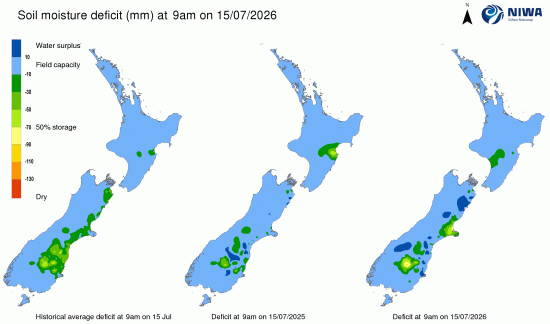
This soil moisture chart is animated here.
Keep abreast of upcoming events by following our Economic Calendar here ».
16 Comments
"It's Only Getting WORSE And WORSE..." - Jiang Xueqin
Makes a lot of sense
A number of points to consider...China needs iron ore, copper, oil and food (to name a few)....and shipping is increasingly vulnerable.
Chinas problems (as do almost eveyones elses) compound quickly without unencumbered trade....and diminishing resources.
Excrement meet fan
Which district spends the most on water, which has the most leaks? https://www.rnz.co.nz/news/political/809634/which-district-spends-the-m…
An interesting read. I think my local CHB District Council is performing reasonably well.
I had to click through the RNZ link to the original report to obtain the council legend.
It would be interesting to drill into the raw data. Some of the measures chosen look contrived to support more water authority / council blameshifting & self justification: remembering that ~40% of wgtn water leaks out of council pipes before it reaches end users.
Interesting that Nelson City Council noting the least water usage. Perhaps this is due to a being small district with a relatively high urban population vs rural.
Just when you want wind to pull its weight, it is no were to be found. Just doing 143mw of the 1470mw of capacity.
We need to nationalize the generators
As a capitalist I find that hard to say but Hydro is our biggest battery and having profit in the way, does not work in a small country.
NZ Govt needs to own all gen IMHO and reinvest dividends
That will make no differnce as they have done what the goverment wanted and built wind farms that don't work all the time and you have to build back up for them when the wind doesn't blow. Plus all the power lines add up to expensive power. The call to stop drilling for gas just made things worse for us now and going forward.
Going forward
I assume a lot about people peddling that couplet.
None of those assumptions are complimentary.
Perhaps you could start by explaining what you advocate by way of replacing the gas - given that it is finite - when you run it out.
Then you could explain why we don't just jump straight to that?
Gas is a stepping stone till we as a nation realise nuclear or fussion is the way to go. Wind is just a waste of time.
People do a lot of fussion
Lots of believing, too.
The big cranial mistake is to assume that the temporary build-up we've done since 1800, is permanent. Even if we could find the energy, there are several other parameters we are already exceeding.
Geothermal beats out Nuclear for cost.
Cui bono. The govt does "own" 51% of the generators.
there only lever is the price trans power has to pay, its a stupid lever
Its not working for NZ..... productivity is worth 10's billions and these guys are pissing around down at hundreds of millions
it ends badly I suggest you need solar before NZ looks like South Africa
Something big going on with Electricity Spot market - $1000+ MWH in Auckland right now, and $800+ MWH for whole North Island.
How do you track rates?
We welcome your comments below. If you are not already registered, please register to comment
Remember we welcome robust, respectful and insightful debate. We don't welcome abusive or defamatory comments and will de-register those repeatedly making such comments. Our current comment policy is here.