
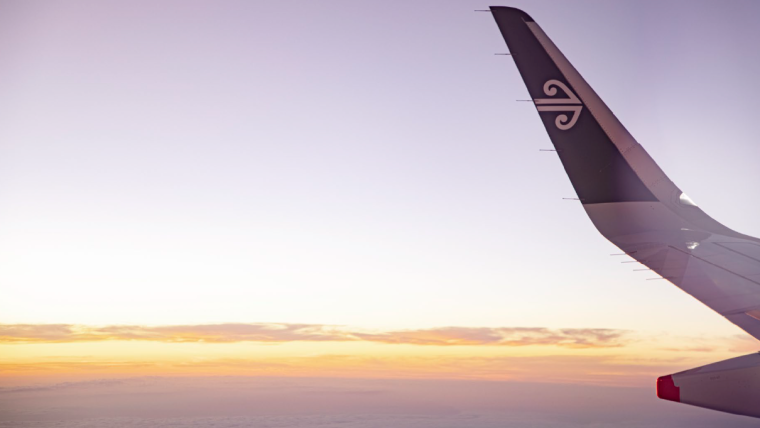
From sub-basement level to soaring over the rooftops, our national airline has spectacularly resurrected its fortunes over the past year after the travails of the pandemic, turning in its second highest ever profit.
Air New Zealand (AIR) has reported pre-tax earnings of $574 million and after-tax profits of $412 million for the June 2023 year, turning around from a pre-tax loss of $810 million and after-tax loss of $591 million a year ago at the tail end of the pandemic.
The performance for the airline this year is second only to that turned in during the 2016 financial year, when it reported pre-tax earnings of $701 million and an after-tax profit of $490 million.
In 2019 before the onset of Covid, Air New Zealand reported pre-tax earnings of $382 million and after-tax earnings of $276 million.
And there is something in the latest result for the shareholders, among which we, the taxpayers are - courtesy of the government - 51% owners of Air New Zealand. At the time the airline had its $1.2 billion recapitalisation last year Air New Zealand said it wouldn't look at paying dividends before 2026. But such has been the turnaround this year that it is paying out $200 million, styled as a 'special dividend', which equates to 6c per share.
From the 2024 financial year onwards the airline plans to pay out between 40% and 70% of its after-tax profits as dividends.
The profitability this year for Air New Zealand came despite a 31% rise in fuel costs, which contributed to a $1.5 billion fuel bill - the largest single cost for the airline.
But with capacity still relatively limited compared with before the pandemic, the airline was able to spectacularly increase its yields.
The key operating statistic of passenger revenue per available seat kilometre was some 45% higher than the last pre-pandemic year of 2019. Such yields are expected to drop as increased global flying capacity kicks in with airlines all gradually gearing up again after the pandemic disruptions.
In its statement to the NZX, Air NZ said it notes that the 2023 financial year was particularly unique with significant customer demand, constrained market capacity and lower fuel prices in the second half, "and as such, we believe the 2024 financial year will be more reflective of future financial performance".
"Looking ahead to the first half of the 2024 financial year, customer demand remains strong across our markets. We are mindful of the uncertain economic environment however and acknowledge a number of factors that may impact future customer demand and profitability. These factors include increased international competition, volatile fuel prices, a weaker New Zealand dollar, ongoing wage inflation and increased airport charges. Given the uncertainty and volatility of some of these macroeconomic factors, the airline will not be providing guidance at this time."
Air NZ's chief executive Greg Foran said a strong Air New Zealand "is good for New Zealand".
"We have rehired and trained in a tight labour market, lifted the starting wage for the airport teams to $30 an hour and improved the way we work with digital systems on the ground and in the air.
"Restoring services to 500 flights a day is not only good for Kiwis who’ve been able to take that long planned holiday, but it has also brought tourist dollars back to the regions and supports exporters who rely on regular air freight.
"We know increased costs and high demand have made flying more expensive. In the past year we put more aircraft and seats in the air, so there are more choices for customers which helps alleviate the cost of flying. At the same time, our own costs continue to rise and the reality is that airfares are unlikely to return to pre-pandemic levels.
"After several volatile years it’s great to be back in the black and standing on our own two feet especially given we have more than $3.5 billion in aircraft investment coming over the next five years."
On Thursday the airline also announced an order for two new ATR turboprop aircraft for regional routes, as well as two new Airbus A321neos for the international short-haul network. That’s in addition to the existing domestic Airbus A321neo orders, and the eight new Boeing 787 Dreamliners coming into the fleet as the airline retires its Boeing 777-300s over time.
“We’re making progress on the things that matter to customers. Contact centre wait times have, on average, reduced by 75% since December, we’ve introduced an enhanced app, and we’ve had a step change in on time performance and more importantly, a reduction in cancellations. This June we were one of the best airlines in the Asia Pacific region at arriving on time, so we have momentum," Foran said.


We welcome your comments below. If you are not already registered, please register to comment
Remember we welcome robust, respectful and insightful debate. We don't welcome abusive or defamatory comments and will de-register those repeatedly making such comments. Our current comment policy is here.