

Okay, if somebody wanted to throw $1.2 billion my way I would be very appreciative - and I reckon I could do plenty with it.
Let's face it, that's a lot of money. But even 'a lot' is potentially 'not enough' in some circumstances. Not if you are trying to run an international airline.
And, well, such is the onerous job that Air New Zealand finds itself faced with, I'm not sure that even the $1.2 billion of new equity it is about to raise will be quite enough.
To put it in some perspective - it's only about the same amount that Air New Zealand has had sheared off its shareholders funds since the 2019 financial year. Thank you, Covid.
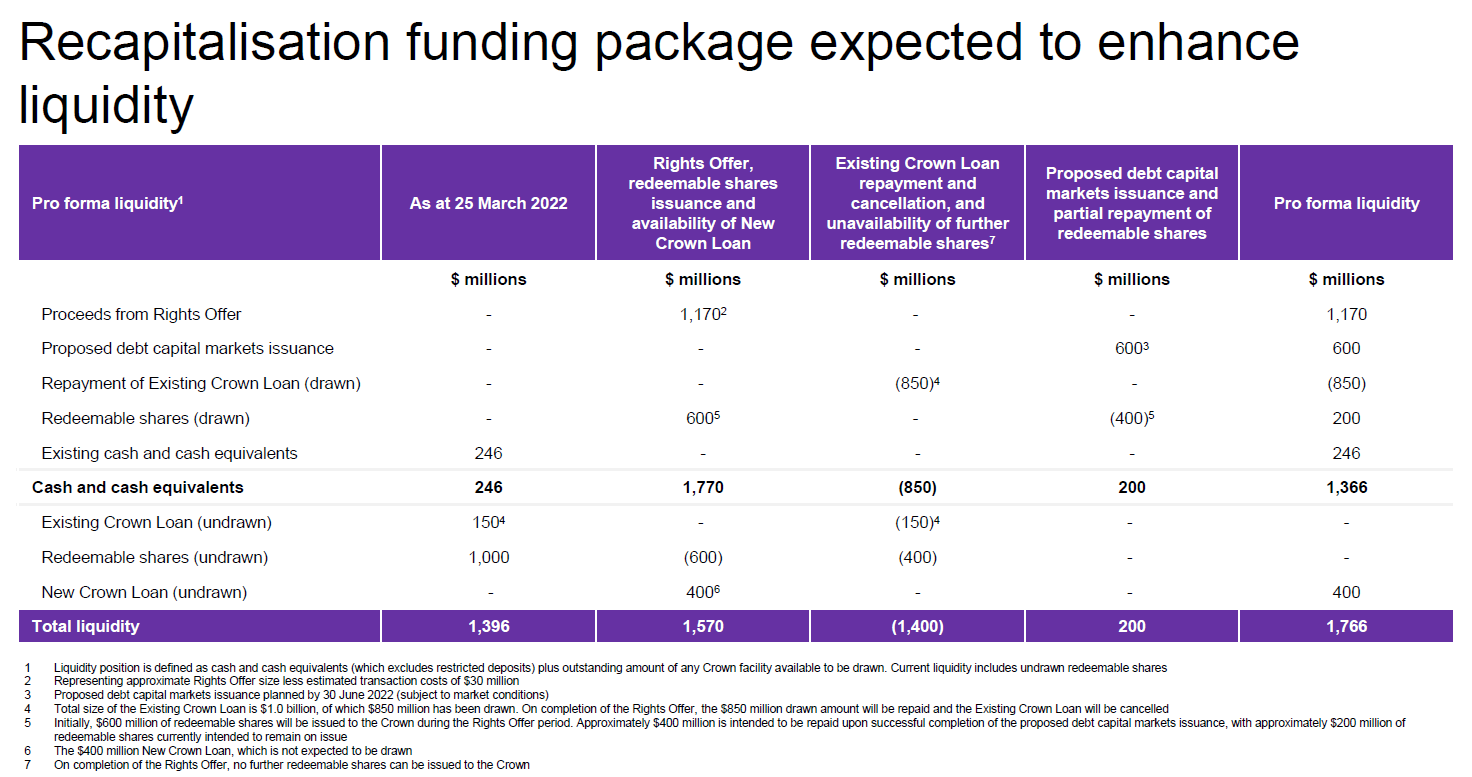
Now yes, there is also $600 million of redeemable shares that will be going to the government (with $400 million of those set to be repaid with a $600 million debt market capital raising by June - subject to market conditions). And there's a new $400 million standby debt facility from the Government - which won't be drawn on at this stage.
But having more good old shareholders funds would have been better. Equity always trumps debt, particularly when interest rates are on the climb.
My gut feeling is the airline probably needed $1.5 billion worth of new shareholders capital at least - and $2 billion would have been ideal.
But there was always the question of literally how much could be successfully raised from our shallow equity pool.
As I've said a few times, I think one of the things holding back Air New Zealand from a successful equity raising has been, ironically, NOT that shareholders have been looking to get out of investing in it - but in fact the complete opposite.
Air New Zealand's 2019 (June year) financial report shows it then had about 27,500 shareholders. Fast forward to 2021 and that number had close to doubled - to just under 52,000.
The big 'bulge' has come from shareholders with fewer than 5000 shares - with 18,000 more Air NZ investors in this category now than before Covid.
The real point is, these newbies have not been coming in at exactly bargain basement prices. The Air NZ price started 2020 at over $3 then tanked to under $1 as the Covid sky fell in during March 2020.
However, during the completely unexpected (well, certainly by me) raging market rally that followed, the Air NZ shares got flavour of the month status and have traded at close to $2 on a number of occasions since - which is ridiculous for a company losing money hand over fist. (Note that Air NZ has revised its forecast for the June 2022 year and now sees a slightly lower loss of under $800 million.)
And I'm sure it probably gave the 52% Air New Zealand major shareholder the Government (AKA the taxpayer) pause for thought. It made pitching the share price of any capital raising really difficult.
I think they've done a pretty good job in setting the price where they have, but it will still be interesting to see what the enthusiasm is of some of the newbies and how prepared they were really to be stumping up with extra cash. (Or if they even knew they would be asked to. They should have known.)
Based on the pre-offer closing price of just under $1.38 for the Air New Zealand shares, this means that any shareholder that bought shares at that price is now going to be asked for another $1.06 (being the 53c a share price times two under the terms of the two-shares-for-every-one offer). So, that's a bit under $2.44 that it would cost our shareholder, for which they would end up with three shares each worth a little over 81c.
I've got to say, 81c sounds like a fairly high price relative to where Air New Zealand is in its recovery process. Again, gut feeling would suggest 65c to 70c would be more like it.
To be honest, it would have been better for the airline if the share price had been trading at basement levels. Then the Government could have backed probably a bigger capital raising and ended up owning most if not all the airline.
As it is, under this offer the Crown is committing a princely $600 million of taxpayers' money for new shares and yet will see its level of shareholding actually fall slightly from just under 52% to 51%.
I'm probably sounding overly negative, but really I don't mean to be. It's great that Air New Zealand will get this new money (with the public part of the equity raising fully underwritten by Citigroup Global Markets and UBS New Zealand - so, the money will be raised). But it's not like the airline is flying off into clear blue skies leaving the pandemic behind it.
We are now in the midst of an oil shock, made much worse by the invasion of Ukraine. And inflation's galloping, with economists seeing 7.5% inflation very soon. To be honest I wouldn't rule out the chances of us seeing double digit inflation by the end of this year.
Undoubtedly there is going to be some pent up demand for travel, given we've all been shut in for two years. But none of the airlines are going to be able to offer cheap-as-chips seats with the oil price in the heavens, while the cost of living (and don't forget those rising mortgage rates) may well dampen down enthusiasm for travel after an initial flurry.
So, I really wish our airline all the best, but fear it could be a struggle. I would feel happier if Air NZ was raising more money and I think the Government's provision of a $400 million standby loan facility betrays some concern on its part that more money may be needed.
It's very sensible that Air NZ's not making any promises on paying any dividends before 2026, which of course demonstrates that profits it does make before that time will be held in the coffers to bolster shareholders' funds. Very sensible.
But I still wouldn't rule out unfortunately that Air NZ will have to come back to shareholders for more money before then.
What the 25,000 people who climbed into Air NZ shares after the start of Covid will make of this will be interesting to see. I expect we will see some consolidation of shareholder numbers.
(Note: At time of writing the Air NZ share price had fallen over 10% to $1.22 in Thursday trading.)
Below for interest are some of the 'crunchy' financial details Air NZ has provided in relation to its capital raising:

We welcome your comments below. If you are not already registered, please register to comment
Remember we welcome robust, respectful and insightful debate. We don't welcome abusive or defamatory comments and will de-register those repeatedly making such comments. Our current comment policy is here.