
Here's our summary of key economic events overnight with news the OECD says we may be heading for a war-induced global slowdown (rather than a war-induced global spending spree). But financial markets have turned risk-on now they know where the US Fed is headed.
But first, last week's initial jobless claims data in the US came in lower than expected at 203,000 and there are now 1.8 mln people on these benefits a multi-generational (52 year) low.
US industrial production data for February came in exactly as expected with a modest rise. But it was held back by mining data. The factory production data was really rather strong, especially for business equipment. Construction data helped too.
Also moving up is the factory survey responses from the Philly Fed's industrial heartland region. It is expanding in March with new orders and production higher, but cost increases became more widespread, they say.
That bullishness was also reflected in their new housing starts data for February, which came in way above expectations. But there was a fall in their new building permits which at first blush seems counterintuitive until you realise it was only slightly off a record high.
Elsewhere there have been a set of central bank rate echoes of yesterday's Fed move. Hong Kong raised their policy rate by +25 bps to 0.75% in direct response to the US Fed move. Taiwan did the same, increasing theirs by +25 bps to 1.375% (and which frankly was a bit of a surprise). Indonesia left theirs unchanged at 3.50%. And the English central bank raised theirs by +25 bps to 0.75%, also mirroring the US Fed change.
The immediate threat of a Russian default on its debt seems to have passed for now. Banks seem to have processed a US$114 mln interest payment over the past day or so. But some large Russian firms don't seem to have been able to make their own payments, even if a handful have.
In Ukraine, China seems to be shifting to support their government, at the expense of Russia. Their ambassador has "praised the strength and unity demonstrated by the Ukrainian people", in an apparent reference to their efforts to resist Russia’s invasion. China's long-avowed respect for sovereignty appears to be resurfacing.
The war in Ukraine could cut global economic growth by more than one percentage point in the next year, the OECD says. It unsurprisingly sees a "deep recession" in Russia ahead. It also warned that the conflict could push up prices globally by about 2.5%.
Container shipping costs fell rather sharply last week as demand seems to be easing in the outbound China trade. There was a -7% fall in rates to Los Angeles, a -5% fall to New York. This is the largest fall we have seen since late 2021. Bulk cargo rate rises seem to have petered out too.
In Australia they added +77,400 jobs in February and their jobless rate fell from 4.2% to 4.0%. (In February 2021 it was 5.9%.) Better, full-time jobs rose +122,000 while part-time jobs fell -45,000. With our borders open, the sucking sound might be louder.
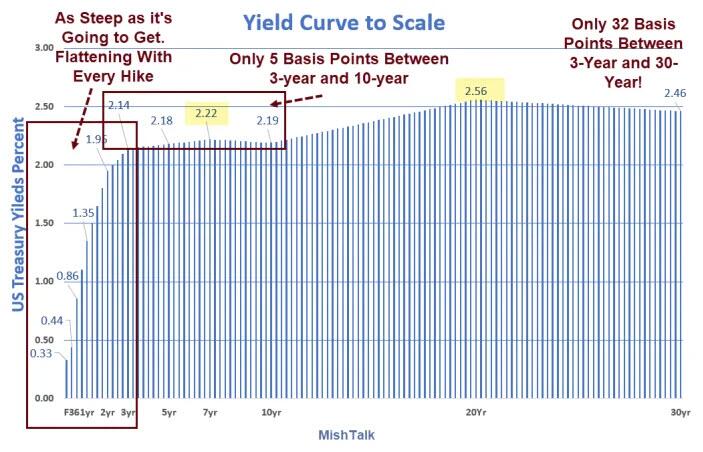
The UST 10yr yield opens today at 2.18% and reversing much of yesterday's Fed-induced initial rise, down -6 bps from this time yesterday. The UST 2-10 rate curve starts today sharply flatter at +23 bps. Their 1-5 curve is steeper however at +92 bps and their 30 day-10yr curve is steeper as well at +199 bps. The Australian ten year bond is up +1 bp at 2.52%. The China Govt ten year bond is unchanged at 2.82%. And the New Zealand Govt ten year is unchanged at just on 3.18%.
Wall Street is up +0.5% on the S&P500 in Thursday afternoon trade. Overnight, European markets were very mixed with Frankfurt lower and London higher to bookend their shifts. Yesterday, Tokyo gained +3.5, but Hong Kong's spectacular recovery continued, gaining another +7.0%. And Shanghai also had a good gain, up +1.4%. The ASX200 rose +1.1% while the NZX50 was also up 1.1%.
The price of gold starts today at US$1944/oz recovering all of yesterday's sharpish fall and up +US$46/oz from this time yesterday.
And oil prices are sharply higher too today, up +US$7/bbl. In the US they are now just under US$101.50/bbl. The international price is just on US$104.50/bbl.
The Kiwi dollar will open today more than +1c firmer, now at just over 68.9 USc as commodity currencies move up again. But against the Australian dollar we are almost -¾c lower at 93.3 AUc. Against the euro we are just over 62 euro cents. That all means our TWI-5 starts today at just under 73.9 and +50 bps higher.
The bitcoin price was up +1.2% from this time yesterday to US$40,794. Volatility over the past 24 hours has been moderate at +/- 2.6%.

The easiest place to stay up with event risk today is by following our Economic Calendar here ».
We welcome your comments below. If you are not already registered, please register to comment
Remember we welcome robust, respectful and insightful debate. We don't welcome abusive or defamatory comments and will de-register those repeatedly making such comments. Our current comment policy is here.