

This Top 5 comes from interest.co.nz's Gareth Vaughan.
As always, we welcome your additions in the comments below or via email to david.chaston@interest.co.nz. And if you're interested in contributing the occasional Top 5 yourself, contact gareth.vaughan@interest.co.nz.
Facebook had a bad day...
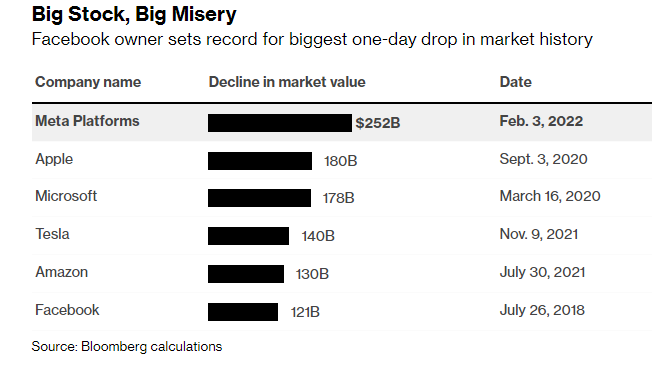
Source: Bloomberg.
1) Mortgages designed for bank shareholders rather than customers?
Writing for The Conversation, Richard Holden looks at why Aussie banks don't offer fixed-interest rate, 30-year mortgages like their US counterparts. Here in New Zealand the longest term home loan currently on offer from banks is five years. TSB offered a 10-year rate for a while and BNZ a seven-year one.
In Australia most borrowers take out floating rate mortgages although Holden, Professor of Economics at the UNSW Australia Business School, cites a growing move to fixed-term mortgages, which are more popular than floating rate loans here in NZ. Holden notes there's an active Aussie government bond market with maturities from one year to 30 years, thus providing a benchmark to price mortgages. NZ has swap rates out as far as 10 years, and there are 30-year government bonds on issue set to mature in 2051.
Holden argues that effectively Aussie mortgage settings benefit bank shareholders at the expense of bank customers.
Longer fixed-rate loans would insulate Australian borrowers from big swings in interest rates. In the US you can refinance a 30-year fixed mortgage if long-term rates drop. So you benefit if rates go down but are protected if they go up.
Another idea to improve loan contract terms for borrowers – long advocated by University of Melbourne economist Kevin Davis – is the so-called “tracker mortgage”. These contracts limit borrowers to paying a certain “spread” over a benchmark interest rate.
Such offerings depend in large part on competition in the banking sector. The US has lots of competition in banking. Australia has very little.
When costs go up, two groups can bear that cost: customers or shareholders.
In Australia when bank funding costs go up, customers bear pretty much all of the cost, and shareholders zero. That’s the best evidence you’ll ever get of true market power.
Behind its paywall The Australian Financial Review takes a look at a how Westpac has gone from being bigger than ASB's parent Commonwealth Bank of Australia, by share market capitalisation, to less than half its size in a little over a decade. The story looks at problems and mistakes at Westpac, and things CBA has done well.
IT woes, bad management, compliance problems (hello AUSTRAC, APRA and ASIC), and Westpac's costly regional bank strategy, are all issues probed by the AFR. Westpac has also had its problems in NZ, getting offside with the Reserve Bank.
Here's the AFR;
Westpac surpassed the CBA in market value terms in 2008 after it bought St George Bank in a scrip merger deal worth $12 billion. It had a market cap of $42 billion, about $2 billion more than CBA.
The two banks had fairly similar franchises and almost the same key financial ratios. Westpac and CBA controlled about half the residential mortgage market with $265 billion each of mortgages.
Both banks traded at twice their book value, had cost to income ratios – a measure of efficiency – of 46 per cent and total capital ratios of about 10.5 per cent.
Westpac’s return on equity at 22 per cent in 2008 was superior to CBA’s 19 per cent and the market was willing to pay more for Westpac’s management expertise, as shown by the fact Westpac had a higher market value even though its assets of $590 billion were less than the $620 billion at CBA.
Today, the gap between the two banks is $86 billion, with Westpac’s market cap at $75.6 billion and CBA’s at $162 billion. The market’s poor assessment of Westpac’s prospects is summed up in its share price being equal to book value while CBA trades at twice its book value.
3) The rise and rise of average home loan sizes.
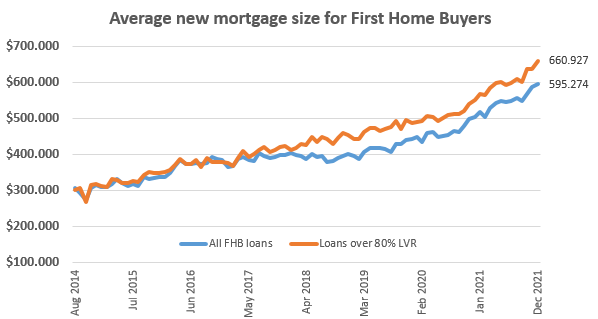
A report from Australia's BankingDay this week, saying the average Aussie owner-occupier home loan size reached A$602,035 in December, got us thinking about what it is in New Zealand.
David Chaston's chart below, from Reserve Bank data, shows the average new mortgage size for NZ first home buyers has been steadily climbing over recent years. In December it reached NZ$660,927 for low equity loans, and just under $600k for all first home buyer loans. The high loan-to-value ratio loans, based on house prices and incomes, suggests plenty of debt-to-income ratios for borrowers north of six times.
4) Banksy and a New Zealand trust.
Writing for the International Consortium of Investigative Journalists (ICIJ), Scilla Alecci - with help from the Pandora Papers - exposes how thousands of art works were secretly traded through shell companies in tax havens.
Alecci details how London financial broker Maurizio Fabris used a New Zealand trust to buy more than a dozen art works by British street artist Banksy, noting that when a trust becomes the legal owner of assets, the collector may be able to avoid or defer taxes on wealth, estate and capital gains.
The British-born Fabris, a former car racer and now a partner at a classic car investment fund, co-founded Enigma Securities in 2004 in London. Enigma, an investment brokerage firm, had outposts in Milan, Malta and Dubai.
In 2008, Fabris established the Heritage International Trust in New Zealand with the help of Asiaciti, a Singapore-based financial service provider whose internal documents are among those in the Pandora Papers leak. Trusts are commonly used to protect assets or reduce taxes by transferring legal ownership of the assets ー stocks, cash, real estate ー to another party, often a professional firm such as Asiaciti.
At the time, New Zealand offered anonymity and tax exemptions to foreigners who established trusts there. It didn’t require trust managers like Asiaciti to disclose a trust’s real owners or what it held.
A chart of Fabris’ offshore holdings and other leaked records reveal that he used the New Zealand trust to buy two luxury cars ー a Ferrari and an Alfa Romeo ー, invest in an Italian firm that patented automotive technologies, and hold shares in shell companies registered in the British Virgin Islands, the Marshall Islands and Switzerland.
Fabris, who described himself in a recent newspaper interview as “an entrepreneur with a passion for architecture and design,” used the shell companies to buy property and to hold shares in the Maltese affiliate of his Enigma brokerage firm.
In 2009, Fabris’ trust paid about $750,000 for 12 Banksy works, including a copper rendition of “Girl with Balloon.”
ICIJ reports that in 2017 a Milan court found Fabris and two Enigma co-founders guilty of evading about US$6.6 million in Italian taxes and collaborating with an international criminal network, and sentenced them to more than three years in prison. A year later, an appeals court dismissed the international collaboration conviction and overturned the verdict, saying the tax crime had occurred outside the statute of limitations.
5) Britain's partying PM.
Someone with a bit of time on their hands had some TikTok fun with Britain's lockdown partying Prime Minister Boris Johnson. The result is below, with a little help from the Beastie Boys.
Well this is outstanding pic.twitter.com/Rhct4e4aEY
— Sanjeev Kohli (@govindajeggy) February 1, 2022
For those wanting something more serious, this podcast from Tortoise Media, The Ministry of Untruths, probes Johnson's relationship with the truth against the backdrop of the Covid-19 pandemic.
We welcome your comments below. If you are not already registered, please register to comment
Remember we welcome robust, respectful and insightful debate. We don't welcome abusive or defamatory comments and will de-register those repeatedly making such comments. Our current comment policy is here.