
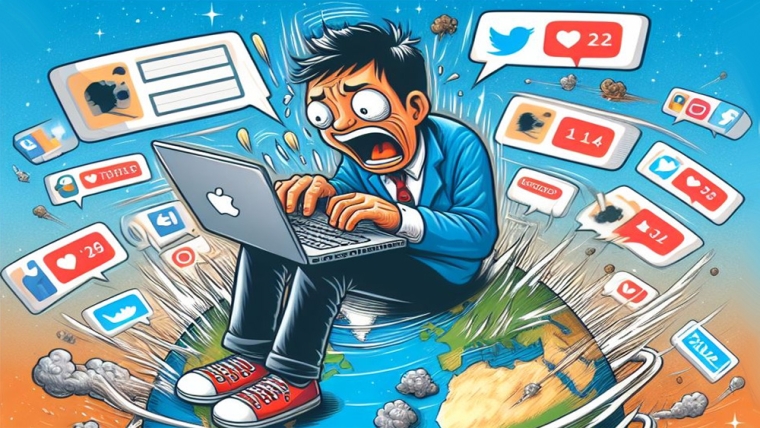
There’s nothing to suggest that we need news and analysis less than in the past, or interesting and amusing opinions on politics and culture for that matter. This is now harder to come by, whereas disinformation is literally “flooding the room with shit”. Even if you don’t like particular media outlets, the world is much poorer without them.
It also bears repeating that democracy in a world without media holding governments and the powerful to account will be threatened. If you don’t agree with that, you probably need to think about your politics and the rather obvious consequences of them.
What has happened then that has seen a desirable product become devalued and starved of the money required to pay for the hard and often risky work to bring people valuable information?
With apologies to Bill Clinton era political strategist James Carville, “it’s the techonomy, stupid”.
Let’s take a rideshare detour, and check out Uber Technologies which bills itself as “a tech company that connects the physical and digital worlds to help make movement happen at the tap of a button.” That is, Uber does not want to be a transportation company, subject to regulations that apply to that industry sector.
You can’t compare Uber with social media companies and Google directly, point for point. Its business is too different. But the story of how Uber circumvented regulation and destroyed existing businesses is eerily familiar.
That brings us to another point: could we please stop using “disruption” when “destruction” is more apt?
Uber made its first annual profit this year, some US$1.1 billion. That’s after 15 years of operation and making huge losses, which investors presumably will want to recoup in some way.
If you consider Uber is able to save massively on fixed and variable operating costs like fleet maintenance, call centres, administration, garage rents, and training the drivers which need permits, the long line of losses seems even more remarkable.
Over its relatively short period of existence, Uber has lurched from one scandal to another, accused of unethical behaviour, breaking the law, exploiting “gig economy” drivers, data breaches, and sexual harassment that led to founder Travis Kalanick being dumped.
None of that has made any difference. Uber is still the king of the ridesharing hill, making inroads in the courier business and food delivery in 70 countries worldwide, with millions of drivers. Has the convenience of using a smartphone app to hail and pay for transportation made the world a better place? That Uber has sunk the taxi industry, reduced public transport use and presumably investment in it, increased congestion and pollution suggests not.
Some would point to the greater freedom with Uber, but that is mirage. There's no hailing an Uber on the street and paying cash for the ride, like you can with a taxi. Instead, you hand over data for marketing and sales purposes with each Uber ride.
But, we let Uber get away with all that. It is now a global giant rising over the industries it crushed, and it’s not clear how the damage caused can be remedied.
The rise of social media and Google’s internet search monopoly should be seen in a similar light.
Regulators are notoriously slow to react whereas tech companies grow and scale at speeds unheard of in the past. Facebook, for example, has something like three billion active monthly users, a mind boggling figure.
Not only that, but the social network does not need to pay anyone anything to generate the data and eyeballs it sells to advertisers. In fact, it doesn’t matter what you, the user, generates to become the product that a social network sells.
It can be anything, from pictures of your children, yourself, cute kittens to dangerous disinformation and scams. Much of it in recent times is machine generated through artificial intelligence that mimics human appearances, thoughts and voices in seconds.
There’s a never-ending stream of everything. As Facebook has said, it doesn’t need news. Or politics. Or movies. When those sectors become squeaky wheels, Facebook just dumps them.
Thanks to their gigantic sizes and omnipresence, the tech companies that are now devouring media’s collective lunch have an outsized influence on areas beyond advertising like handling our money.
Twitter, now X under Elon Musk’s slash and burn ownership, wants to become a payments app. Facebook, or its parent company Meta rather, already has payments. Lots of other social apps are used for payments by millions of people around the world.
There’s also the Facebook Marketplace which is growing in popularity everywhere, and which is very much a use at your own risk trading post.
Disruptive or destructive? A small business owner forced to trade on a social network, and perhaps use its payments processing feature with whatever fees that apply might not appreciate the difference.
It goes further than that though: Google and Facebook, along with Amazon Web Services are building the fundamentals of the technology they use to power their empires. That’s all the way down to computer chips and servers that go into the data centres they design and build, to the software that runs on them.
Much of this is open source and nominally free for others to use; at least it seems free until you start looking at the bigger picture and context of suffocating market dominance that squeezes the life out of smaller competitors.
It may be that it was difficult to see where the digitise-everything Internet was headed in the late 90s and early 2000s. Who’d have thought then that Google would evolve into the world’s largest media company, reaping in nearly a quarter of a trillion US dollars a year in advertising revenue?
You can go on about entire business sectors having to evolve their models as digitisation rolls over them. How that can be done when faced with unregulated opponents who have economies and resources the size of medium-sized nations is not at all clear, however.
The questions we’re now left with are: was it a good idea to allow tech companies to grow into oversized giants? If not, should they be broken up - and ideally, before it’s too late which it nearly is?
Update Last month Uber agreed to compensate Australian taxi and hire car drivers A$272 million for loss of income and licence values, in a class-action lawsuit that was launched in 2019. The plaintiffs argued that Uber Australia knowingly operated illegally, which gave it an unfair advantage over taxi and hire car drivers that complied with the law. Uber Australia is facing further legal action in Australia.
In March this year, TheRighting in the United States, which is as partisan as the name implies, published Comscore statistics suggesting that publications' political leanings have very little to do with the decline in visitors.
We welcome your comments below. If you are not already registered, please register to comment
Remember we welcome robust, respectful and insightful debate. We don't welcome abusive or defamatory comments and will de-register those repeatedly making such comments. Our current comment policy is here.