
By Ryan M. Katz-Rosene & James Jackson*
If you ask an economist why everything is so expensive these days, you will likely get an answer explaining how oil — the lifeblood of the global economy — is currently facing supply bottlenecks in the Strait of Hormuz, thereby bringing up global energy prices.
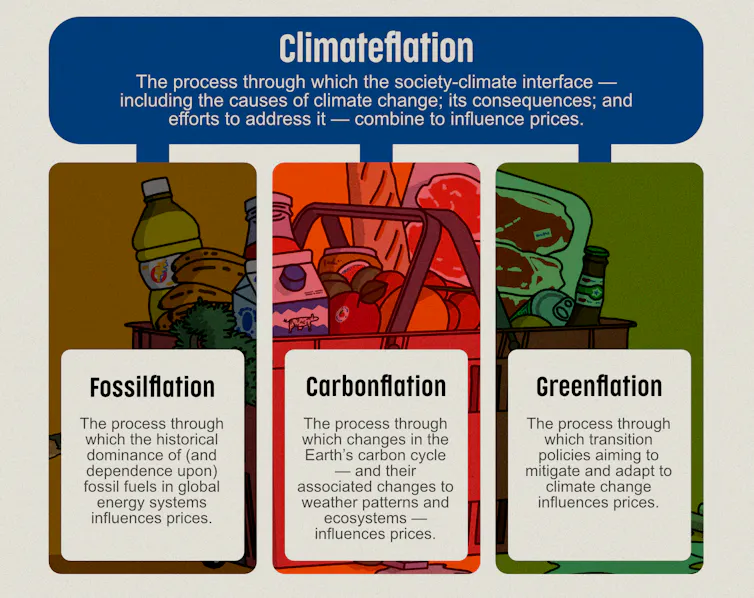
That explanation is part of the answer, but it doesn’t paint the whole picture. Our new research proposes a new way of thinking about rising costs in our contemporary era, through the lens of what we call “climateflation.”
As a concept, climateflation proposes that the causes, effects and even attempts to mitigate and adapt to climate change are conspiring to make everyday life more expensive.
As ecological political economists, we are concerned not just with how rising costs impact people’s wallets, but also with how it might have spin-off effects in areas such as social inequality, political radicalisation, geopolitical instability and environmental degradation.
‘Fossilflation’ and political failure
By burning fossil fuels since the rise of the industrial era, humans have added 495 billion tonnes of carbon to the atmosphere. Those emissions have contributed to global warming, which in turn has increased the likelihood of extreme rainfall events, extreme heat and agricultural drought.
However, since at least the early 1990s, the international community has sought to limit dangerous global warming. In 2015, members of the United Nations agreed to limit global warming to 1.5 C above the pre-industrial era (or well below 2 C).
Yet only in the last few years has the UN Framework Convention on Climate Change specifically named the elephant in the room — fossil fuels — as a core cause of the problem. As such, decades of corporate greenwashing and political stonewalling have enabled fossil fuel use to continue growing, leaving the global economy heavily dependent on this form of energy.
If the global energy system were not so dependent on fossil fuels, it is unlikely that present-day oil and gas supply bottlenecks in the Strait of Hormuz would be contributing so much to headline inflation.
Put differently, if climate mitigation efforts had been taken more seriously 35 years ago, today’s conflict in Iran would have far less bearing on everyday prices. In this way, we can link rising prices today to the political failure to act on climate change.
From ‘carbonflation’ to ‘greenflation’
There is also a more direct impact from climate change on everyday costs.
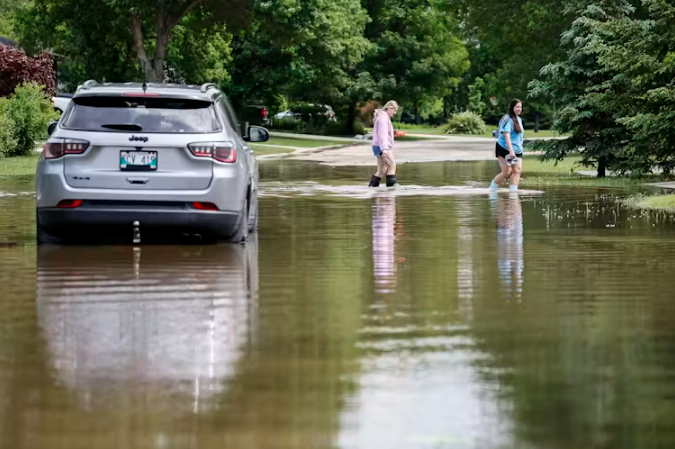
Weather extremes are incurring tremendous costs, from rising public health costs and productivity losses associated with severe wildfires and heatwaves to rising grocery prices for climate-vulnerable crops because of agricultural failures. Extreme weather events such as heatwaves and flooding are also imposing major costs on infrastructure and buildings.
These direct costs tend to be more sporadic, occurring more acutely in areas dealing with extreme weather. However, as the world warms, the underlying weather events causing these price increases are expected to become more frequent and severe.
Yet the direct effects of climate change and our failure to get off fossil fuels are not the only forces influencing costs. Much of our present-day infrastructure was constructed with a more stable climate in mind. Homes, businesses and capital have built up in vulnerable areas without adequate resilience measures in place.
In other words, not only have our political leaders largely failed to heed the warning to wean our energy systems off fossil fuels, they have also failed to invest in more climate-resilient infrastructure.
This makes dealing with climate change today more expensive. It also means yet more costs as people and institutions are forced to retrofit or refurbish buildings and infrastructure, invest in and build new clean energy production systems, acquire new climate-friendly equipment, secure new forms of insurance protection or even relocate to new areas.
In some instances, governments have sought to tackle climate change by applying a surcharge on fossil fuel consumption (a carbon tax) or by incentivising low-carbon purchases (through things such as electric vehicle rebates). Yet these policy tools can result in higher costs for society.
Not just about rising costs
Overall, the three main areas we outline above — fossilflation, carbonflation and greenflation — are the main constituent parts of climateflation.
In our work, we are careful to note that climate change does not always lead to cost increases. In fact, in some instances it is associated with reductions in prices — for instance, when higher levels of CO2 help to fertilise crops, or when clean-energy retrofits actually reduce energy use and bring down household costs.
Nevertheless, the net effects of climateflation are likely to be increasing costs for the foreseeable future. That is likely to remain the case until we can power most of the global economy without fossil fuels, bring emissions down to net zero and halt further warming, and build infrastructure that is truly resilient to new climate conditions.
Of equal concern to us, however, are the potential spin-off effects that rising costs can create in other areas.
Climateflation could create winners and losers, dividing those who can afford higher costs from those who cannot. It could also make reactionary — and xenophobic — political movements more compelling to an increasingly frustrated and angry population. The resulting discontent, or competition for new resources in an effort to bring down costs, could sow the seeds of conflict between communities or nations.
If history is any measure, periods of relatively high costs can be destabilising to the traditional power structures that uphold society. How will climateflation play out in this regard? Only time will tell.
*Ryan M. Katz-Rosene, Associate Professor, School of Political Studies, with Cross-Appointment to Geography, Environment and Geomatics, L’Université d’Ottawa/University of Ottawa and James Jackson, Lecturer and Research Fellow, School of Social Sciences, University of Manchester. This article is republished from The Conversation under a Creative Commons license. Read the original article.
24 Comments
Viewers imo would benefit from an interest.co.nz article on NZ climateflation. This article is OK but concrete NZ examples could focus the mind on consequences that do and will impact us and could provide needed discussion and debate prior to the coming general election.
Nigel it need to be wider.
Much, much wider.
But your timeframe is correct.
@Nigel Ritson, I did speak with Rod Carr about climateflation for a podcast - https://www.interest.co.nz/public-policy/116513/climate-change-commission-chairman-rod-carr-tackling-climate-change
An interesting perspective but....
It doesn't address the point that the humanosphere (there is can invent a new term too) is trying to maintain a lifestyle that the biosphere cannot support.
One can analyse component parts in isolation and arise at explanations that provide a degree of misguided hope that the current arrangement can be perpetuated.
Growth cannot be maintained indefinitely. And the collapse will be painful for all. Those $ asset value accumulated cannot be eaten and cannot be turned into sustenance if the sustenance products are not available. Yet the system continues to deceive itself that continued growth in share markets and investment funds, that churn notional money round and round, producing tangibly little actual product, is where future security lies.
As a farmer in an earlier life, I drew great satisfaction that my management and husbandry translated sunshine, water, and soil sourced nutrient into tangible products important to sustaining human life. How does the finance sector contribute at that fundamental level?
What do all those economists, financial advisors, fund managers, etc, actually produce?
In theory, if they are doing their job properly, they help us to invest in the most productive opportunities. Without them we would be wasting investment in dud companies.
And for companies, they help attract investment which helps improve productivity.
You sound a bit like PDK where anyone who doesn't produce a physical necessity is considered a parasite.
Well, they are.
'they help us to invest in the most productive opportunities'
You said it.
Parasites don't produce - but you bet your a-- they expect to consume.
An engineer would understand that
"What do all those economists, financial advisors, fund managers, etc, actually produce?"
Noise, societal drag? A cut of actual work done? David Graeber had a term, but Jimbos is nearer the mark I suspect.
"which in turn has increased the likelihood of extreme rainfall events, extreme heat and agricultural drought."
increased the likelihood has not shown up. So, Only time will tell if the runaway climate change hypothesis proves remotely correct. Not really a great basis for a taxation system where there are other actual problems taxes could be focused on.
"where evidence is lacking or the signal is not present, leading to overall low confidence of an emerging signal.
-
River floods
-
Heavy precipitation and pluvial floods
-
Landslides
-
Drought (all types)
-
Severe wind storms
-
Tropical cyclones
-
Sand and dust storms
-
Heavy snowfall and ice storms
-
Hail
-
Snow avalanche
-
Coastal flooding
-
Marine heat waves
https://episode3.net/grain/wheat-prices-recover-from-760-year-lows/#ima…
https://ourworldindata.org/grapher/yields-key-staple-crops?stackMode=re…
https://www.ipcc.ch/report/ar6/wg1/downloads/report/IPCC_AR6_WGI_Chapte…
https://rogerpielkejr.substack.com/p/what-the-ipcc-actually-says-about
What do I say to this? Read this out of many examples of evidence that your statements are often incorrect:
https://earth.org/ongoing-european-heatwave-most-severe-ever-recorded-v…
Gemini AI asses the validity of Profiles comment pasted below
The comment by user profile under the article makes a key claim: that the IPCC AR6 WG1 report indicates low confidence in an emerging human-caused climate signal across a wide variety of extreme weather events, and uses this to argue that increased likelihood of extreme weather has not shown up.
Evaluating the accuracy and context of this comment reveals where it is partially grounded and where it misleads:
1. Context of the Quoted List
-
Accurate Source Material: The list cited by profile (covering river floods, pluvial floods, landslides, severe wind storms, tropical cyclones, etc.) comes from Roger Pielke Jr.’s synthesis of Table 12.12 in the IPCC AR6 WG1 Report.
-
The IPCC specifically assessed whether a signal of climate-change-driven change had emerged from natural variability at global/regional levels for those specific sub-categories with high confidence by 2021. For those listed, the IPCC indeed stated that evidence was either lacking or the signal had not yet emerged above natural variability at high confidence levels.
2. Where the Comment Misleads
-
Omitted High-Confidence Extremes: The comment selectively lists the categories where signals have not yet emerged with high confidence while omitting the categories where the IPCC did find high confidence of an emerging climate signal due to human influence. These include:
-
Extreme heat / heatwaves (virtually certain increase)
-
Agricultural and ecological droughts in several regions (high confidence)
-
Marine heatwaves (high confidence)
-
Heavy precipitation increases globally/regionally (high confidence)
-
-
Confusing Detection with Non-Existence: In climate science, "low confidence in detection of an emerging signal" means natural variability currently masks the long-term trend in observational data for that specific event type. It does not mean global warming has zero effect on those events or that the underlying physical mechanisms are absent.
Summary Verdict
The commenter correctly cites a subset of IPCC AR6 findings showing that many specific extreme weather sub-types do not yet have high-confidence signal emergence. However, using this list to argue that increased likelihood of extreme weather "has not shown up" overall is cherry-picked, as it ignores the clear, high-confidence signals documented by the IPCC for extreme heat, heavy rainfall events, and regional droughts.
But is it the global panic situation we were told of? Reads to me like "things seem to be a little bit worse but we are not sure yet"
I guess by the time the emerging trends coalesce into a coherant thought among the money god sect controlling our politicians and their corporate owners, the planet will be an unliveable hell hole? You'd think the bleeding obvious physics of the situation would be enough to provoke some action in an intelligent species. Maybe we're not as intelligent as our mythology?
Provoke some action, yes you would think so. And no we're not as collectively intelligent as we like to think we are
It will be interesting to see how long Profile continues peddling - will he have the decency to go away, or do Interest.co grow the social conscience to remove him?
Bravo. Over to profile........but, but CO2 is plant fooood......
As usual the AI is crap stating:
where the IPCC did find high confidence of an emerging climate signal due to human influence. These include:
-
Extreme heat / heatwaves (virtually certain increase)
-
Agricultural and ecological droughts in several regions (high confidence)
-
Marine heatwaves (high confidence)
-
Heavy precipitation increases globally/regionally (high confidence)
Nigel, don't be lazy and read the Table 12.12 yourself (it is in the link above) and don't trust AI. Agricultural and ecological droughts, Marine heatwaves and Heavy precipitation increases globally/regionally do not "find high confidence".
Only Heavy precipitation shows in in the implausible RCP8.5 column - which is removed from AR7. and footnote 8 states "not in low-end scenario" ie scenarios other than RCP8.5.
Now is you chance to educate AI Nigel - go for it!
Im too lazy to look but if its your thing you might know. Did the assessments of change find any increased.precipatation in areas that are currently arid?
Seems to me (perhaps ill be corrected) more moisture in the air from evaporation means more rain and some of that might be in places that could use it flora wise - or is it just more rain in places that already have plenty?
Ive got important things like "who wins a fight between Bruce Lee and Mike Tyson?" To consider before I start looking into whether I'm going to need to harvest and ration the rainwater in 25 years.
Well for mean rainfall, even under RCP8.5, "evidence is lacking or the signal is not present". Higher atmospheric CO2 means plants use water more efficiently, contributing the global greening we are seeing but not reading about at interest.co.nz.
Bruce Lee any day, though Ritson AI will not doubt prove me wrong on that one as I am under the pay of big Kung Fu.
"Global mean vegetation greenness reached a record high in the year 2025, extending the multi-decadal upward trend. A total of 68.2% of vegetated land surfaces experienced greening, particularly in grasslands and croplands in the Southern Hemisphere and in northern mid-latitudes."
https://www.nature.com/articles/s43017-026-00776-0
Good try profile as devoted FF industry mouthpiece.
So either lazy or so disingenuous couldn't admit table 12.12 doesn't state what your AI generated comment described. Roger even went to the trouble of telling you to read it carefully!
"Take a moment and look at the table carefully. Look especially at all those white cells." I guess you didn't have a moment.
"Furthermore, the emergence of a climate change signal is not expected under the extreme RCP8.5 scenario by 2100 for any of these phenomena, except heavy precipitation and pluvial floods and that with only medium confidence. Since we know that RCP8.5 is extreme and implausible, that means that there would even less confidence in emergence under a more plausible upper bound, like RCP4.5
The IPCC concludes that, to date, the signal of climate change has emerged in extreme heat and cold spells. The IPCC states:
An increase in heat extremes has emerged or will emerge in the coming three decades in most land regions (high confidence) (Chapter 11; King et al., 2015; Seneviratne and Hauser, 2020), relative to the pre-industrial period, as found by testing significance of differences in distributions of yearly temperature maxima in simulated 20-year periods. In tropical regions, wherever observed changes can be established with statistical significance, and in most mid-latitude regions, there is high confidence that hot and cold extremes have emerged in the historical period, but only medium confidence elsewhere.
Clearly, with the exception perhaps of only extreme heat, the IPCC is badly out of step with today’s apocalyptic zeitgeist. Maybe that is why no one mentions what the IPCC actually says on extreme events. It may also help to explain why a recent paper that arrives at conclusions perfectly consistent with the IPCC is now being retracted with no claims of error or misconduct.
I’ve done research on climate change and extreme weather for almost 30 years (yowza!). I know the literature and have contributed quite a bit to it. My view is that the IPCC has accurately summarized that literature (if perhaps overlooking some key work, ahem).
I wonder if the IPCC is next in line to be attacked by champions of the apocalyptic zeitgeist. After all, how can science like this co-exist with an end-of-times panic?"
https://rogerpielkejr.substack.com/p/what-the-ipcc-actually-says-about
Its your religion.
Well said. I've seen a lot of late-like folk need to deny Climate- the late Jock Allison (father of Katherine Rich, and ex head of Invermay, for one).
At some point you can't get your life back to rerun, so you do whatever you have to, to self-justify.
Humanity requires a collective global political response to try to turn the ship around and avert disaster.
Unfortunately for our children and grandchildren this is highly unlikely, as we continue sleepwalking to the inevitable calamity
Luckily the System (which is so large that the entropic exhaust is warming the planet - a physics inevitability) is based on exponential GROWTH, and is faltering as we speak. Partly because of said exhaust - but it's a multi-faceted crisis.
That is likely to remain the case until we can power most of the global economy without fossil fuels . . . .
We have built our house of cards global economy on a foundation of fossil fuels. Without fossil fuels the global economy will expire.
We welcome your comments below. If you are not already registered, please register to comment
Remember we welcome robust, respectful and insightful debate. We don't welcome abusive or defamatory comments and will de-register those repeatedly making such comments. Our current comment policy is here.