
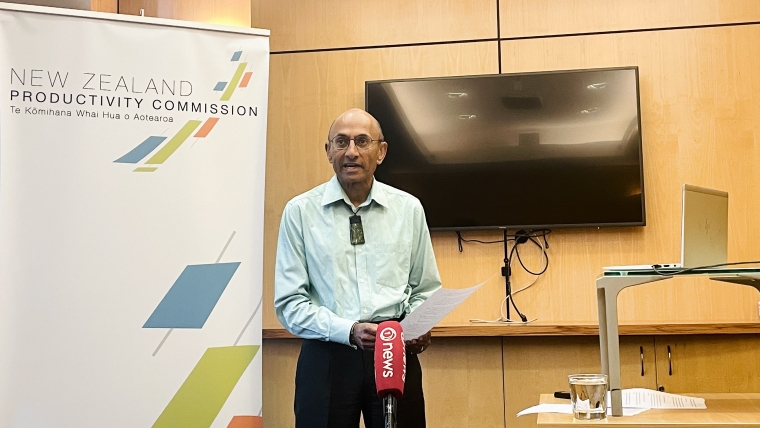
The process of shutting down the Productivity Commission was needlessly cruel and disrespectful to its staff, according to the crown entity’s Chairman Ganesh Nana.
Nana gave a closing statement on Wednesday morning, in which he thanked the Commission’s staff who had worked hard to finish research under a cloud of uncertainty.
Staff and leadership only learned the Commission would be shuttered through media reports in November, and no direct contact was made until the letter of expectations on December 19.
“To hear via a public announcement to media that the organisation you work for is to be closed, without even a courtesy heads up beforehand, was incredibly thoughtless and unnecessarily cruel to the Commission’s staff,” he said.
The Commission was also not given the opportunity to discuss the closure and possible options for transferring staff to the new regulation ministry or other economic agencies.
Nana said a ministerial briefing was prepared and he made “repeated requests” to meet with Finance Minister Nicola Willis to discuss how to preserve the finished research and best manage the shut down.
Treasury, which is the monitoring agency for the Commission, has arranged to take over management of the organisation’s website and host its research.
“We had good engagement through Treasury, but we sent numerous requests for a meeting with the Minister. We were open that we didn’t want to contest the decision, that was done”.
Nana said the board wanted to discuss the two key priorities: looking after the now redundant staff and ensuring the Productivity Commission's completed work remained available.
Some staff had expertise in regulation and he wanted to recommend them to ACT leader David Seymour’s new ministry, which is yet to be established.
In a statement, Willis said the coalition Government understands the disappointment of Nana and his colleagues at the disestablishment of the Commission.
“The Government stands by its decision and is confident the Public Service Commission and Treasury have ensured that all employment obligations have been met in the disestablishment of the Commission”.
In 2022, the NZ Herald reported the Productivity Commission had faced a wave of resignations after Ganesh Nana became Chairman in 2021.
An HR consultancy firm was hired to review the situation. It found the transition to the new Chairman went poorly and broader remit from the minister had contributed to the upheaval.
Staff comments to the Herald were highly critical of Nana and the other commissioners’ leadership, the way they treated the staff, and their approach to the research.
On productivity and regulation
In his closing statement on Wednesday, Nana gave the new Government some advice on how to achieve its commitment to lifting productivity and economic growth.
“Bluntly, productivity should not be confused with making more and more stuff. It is the ‘how it is made’ that matters”.
Having more workers, doing longer hours, for less pay, to make more stuff, was not an improvement to productivity, only economic output.
“More critical, and sometimes mischievously, is the conflation of productivity with profitability,” he said.
Reducing costs on businesses, such as by cutting regulations, does not necessarily eliminate those costs and improve productivity across the entire economy.
“The burden of those costs may rather be shifted to another group in our community to be borne by them,” he said.
Pursuing productivity with isolated, short-term measures had not been successful and would not work in the future.
One of the Commission's final pieces of work, Improving Economic Resilience, called for more “cross-silo, long-term investments” which would prepare NZ for future disruptions.
He said productivity policies needed to be connected to other policy areas, such as immigration, access to education and workforce training.
The coalition Government has promised to make changes to both the education and immigration sectors as part of its long-term economic development plan.
Another problem for productivity in New Zealand was that successive governments had targeted too low a level of net debt, he said.
“The fixation with fiscal parameters and fiscal targets is something that has held this country back for a long time … it's a total misunderstanding of the way an economy functions”.
It was important to also consider the state of the real resources and infrastructure in the economy as part of that picture.
“Fiscal targets are another example of those silos that we put ourselves in, [with] a very superficial understanding of economics and productivity”.
We welcome your comments below. If you are not already registered, please register to comment
Remember we welcome robust, respectful and insightful debate. We don't welcome abusive or defamatory comments and will de-register those repeatedly making such comments. Our current comment policy is here.