
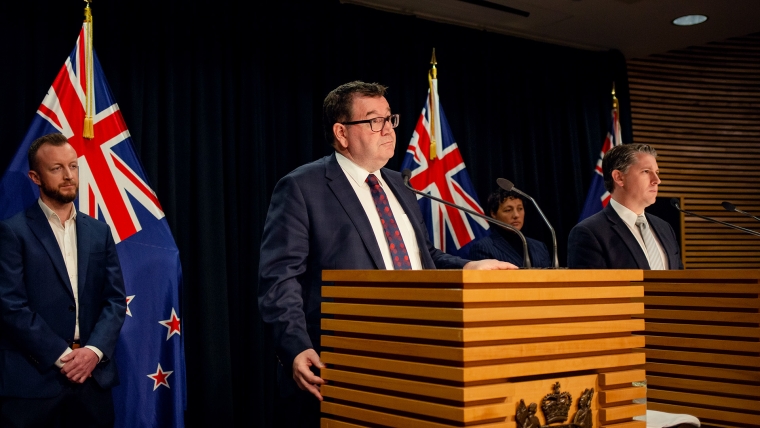
Labour leader Chris Hipkins has announced the shadow front bench that will be opposing the new Coalition Government in Parliament, with Grant Robertson holding onto finance.
The top 10 features some familiar faces and some younger MPs expected to be key players in the future.
For example, Robertson has decided to stay on as finance spokesperson for the time being, despite speculation he might resign if Labour was unable to win a third term.
There aren’t formal list rankings in opposition, but Robertson was third in the announcement document, behind Hipkins and his deputy Carmel Sepuloni.
Just outside the top 10, there is a possible successor for Robertson in former Revenue Minister Barbara Edmonds, who spent a short stint in Cabinet prior to the election.
Rather than reprising the revenue portfolio in opposition, she has been given regional economic development, infrastructure, and associate finance.
Two of Robertson’s former associate ministers, Michael Wood and Kiri Allan, have both dropped out of Parliament, leaving the pipeline of future finance ministers empty.
Senior Labour MP Megan Woods has also been named as associate finance spokesperson, alongside climate change, energy, and resources.
The revenue portfolio has been passed to tax expert Deborah Russell who has a lower implied ranking in the opposition list.
Robertson isn’t the only MP who has decided to stay in Parliament despite the election loss.
Māori caucus members Willie Jackson and Kelvin Davis have both opted to stay on board to oppose the Coalition’s proposed reform of the Treaty of Waitangi.
There may also be some nervousness among the party about ceding too much leadership to Te Pati Māori, which won most of the Māori electorate seats during the election.
Competing on climate
Labour has already been eclipsed on climate change by the Green Party, which has successfully positioned itself as the main progressive voice on that issue.
The new government has opted to send James Shaw as the opposition representative accompanying its Climate Minister, Simon Watts, to the COP 28 climate conference.
Hipkins said he was not consulted on this decision and that it was out of step with previous practice. Labour will have to scramble to send a representative under its own steam, if it wants to be at the conference.
Shaw is easily the member of Parliament with the most expertise on climate issues and will likely be seen as the authoritative opposition voice for as long as he remains an MP.
The Green Party also unveiled its portfolio list this week, with the most notable change being Shaw picking up finance from Julie Anne Genter.
The notable promotion in Labour’s opposition lineup was Kieran McAnulty, who has been made Shadow Leader of the House and given the housing, local government, and regional development portfolios.
He now has an implied caucus ranking of #7 while previously very senior MPs have been put in the backseat. These include Kelvin Davis, Damien O’Connor and David Parker.
Parker has been given the foreign affairs portfolio with the understanding that his positive relationship with Winston Peters will help maintain a bipartisan approach overseas.
Duncan Webb—described by his colleagues as being “forensic” in his attention to detail—will be in charge of keeping tabs on David Seymour in his new role as Minister for Regulation.
We welcome your comments below. If you are not already registered, please register to comment
Remember we welcome robust, respectful and insightful debate. We don't welcome abusive or defamatory comments and will de-register those repeatedly making such comments. Our current comment policy is here.