
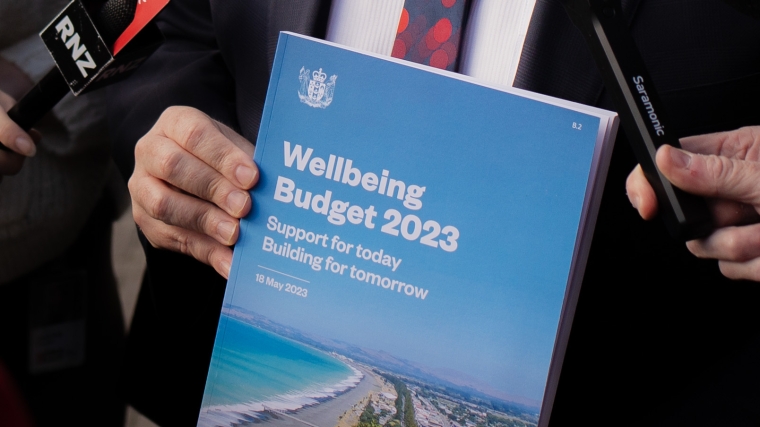
The Government will spend $2.6 billion to help households handle the increased cost of living by providing cheaper public transport, 20-hours of free childcare for two-year olds, and subsidies for insulating older houses.
Budget 2023 includes $4.8 billion of new annual spending, with almost 80% of that figure absorbed by cost pressures in existing services — largely due to inflation.
The cost of the four headline policies comes to $2.6 billion across the next four years, during which the government will spend an additional $15.3 billion.
Despite the nominal increase, Government spending in real terms has already been reduced and will have fallen by 5% by 2025.
One of the large capital allocations is the $3.1 billions set aside to build 3,000 new public housing places by June 2025. In terms of tax, a key change is increasing the trustee tax rate to 39% from 33% to align it with the top personal tax rate from April 2024.
Meanwhile, extending 20 hours of free early childhood education to two year-olds is another big ticket spending item at $1.2 billion.
Minister for Education Jan Tinetti said childcare was one of the biggest costs for families and this policy would make a big different and allow more parents to return to the workforce.
“This is a win-win for families with young children; it will reduce costs, remove barriers to early learning and allow parents to return to work or take on more hours if they can,” she said.
The government will also scrap the $5 co-payment for prescription medicines, at a cost of $618 million, to help remove barriers for low-income people.
Minister for Health Ayesha Verrall said more than 135,000 adults did not collect their prescriptions in 2021 and 2022 because of the cost of doing so.
“Free access to medicine will also relieve pressure on the health system. Removing the co-payment charge will help reduce the demand on hospitals and other health services”.
The budget sets aside $327 million to set up free travel for children under 13 years old and half price for people under 25 years old. This could save as much as $30 per week for the average household of two children.
Approximately 770,000 New Zealanders will be eligible for cheaper fares because of this decision, adding to the 895,000 made eligible for half price fares in the previous budget.
Transport Minister Michael Wood said everyone in New Zealand will benefit from the policy, either through improved access to public transport or reduced congestion on roads.
The final flagship spending item was one on the Climate Change Commission’s wishlist: retrofitting older houses with better insulation and heating products.
Budget 2023 provides $402 million of funding to double the Warmer Kiwi Homes programme which will deliver 26,500 insulation and heating retrofits in each of the next four years.
Energy Minister Megan Woods said a study by economic research group Motu found the programme reduced electricity use by an average of 16% in the winter months and cut the risk of respiratory illness.
Many of these policies were pitched as serving dual-purposes. For example, the cheaper public transport fares help households cope with the cost of living while also incentivising uptake of the cleaner mode of transit.
Better insulation in households reduces demand for electricity and makes it less likely the power grid will require generation from fossil fuel power plants, as well as being cheaper for users.
Providing cheaper childcare allows more parents to return to workforce, which could help ease the labour shortage and provide an extra income stream for families.
Other large operating costs include $160m in subsidies for the gaming industry, $465m of funding to build 3,000 state houses, and $120m on vehicle charging infrastructure.
Budget 2023 has allocated $10.7 billion of capital spending on a range of infrastructure projects.
The largest of these is a $6 billion allocation into a new National Resilience Plan which will initially support the cyclone rebuild before morphing into a vehicle to address the long-term infrastructure deficit.
You can read Budget 2023 in full online.
We welcome your comments below. If you are not already registered, please register to comment
Remember we welcome robust, respectful and insightful debate. We don't welcome abusive or defamatory comments and will de-register those repeatedly making such comments. Our current comment policy is here.