
By Chris Trotter*
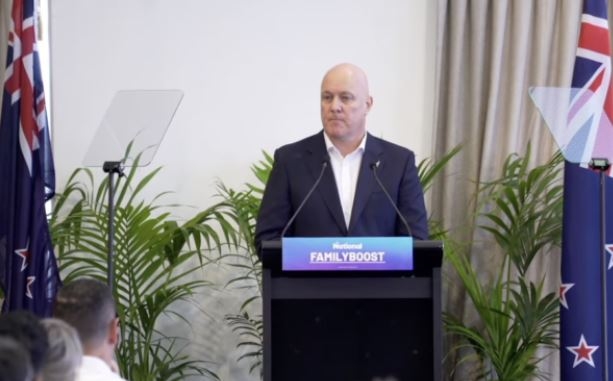
Martyn 'Bomber' Bradbury* called it Christopher Luxon’s “least worst speech”. High praise, coming from the firebrand left-wing editor of The Daily Blog. Certainly, Luxon’s (much delayed) State of the Nation speech 2023 touched all the bases one would expect the leader of a moderate centre-right party to touch. It also contained a handy five-point checklist of National’s electoral commitments. Finally, to ensure a spot near the top of the evening news bulletins, Luxon’s speech contained a generous child-care subsidy for middle and low income earners. Altogether a workmanlike effort.
Lacking from the speech, however, was the slightest trace of any serious, conscientious analysis of the deep-seated problems that New Zealand is currently struggling to resolve. Just once, before trooping into the polling booths, voters might appreciate hearing some evidence that the individuals vying to lead them are capable of thinking seriously and conscientiously about where their country is right now, how it got there, and where it should attempt to go next. They don’t call these things “state of the nation” addresses for nothing!
Luxon’s advisers and speechwriters very obviously disagree. Even if they could write such a speech, they would strongly advise their boss against attempting the deep and meaningful. Not in front of a right-wing New Zealand audience. To demand and deliver a serious and conscientious speech, a National Party leader would have to be both principled and clever – two qualities certain to arouse deep suspicion among right-wing Kiwis. Principles are volatile and apt to incite division. Excessive cleverness is received by the less clever as a rebuke, or, worse still, as showing-off – not good politics at all. Not in God’s own country.
All a right-wing New Zealand audience demands of a political speech is that the person delivering it gets to the end without making a fool of themselves. A speechmaker who could do that, and supply them with a few simple political priorities to regurgitate in front of friends, neighbours and workmates, would leave them well satisfied.
That satisfaction would turn to noisy approbation, however, if the speaker – like the legendary Rob Muldoon – had the capacity to eviscerate hecklers. Right-wing audiences also thrilled to well-crafted insults directed at the other side. Again, Muldoon was famous for his vicious one-liners: “I’ve seen shivers all over [Labour Prime Minister] Bill Rowling’s body”, he quipped during the bitter 1975 General Election, “looking for a spine to crawl up.”
Ah, but Muldoon was a National leader New Zealanders feared, rather than loved. Right-wing Kiwis may have respected him, but mostly they were just immensely grateful that he was on their side. Not for nothing was the populist Muldoon referred to as “the best leader Labour never had”.
Twenty-First Century National Party leaders have mostly veered away from presenting themselves as intimidating “counter-punchers”. John Key’s extraordinary electoral success is attributable to his ability to attract votes from across the social (and even the political) spectrum. “Mr Smile and Wave” may have been meant as an insult, but Key turned it into a winning routine.
Comparing Luxon’s political style with Key’s has become a commonplace of New Zealand punditry. Certainly, the man has the sunniest of smiles and generally exudes a comfortingly genial demeanour. Unfortunately, the similarities between Luxon and Key tend to run out at about that point. Key was a preternaturally gifted politician, equipped with the quick reflexes of a currency trader and the intuitive powers of a market analyst. He was also a very fast learner. When he first entered Parliament the persona he projected to the public offered few soft surfaces. Six years later, however, the man who described Michael Cullen’s Working For Families programme as “communism by stealth” was walking alongside Helen Clark to announce National’s support for the anti-smacking legislation. Long before anybody else, Key could smell what was in the wind, and prepare himself accordingly. Luxon can’t.
Never mind. National may not be blessed with a leader of Muldoon’s unflinching pugnacity, or Key’s velvet glove, but it has more than enough money to afford the best pollsters and focus-group convenors. Their work is clearly on display in Luxon’s five electoral commitments:
One – National will curb the rising cost of living.
Two – National will lift incomes for all.
Three – National will deliver resilient infrastructure for the future.
Four – National will restore law and order.
Five – National will provide better health and education services.
Since these commitments reflect almost exactly the current pre-occupations of the New Zealand electorate, the Nats have no reason whatsoever to fear their repudiation. This is what the electorate wants, this is what National is offering, and it’s a safe bet that Labour will present voters with a remarkably similar list of promises.
Vague and uninspiring though Luxon’s State of the Nation speech may be, it did announce one solid and politically astute policy initiative. “FamilyBoost” is an unashamedly socialistic childcare subsidy aimed squarely at middle- and working-class working parents, and paid for by the money National is pledged to free-up by decimating Wellington’s occupying army of consultants. Delivered in the form of a $75.00 per week tax rebate, deposited fortnightly in the couple’s bank account, FamilyBoost will appreciably lighten the burden of childcare costs averaging $300 per week.
It was the New York State Governor, Mario Cuomo, who advised candidates to: “Campaign in poetry, govern in prose.” The New Zealand Centre-Right’s paraphrase might as well be: “Campaign as Labour, govern as National.” Although, given the Labour Party’s all-too-apparent inability to any longer seize the public imagination in the manner of Mickey Savage or Norman Kirk (and considering the salutary fate of the last prime minister who tried) a more accurate National Party paraphrase might be “Campaign like John Key, govern like Steven Joyce.”
All joking aside, it is depressing to admit that in a country struggling to deal with the eye-wateringly expensive consequences of Climate Change; an infrastructure deficit rapidly entering its critical phase; a political class that will not let go the hand of its neoliberal nurse (for fear of meeting something worse?) and an indigenous population desperate for constitutional transformation but unable to explain what that means in terms which the rest of the country will accept; none of New Zealand’s political leaders have the wherewithal to stand on a stage and deliver anything other than cliches and platitudes about the state of their nation.
This Election Year, New Zealand desperately needs, and deserves, so much more than the “least worst” option.
*Chris Trotter has been writing and commenting professionally about New Zealand politics for more than 30 years. He writes a weekly column for interest.co.nz. His work may also be found at http://bowalleyroad.blogspot.com.
We welcome your comments below. If you are not already registered, please register to comment
Remember we welcome robust, respectful and insightful debate. We don't welcome abusive or defamatory comments and will de-register those repeatedly making such comments. Our current comment policy is here.