
By Bernard Hickey
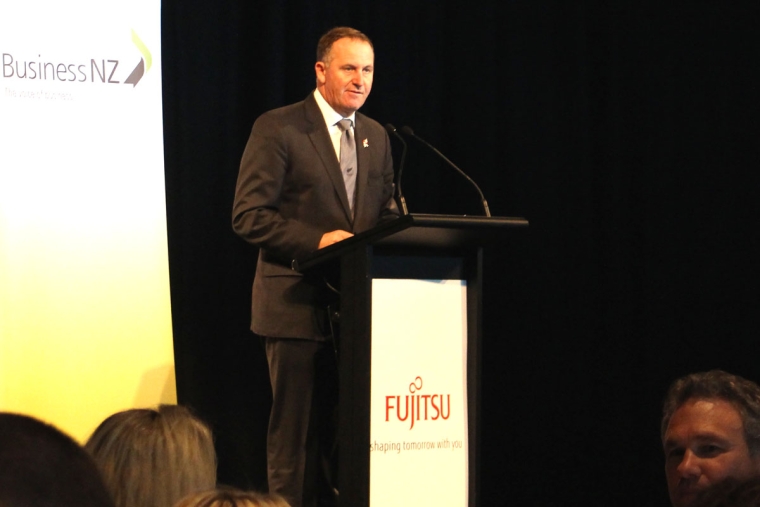
Prime Minister John Key has announced Budget 2015 will include a range of measures to crack down on property speculators who sell houses within two years, and he has announced foreign buyers will have to register with the IRD and have a New Zealand bank account.
In a release titled 'Taxing property gains fairly', Key announced the Budget would "include extra measures to ensure that people buying and selling residential property for profit - including overseas buyers - pay their fair share of tax."
"People calling for a new capital gains tax often overlook the fact that under existing rules, anyone buying property with the intention of selling for a gain is liable for tax on that gain," Key told the National Party's Lower North Island regional conference in Lower Hutt on Sunday.
"Everyone - whether from New Zealand or overseas - should pay their fair share of tax according to the law. So we need to ensure the existing law is enforced."
Key said the Budget this week will contain several measures to bolster tax rules on property transactions and to help Inland Revenue enforce them.
They include:
- Providing Inland Revenue with extra funding for compliance and enforcement.
- Requiring non-residents and New Zealanders buying and selling any property other than their main home to provide a New Zealand IRD number.
- Requiring non-residents to have a New Zealand bank account and to get a New Zealand IRD number.
- Introducing a new "bright line" test to tax gains from residential property sold within two years of purchase, unless it's the seller's main home, inherited or transferred in a relationship property settlement.
The changes will be subject to consultation and take effect on 1 October this year.
The "bright line" test will apply to properties bought on or after that date.
"These measures will not affect New Zealanders' main home, although existing tax rules will still apply in addition to these new steps," Mr Key says.
"They are aimed squarely at ensuring that property buyers - including overseas speculators - who buy residential property with the intention of selling for a gain pay their fair share of tax as required by the law," he said.
"It's not unreasonable to expect that if you buy an investment property and sell it for a gain within two years, then you should be taxed on that gain. "
"This is quite different to an investor buying with a long-term view of renting their property to tenants. And it's completely different to New Zealand owner-occupiers who have worked hard to buy their family home."
Key said that while the current law was clear about taxing property gains, decisions often relied on the intent of the buyers or an assessment of their intentions by Inland Revenue.
"One of the reasons this has become an issue, particularly with overseas investors, is that we don't always have good information about them. And some overseas investors can be difficult to track down - even if Inland Revenue knows they owe tax."
Key said New Zealanders would expect Inland Revenue to apply the same tax rules on overseas property investors that are applied to New Zealand property buyers.
"That's what these changes are about. As New Zealanders, we expect each other to pay our fair share of tax. "That same requirement must also apply to overseas residents. The Government welcomes overseas investment, but in return those investors must follow our rules when it comes to tax."
Here is a statement below from Bill English and Todd McClay with more detail on the changes.
Budget 2015: Extra property tax measures
The Government is taking extra steps to bolster the tax rules on property transactions - including those by overseas buyers - and to help Inland Revenue enforce them, Finance Minister Bill English and Revenue Minister Todd McClay say.The tax measures are also expected to take some of the heat out of Auckland's housing market and sit alongside the Reserve Bank's latest moves to address associated financial stability issues, Mr English says.
"Taken together, they will help Inland Revenue enforce existing tax rules, provide it with extra resources and ensure that property investors pay their fair share of tax - whether they're from New Zealand or overseas."
The Budget this week will confirm that, from 1 October this year, the following will be required when any property is bought or sold:
* All non-residents and New Zealanders buying and selling any property other than their main home must provide a New Zealand IRD number as part of the usual land transfer process with Land Information New Zealand.
* In addition, all non-resident buyers and sellers must provide their tax identification number from their home country, along with current identification requirements such as a passport.
* And to ensure that our full anti-money laundering rules apply to non-residents before they buy a property, non-residents must have a New Zealand bank account before they can get a New Zealand IRD number.
* In addition, a new "bright line" test will be introduced for non-residents and New Zealanders buying residential property, to supplement Inland Revenue's current "intentions" test. Under this new test, gains from residential property sold within two years of purchase will be taxed, unless the property is the seller's main home, inherited from a deceased estate or transferred as part of a relationship property settlement.
"Tax rules are complex and affect people in different ways, so we will consult on these measures before they take effect on 1 October," Mr English says.The "bright line" test will then apply to properties bought on or after 1 October.
To further ensure overseas property buyers meet both existing tax requirements and those of the new test, the Government will investigate introducing a withholding tax for non-residents selling residential property.
Officials will consult on these details with a view to this withholding tax being introduced around the middle of 2016.
Mr English reiterated owner-occupiers of residential property will not be affected by the new measures when they sell their main home, or if property is inherited from a deceased estate or transferred as part of a relationship property settlement.
"It's important to reiterate that these changes will not apply to New Zealanders' main home, although existing tax rules will still apply in addition to these new measures," Mr English says.
"It's equally important that people buying residential property for gains meet their tax obligations, whether they are from New Zealand or overseas.
"The combination of collecting IRD numbers and introducing this new bright-line test will help ensure that non-residents pay their fair share of tax in New Zealand."
Since Budget 2010, the Government has provided Inland Revenue with $33 million more for property tax compliance and enforcement. In return, up to March this year, this has resulted in an extra $258 million of assessed tax revenue - a return of over $7.80 for every $1 invested.
The Budget will provide Inland Revenue with a further $29 million for property tax compliance, taking its total budget for work in this area over the next five years to $62 million. This is expected to generate around $420 million of additional assessed tax in the coming five years.
Mr McClay says the extra information disclosure requirements for property buyers, particularly for non-residents, will help Inland Revenue track and identify transactions that are likely to be taxable.
"In particular, they will allow Inland Revenue to share information about non-residents with overseas tax authorities," he says."Under the current law, anyone buying property with the intention of selling it for a gain is liable for tax on that gain. As the extra tax assessed confirms, Inland Revenue has had good success in enforcing the existing rules in recent years.
"So we're providing Inland Revenue with more resources, information and tools to ensure that both New Zealand and non-resident property investors pay their fair share of tax.
"The new bright line test will create a clearer rule that ensures buyers who sell properties within two years are taxed on their gains, subject to the few exemptions we've set out.
"They will still be subject to tax under existing rules if they buy a property with the intention of selling the property for gain - even if they do so outside the two-year "bright line" period," Mr McClay says.
And here's a statement from Labour leader Andrew Little in response.
John Key’s weak measures to rein in the astronomical profits property speculators are making are an admission – finally – that there is a housing crisis, Labour Leader Andrew Little says.
“But yet again National is tinkering with the housing market. The moves announced today are tentative and incremental.
“The Prime Minister is creating a massive loop hole with his new ‘bright line’ test which will exempt speculators who hold onto their properties for longer than two years.
“A tax which only applies to sales within this arbitrary period will not deter the land-bankers and will only capture the small number of short-term buy-and-flick speculators.
“It will take two-and-a-half years for this tax to fully come into effect. That is a long time to wait when Auckland house prices rose over $100,000 last year.
“For years the Prime Minister has denied there is a crisis, refused to admit foreign investors are pushing up house prices and said there is no need to dampen down housing demand. Today John Key has been forced to eat his words.
“This is not only an admission there is a housing crisis, it is an admission that the intention test in the current law is not working.
“However, it is unclear whether this measure will have much effect on Auckland’s run-away housing market. I call on the Government to release its figures showing how many speculators will be caught and how many will escape untouched.
“What is needed is a more comprehensive and wholehearted crack down on speculators, alongside Labour’s policy of banning residential property sales to foreign speculators,” Andrew Little says.
We welcome your comments below. If you are not already registered, please register to comment
Remember we welcome robust, respectful and insightful debate. We don't welcome abusive or defamatory comments and will de-register those repeatedly making such comments. Our current comment policy is here.