by Helen Kevans*
The housing market has long been a feature of New Zealand’s persistently large saving-investment imbalances.
Declining nominal interest rates, easy access to credit, strong immigration, and a tax system favoring property as an investment-vehicle fuelled a house price bubble earlier this decade.
House prices surged 120% between 2000 and 2007 and, although that bubble has since deflated, house prices today are just 5% below their most recent peak in November 2007.
This is even though the economy endured a recession stretching over five straight quarters.
The housing market did, though, soften last year after the government announced tax changes preventing investors from offsetting their losses against income. But, recently, signs have emerged that the price cycle is turning up.
We forecast that recent gains in house prices will continue, with nationwide house prices to rise 3% in 2011 and 2012 as the chronic shortage of housing supply supports prices.
Weaker immigration, increased household austerity, and higher interest rates will, however, cap the upside.
Finding a floor
Most measures suggest that house prices already have bottomed.
The most recent Real Estate Institute of New Zealand report, for example, showed that house prices rose 0.5%m/m in August (+0.7%oya), sales volumes jumped 5.4%m/m (+21%oya), and turnover accelerated.
 It took an average of just 39 days to sell a house (the long-term average), compared to a lengthy 51 days at the start of 2011.
Mortgage approvals also are increasing.
Local banks approved NZ$839 million worth of mortgages in the week to September 2 (most recent data available), with the 25%oya increase marking the largest rise since mid-2007, signalling a lift in housing prices over coming months.
The number of home loans approved rose 14%oya, owing (worrisomely) to looser lending criteria.
Banks recently increased their maximum loan to value ratios to 95% (in some cases even higher) and waived some fees to revive lending growth.
Construction activity at decade low
On the supply side, the dominant driver of our forecast for further house price gains is the persistent weakness in construction activity.
The rate of construction has been insufficient to fill the existing shortage of homes, let alone meet the underlying increase in demand. In fact, residential construction activity has slowed abruptly, with the volume of building work falling to a decade-low in 2Q.
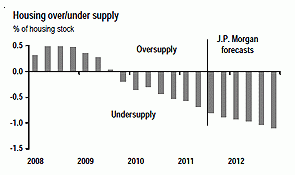
Indicative of the worsening imbalance, new housing supply increased just 15,600 last year, well below the 21,000 level we estimate is required to satisfy demand. But, as indicated by our housing market model (second chart), the level of aggregate undersupply has been rising since end-2009.
To estimate whether housing is over or under supplied we:
• Estimate the size of the dwelling stock. We derive this from Stats NZ estimates of the number of residential dwellings from the Census data. Between Census collections, we estimate the number of dwellings by adding the number of quarterly dwelling approvals to the data series.
• Estimate the size of the 'desired' housing stock, based on underlying demand. This requires an estimate of the average household size—we use persons per house (number of houses divided by population) as a proxy to obtain a quarterly series. The number of persons per house has been on a steady downward trend.
This year, we forecast that just under 14,000 permits will be issued, even accounting for an acceleration in the number of permits issued in 2H11.
Given that construction activity tends to lag consent issuance by roughly six months, new home building likely will stay anaemic until 2012.
A number of factors are constraining supply.
Red tape has increased the cost of getting building permits, some councils have limited land supply, and construction costs have risen - the CPI subindex for construction has been increasing at a faster rate than headline inflation.
Furthermore, the Productivity Commission recent take on housing affordability in New Zealand highlighted that housing supply may be unduly slow to respond to rises in demand. This, it said, potentially owed to inefficiencies in the building industry or deficiencies in government regulation, such as insufficient and delayed land release.
The Commission highlighted that poor productivity in the industry also was a factor contributing to supply constraints.
Poor productivity resulted in more expensive housing than otherwise would be the case.
The demand side of the equation
That all said, the rate of house price appreciation will be limited by softer demand-side dynamics.
Inbound migration flows have softened, households still are focused on paying-down debt, and interest rates are likely to rise.
 First, weaker migration inflows will offset some of the upside pressure on house prices. Migration in and out of New Zealand tends to create significant fluctuations in housing demand. But net migration flows have reversed since the February earthquake in Canterbury and, for the year to July, the net outflow of migrants was just 2,900, the lowest number in a decade.
Second, households remain cautious with respect to their spending - most households are still focused on rebuilding precautionary savings. Households have been reining in their liabilities, with household credit falling in March for the first time in more than two decades (although it has since increased modestly) and the debt-to-income ratio recently falling.
And, while nominal house prices are just 5% below their most recent peak in 2007, in real terms they are much lower, with the ratio of housing assets relative to GDP falling from 3.5 in 2007 to 3.1 in 2010.
There also is the threat of rising interest rates.
We think that the RBNZ will deliver the first rate hike in December, providing the global situation does not deteriorate further.
Regional disparities to widen
House price gains will not be uniform across the nation, however, particularly given the distortions created by the earthquake in Canterbury. Persistent aftershocks in the region imposed constraints on rebuilding in the first half of the year, limiting new housing supply.
House prices increased until July amid high demand for homes in undamaged areas, before falling in August. Canterbury likely will experience further house price declines in the near-term as some residents leave the area permanently.
But the exodus of Canterbarians likely will mean, at least in the interim, that existing housing shortages will intensify in other areas, such as Auckland, and house prices rise.
Momentum in the Auckland market already is building, thanks to strong internal migration inflows and a chronic shortage of new housing. The city of Wellington will, though, benefit to a lesser extent. The Wellington housing market is directed by trends in government hiring more than other cities, and the government has committed to reducing the size of the state sector.
------------------
Helen Kevans is a Sydney-based analyst at JPMorgan Australia.
You can contact her here.
We welcome your comments below. If you are not already registered, please register to comment
Remember we welcome robust, respectful and insightful debate. We don't welcome abusive or defamatory comments and will de-register those repeatedly making such comments. Our current comment policy is here.