


The number of first home buyers taking out low equity mortgages climbed back up over the 50% mark in June.
According to the Reserve Bank, 2707 mortgages were approved to first home buyers in June. Of those, 1358, or 50.2%, were low equity loans, where the borrower had less than a 20% deposit.
Low equity lending to first home buyers has grown significantly in recent years.
Ten years ago, less than 30% of the mortgages approved to first home buyers were low equity loans. It passed the 50% mark for the first time in January this year, before dropping back under 50% from February through to May and pushing past 50% again in June.
Also over the last decade, the amount of money banks have provided to first home buyers as low equity mortgages has increased more than fourfold, rising to $881 million in June 2026 from $218 million in June 2016.
Over the same period, the total value of mortgages approved to first home buyers with at least a 20% deposit has increased by a relatively modest 39%, to $721 million in June 2026 from $520 million in June 2016.
This suggests low equity mortgage lending to first home buyers will be helping to prop up banks' overall lending levels, and is also likely to be propping up house prices.
That's because first home buyers have a natural tendency to buy the most expensive home they can afford, which generally means borrowing as much as they can, which of course is dependent on how much banks will lend them.
Low equity loans are considered higher risk, because they would generally give the borrower less wriggle room to restructure their repayments should they strike financial difficulties, and the bank also has a lower level of security in the event of a default. Low equity loans are, however, more lucrative for banks because of the extra fees they charge for them due to the higher risks involved.
Interest.co.nz estimates the average price paid for a home by first home buyers taking out a low equity mortgage in June 2026 was $721,000. Meanwhile first home buyers with at least a 20% deposit paid an average of $668,000, which was 7.4% less than their low equity counterparts.
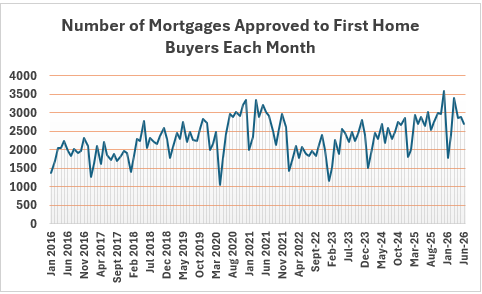
The Reserve Bank figures also show strong growth in total mortgage approvals for first home buyers over the last four years, rising to 2707 in June this year from 1885 in June 2022. That's up 882, or 44%, over the four years, but that growth was almost entirely driven by the increase in low equity lending. (See the graph below for the monthly trend).
The total number of low equity mortgages approved over the same period increased from 483 to 1358, up 875 (181%), while the number of standard mortgages (with at least a 20% deposit) actually declined, from 1402 in June 2022 to 1329 in June 2026 (-5.2%).
The comment stream on this article is now closed.

5 Comments
Fantastic, scraping the bottom of the barrell, in the qualified buyers ranks......
This all in the middle, of a siesmicly changing and crashing NZ housing market.... what could possibly go wrong???
The crash isn't making houses more affordable. It was probably easier to buy one at the peak.
Never wise to pay at 5xDTI or higher.
Less Debt buyers are always best placed, to not be Dddebt slaves, their entire natural lives!
Strawman
What a perspective. The crash is making the debt servitude to own you own shelter less of a burden.
The last Govt ran out of ideas and unleashed an excess of printed cash, and allowed the banking sector to spray it everywhere for far to long. This created an artificial buying capacity, the truth of which is coming home to roost in spades. Those who bought with low equity at peak stupid (21-22) are in a very difficult place. How is that better...?
We welcome your comments below. If you are not already registered, please register to comment
Remember we welcome robust, respectful and insightful debate. We don't welcome abusive or defamatory comments and will de-register those repeatedly making such comments. Our current comment policy is here.