
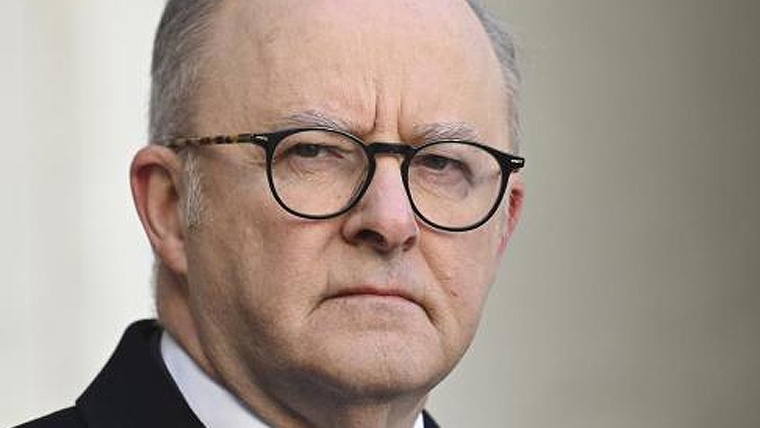
No doubt Australia’s Labor Prime Minister Anthony Albanese was hoping for a Kamala Harris victory in the US presidential election. But not just for the obvious ideological reasons.
Back in 2017 Albanese, a shadow minister at the time, was involved in a videoed panel discussion about then President Donald Trump. When asked how he would deal with Trump, Albanese’s response was ‘with trepidation’.
He explained that Trump ‘scares the shit out of me’ and expressed concern that 'the leader of the free world thinks that you conduct politics through 140 characters on Twitter’.
Albanese probably isn’t the only world leader who holds these views, but he may be the only one foolish enough to have knowingly shared them on camera.
Unfortunately, he won’t be able to rely on the Australian ambassador in Washington to smooth relations with the Trump administration. That ambassador is Kevin Rudd, a former Labor Prime Minister who has previously tweeted that Trump is ‘nuts’, ‘a traitor to the West’, ‘a problem for the world’, and ‘the most destructive president in history’.
Whether Rudd will remain in Washington as ambassador is another question. Earlier this year, Trump was asked about Rudd’s impolitic tweets (since deleted). In his inimitable style – part derision, part threat – Trump replied ‘I hear he's not the brightest bulb, but I don't know much about him. But if he's at all hostile, he will not be there long.’
Albanese rang Trump on Thursday morning to congratulate him. It’s not known whether the latter made any reference to the previous ill-advised comments of the PM or his ambassador.
Of course, those comments are the least of the Australian PM’s problems arising out of Trump’s victory. With an Australia election due in the next six months, Albanese will be particularly troubled by one feature of the US presidential election – the negative impact that the cost-of-living crisis appeared to have on the incumbent.
Two other issues that may be relevant in the Australia election were immigration and the culture wars. While those issues may present differently down under, the rightward shift reflected in the US results would be potentially damaging to the electoral prospects of a centre-left government like Albanese’s.
Going forward, a Trump presidency will create a raft of economic, security, and environmental challenges for Australia.
The President-elect once described ‘tariff’ as ‘the most beautiful word in the dictionary’. That spells trouble for a trading nation like Australia.
Trump campaigned on a policy of 60% tariffs on Chinese imports. If implemented, these tariffs would have an adverse impact on the Chinese economy. That would flow through to Australia as a major supplier of iron ore, coal, and other raw materials used by China to manufacture its exports.
In a worst-case scenario, US tariffs on Chinese imports could lead to a full-scale trade war between two of Australia’s largest trading partners with significant repercussions for the domestic economy.
Australia has a Free Trade Agreement with the US. Hopefully that would protect it from tariffs on most of its $20 billion a year plus exports to the US. However, Trump is a keen protectionist, and nothing can be ruled out. Australia used its close relationship with the US to avoid tariffs on steel under the first Trump administration but there are no guarantees that outcome can be repeated.
These concerns may help explain the dramatic drop in the Australian dollar during Wednesday as Trump’s triumph became apparent. Interestingly, most of that drop has subsequently been reversed.
The other immediate effect on Wednesday of the Republican victory was a rise in Australian bond rates. Many of Trump’s policies, including tax cuts and the imposition of tariffs, are expected to be inflationary which puts upward pressure on interest rates.
However, which policies will actually be implemented by the new President, and when, is impossible to predict. That adds to market volatility.
Trump’s unpredictability is also a feature of his geopolitics. That creates uncertainty for Australia in the Indo-Pacific. What will Trump do if China invades Taiwan? Where does Trump stand on the ‘Quad’, Australia’s diplomatic partnership with the US, Japan, and India?
Australia has gone all in on AUKUS, a security partnership with the UK and US. That includes a $368 billion deal to acquire US nuclear submarines. Are those arrangements secure or will Trump, a noted dealmaker and isolationist, look to renegotiate or even abandon them?
The President-elect claims he will resolve the Russian invasion of Ukraine in 24 hours. That could only be achieved through a major loss of territory for Ukraine. Where would that leave Australia which has been a staunch defender of Ukrainian sovereignty and territorial integrity, and which has given the country more than $1.5 billion in various forms of aid?
Trump has also indicated that he will disengage from global climate initiatives and pursue a policy at home of ‘drill, drill, drill’. That would almost certainly be a disaster for concerted global action on climate change and trigger tremendous pressure within Australia to once again harvest the nation’s abundant carbon fuel resources. Where would that leave Australia’s climate policy?
Trump will take office next January. Between then and Australia going to the polls in May, he may have created no end of trouble for Prime Minister Albanese’s reelection campaign. The PM’s injudicious comments back in 2017 may prove very prescient.
*Ross Stitt is a freelance writer with a PhD in political science. He is a New Zealander based in Sydney. His articles are part of our 'Understanding Australia' series.
We welcome your comments below. If you are not already registered, please register to comment
Remember we welcome robust, respectful and insightful debate. We don't welcome abusive or defamatory comments and will de-register those repeatedly making such comments. Our current comment policy is here.