
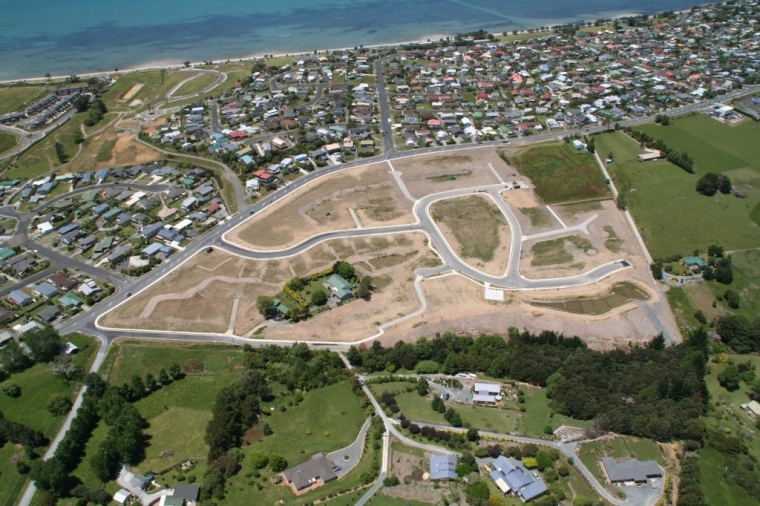
A high-powered government working group has concluded that declining interest rates, the tax system and restrictions on land supply for housing were the main drivers of higher house prices over the last 20 years.
The Housing Technical Working Group is a joint effort by The Treasury, the Reserve Bank and the Ministry of Housing and Urban Development. It has been studying the drivers of house prices and rents and the impact these have had on New Zealand households.
It's initial report, released today, 18 August, focused on the housing market in the Hamilton-Waikato area "to draw insights for the rest of Aotearoa New Zealand," according to the Group's chairman Dominick Stephens, who is also Chief Economic Adviser at The Treasury.
"It is commonly asserted that a lack of dwelling supply relative to population has been a key driver of rising house prices in recent decades," the report said.
"But physical supply and demand should affect rents as well as prices, and over the past 20 years house prices have risen more than rents.
"Our key conclusion is that a combination of a global decline in interest rates, the tax system, and restrictions on the supply of land for urban use have led to a large change in the ratio of prices to rents and are the main cause of higher house prices in Hamilton-Waikato, as well as other parts of Aotearoa New Zealand, over the past 20 years."
The report concludes that although falling interest interest rates had the biggest impact on house prices, that impact would have been mitigated if the supply of new homes had been greater.
"In the context of restrictions to land supply, the key driver of house prices over the last 20 years has been the global decline in interest rates that significantly reduced the cost of debt servicing and increased home buyers' ability to pay," the report said.
The resulting increase in demand inevitably caused an initial lift in prices.
"If land supply had been more responsive, then over time that initial price rise would have incentivised a larger housing supply response, causing prices to retreat and rents to fall below their initial levels relative to income.
"This did not fully happen because land supply has been restricted.
"Due to restrictions in land supply, much of the global decline in interest rates was instead captured into, or captured by, higher land prices.
"As land prices rose alongside house prices, there was less incentive to build new houses, and less of a supply response.
"Consequently, the initial price rise caused by lower interest rates persisted, and the longer run retreat in prices and decline in rents did not materialise.
"Evidence supporting our conclusions includes the fact that prices rose much further than rents, that the price of land rose much further than the cost of construction of new dwellings, and direct indications of restricted land supply," the report said.
The report also concluded that the supply of housing relative to demand from population growth, had a bigger impact on rents than it did on house prices.
"Until recently rents in Hamilton-Waikato had moved broadly in line with, and at times slower than incomes over a long period," it said.
"Trends at a national level were similar.
"But since 2015, rents have increased sharply across the Hamilton-Waikato region as population has grown faster than the supply of dwellings.
"The worsening availability and affordability of rentals has increased financial stress and homelessness.
The increase in rents since 2015 is likely to have had a larger negative impact for the wellbeing of society's most vulnerable members than the large increase in house prices."
However the report did see some relief coming for both renters and home buyers.
"Interest rates are a key driver of house prices," it said.
"It follows that the recent sharp rise in mortgage rates is the main cause of the recent decline in house prices, and are likely to dampen house prices further.
"Because rents are more clearly related to the local balance of supply and demand for dwellings than house prices, we expect a moderation in rent price inflation at a national level.
"Since 2020, population growth has been very low and construction activity has accelerated.
"This combination is diminishing the housing shortage that built up last decade, and in time this partial alleviation of the housing shortage is expected to reduce the rate of rent inflation," it concluded.
The full report is available here.
The comment stream on this story is now closed.
- You can have articles like this delivered directly to your inbox via our free Property Newsletter. We send it out 3-5 times a week with all of our property-related news, including auction results, interest rate movements and market commentary and analysis. To start receiving them, register here (it's free) and when approved you can select any of our free email newsletters.
We welcome your comments below. If you are not already registered, please register to comment
Remember we welcome robust, respectful and insightful debate. We don't welcome abusive or defamatory comments and will de-register those repeatedly making such comments. Our current comment policy is here.