By Hannah Lynch
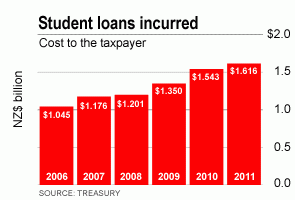
Last year over 250,000 students borrowed over NZ$1.6 billion interest free from the taxpayer and were paid NZ$570 million in living allowances.
A quick Facebook status update and a Tweet prompted a deluge of anecdotes and comments detailing how students and their families are using and abusing these payments, which have been described as middle class welfare.
Interest free loans are being reinvested in interest earning deposits or used to repay interest bearing loans, while allowances are being used for holidays and gadgets.
Wealthy families are also structuring their assets in family trusts so children can claim means-tested allowances. Some families falsely claim relationship breakdowns so children aged under 24 can claim extra independent living allowances.
Here's a few other examples:
- Students on facebook stated they enrolled in papers and then dropped them in order to get their fees refunded while still receiving living costs.
- A student loan is made up of three parts – compulsory fees, course-related costs and living costs. It is not uncommon for the annual NZ$1,000 course-related costs to be used to pay for international airline tickets.
- Students explained how they provide the Ministry of Social Development's studylink service for student finances with a quote for a laptop in exchange for NZ$1,000 used to fund tickets to Asia or Fiji - a great interest-free OE starter.
- The unwritten rule among students is that you apply for the maximum amount of living costs. This is up to NZ$169.51 a week while you are studying, or on a study break of three weeks or less, like a mid-semester break.
- Students detailed how they then invested the money in high interest bank accounts while working a part-time job to fund their lifestyle. The loan and student allowance is then repaid at the end of their study. The interest gained means students are profit from their loan repayments.
- Students also cited examples where they had claimed relationship breakdowns with one or more of their parents. Students must present Studylink with evidence from a psychologist that the relationship between them and their parents was detrimental to their psychological wellbeing. A student who lives at home while studying can only apply for an allowance if their parents’ combined annual income is less than NZ$82,953. If a student lives away from home their parents' combined annual income must be less than NZ$89,936. These rates vary if your parents live together or in separate households or if the parent supports other full-time dependent students aged 16 to 23 years. Several students admitted to getting their mail redirected to a different address while continuing to live at home.
- Finally, students recommended visiting all the banks during the universities orientation weeks and receiving a free NZ$20 for simply opening an account.
Pros and cons
Student representatives acknowledged some students abused the system, but said the majority were responsible. ACT said the decision to offer interest free loans was a Labour election bribe that invited abuse.
New Zealand Union of Student Association Co-President David Do said a vast majority of students borrowed to pay their fees and this was "perfectly appropriate."
Do said "there have always been anecdotes of abuse but we not not condone it. The loan system is there to assist people with the cost of living and a vast majority of students are using it responsibly."
"The loan system is there to assist people with the cost of living," he said
ACT MP Heather Roy said reapplying interest to student loans would not only encourage students to think more clearly about what they wanted to study, but would also help the tax payer who currently subsidises at least two-thirds of tertiary students’ fees.
Interest free student loans have increased 50% over the last five years with more than NZ$12 billion of student loans still outstanding. For every dollar the government lends, it expects to receive back around 55 cents in 2011 dollar terms by the time it is repaid. Of the NZ$12 billion of loans outstanding, the government has a book value on those loans of NZ$7.3 billion, implying losses already of NZ$4.7 billion including forgone interest.
The government announced changes in Budget 2011 on May 19 to restrict eligiblity to those already in default, to stop those aged over 55 from borrowing for course-related costs and to shorten the repayment holiday for overseas based borrowers. See full details here at Beehive.govt.nz
Tertiary Education Minister Steven Joyce told Q&A in April that 85,000 students were living overseas and owed NZ$2 billion, with 35,000 of those behind on their payments. The loans of students who emigrate start incurring interest after a six month 'holiday'.
The Inland Revenue Department declined to comment on how students were abusing student loans and allowances. Studylink also declined comment.
'Not their fault. It's 'free money'
ACT Roy said students were just responding to incentives.
“Students, like everyone, will always respond to incentives and when there is no incentive to borrow wisely this sort of behaviour is inevitable. While many students may be rorting the interest-free loan scheme, the blame really lies with the politicians who created the system."
“Since being implemented student debt has risen hugely. Because loans are interest-free students have no incentive to minimise their borrowing or to repay their debt any faster than they have to. They are effectively being given free money,” Roy said via email.
81 Comments
A couple of Ground Rules are needed , because our kids dont realise that rights dont come without obligations .
1) Only fund recognised institutions , not private haridressing colleges and other such nonsense
2) If you dont pass , you're on your own , and start repaying immediately
3) If its a 3 year course , then funding for 3 years only , not 7 years.......
4) We hear of people learing to fly helicopters at private air school colleges and then departing to Australia "to get work " . Why are we taxpayers apying for training of scores of Chopper pilots , when the airforce only needs 5 new pilots a year and the private sectors needs 3 new pilots a year ? We should have a needs assesment for some of these "fun " courses because its wasteful .
Another wonderful Labour govt creation left behind by that great leader who knew a thing or two about how to buy votes. On the plus side at least we will not run out of fraud happy business people. Guaranteed heaps of work for the new finance police force.
Just another seriously dopey policy from Labour's Clown of Finance , Michael Cullen ....... a last minute teaser , written up on the back of a Bellamy's coaster , to out-bribe National in the 2005 election .
.... And as the venerable Don Brash said at the time , this policy will spiral out of control , as it sends all the wrong messages to students .
Vote ACT , 2011 ..... !
Totally, we should really avoid stimulating our knowledge-based industries and beat any ideas of opportunities for learning out of the next generation. They should all be minimum wage labourers, that'll fix our economic woes.
Apart from the fraudulent practices you describe (claiming fees for cancelled courses, lying about parental income or home address), I really don't see the problem here. Students are entitled to interest-free loans, so they take them: Of course they do!
If some students choose to invest their loans in interest-paying accounts and work part-time, then that's their choice - they should be congratulated for demonstrating financial intelligence!
The right solutions are:
1. To charge a rate of interest which is tied to CPI inflation - no more, no less. This provides some incentive to repay the loan, without amounting to usury.
2. To minimise means-testing of any student loan benefits, as all means-testing systems are prone to abuse.
3. To prevent those with student loans in arrears from leaving the country (as would be done for any other loan).
Prior to the introduction in NZ of PAYE and Provisional Tax, you had to apply to the IRD for a Tax Clearance before you could leave the country. That requirement was then abandoned. Imagine developer Henderson trying to go off on a trip of o/s leisure if he had to ask the IRD for permission.
Hannah, go to university, get a student loan if like, but make sure you do some research papers while you're there. First it's government by focus group, now research by facebook. What next - court verdicts via opinion polls?
Haha, just ask Ian Wishart as he is feeling the same pain today.
Carpetbagger,
How do you think students talk to each other these days? What do you think the most efficient way to ask a bunch of people on the ground what they are doing these days is?
About 2 million New Zealanders use facebook these days.
There has not been any academic research or even government surveys done that we have seen. Maybe this article might prompt a few to be done.
Are you suggesting that the media never report anything until it has been scientifically documented in an academic paper?
cheers
Bernard
PS You might also note the interviews with the head of NZUSA and ACT's spokesman. And the detail from Budget 2011...
Bernard,
Given that a vast amount of university research coming out is undertaken on students these days, then the answer is simple. Design a competent survey, go into lecture theatres and get a more representative sample of students, get a decent enough sample size to be able to control for covariates etc (e.g., rich Mummy and Daddies), analyse the data and interpret within the design's limitations.
What I am saying is that bad data is not a substitue for no data.
Many contributors to this site seem perfectly confident that they know ,better than Government Departments ,what policy decisions Government ought to take - impose taxes, pass legislation, run other people's lives - based on something they saw blogged by some bloke on the Internet, so to suggest that a journalist ought to go to such great lengths just to publish a story seems a bit OTT.
And then when they've finished they're off overseas on their OE, because, like, New Zealand is not good enough for them.
Perhaps posters here should, before they post, declare if they are an Baby Boomer or an X that benefited from free university studies.
I am gutted to be paying for something I would once have received for free, despite an interest free loan.
Interesting how it is the wealthy that are rorting the system. I know of one fellow mature student that is using a maiden name to secure a loan. Single income family yes, but not exactly hard done by. The rest of the story would probably make some cringe, but I won't risk a breach of privacy.
"I am gutted to be paying for something I would once have received for free"...yeah sure scarfie, we been over this old ground before you got off the potty...nothing is or was free scarfie...someone always pays got it...so back when I went to varsity as you say for "free", the tax rates were a bloody sight higher than today and always had been...this place was socialism on steroids..so stop with the BS and start paying for the loan you decide to take out to pay for the education you decide you need....or you could double your tax rate for the next 40 years...suck on that.
Remind me how 66% tax rates was free education ?
Scarfie - get your father to pay 66% tax as my father was back in my university days, and you can have "free" education as well with no loan. Your father won't have paid much more than 39% at worst I'd be guessing so you get what you deserve - I'm heavily into user pays, and this current method is way better because in fact I never went to University yet my father "paid" for it - that said, interest is open to abuse and needs to be corercted
Grant A - there was no GST when your father was paying a top rate of 66% - and no such things as "user pay" charges for the raft of things we have those on now. And that's before considering local government taxes and the well upwards of CPI rises we see on those year on year these days.
Bollocks Kate...you forgot about the raft of sales taxes and import duties and surtaxes all of which together represented your gst.....do your homework.
Wolly, not really. Import taxes were applied to luxury goods and/or for the protection of local manufacturers. And of course there was no tax on services. The taxes were avoidable through not buying said imported goods. GST was the tradeoff against direct taxation (PAYE);
Goods and services tax (GST) is an indirect tax introduced in New Zealand in 1986. This represented a major change in New Zealand taxation policy as until this point almost all revenue had been raised via direct taxes. GST now makes up 19% of the New Zealand Government's core revenue.
http://en.wikipedia.org/wiki/Taxation_in_New_Zealand
Do some homework Kate....either the sales taxes on top of import duties with govt charges to boot were paid or you had to pay the stupidly high prices on local crap which amounted to a tax anyway. Go check out what women were paying on cosmetics, shoes, clothing, the list includes everything. It was a scam policy that protected grossly inefficient thieving NZ manufacturers who had monoploy plays going with the full support of the idiot govts. NZ was a socialist state....bloody awful.
Wolly, I moved here from the US during the Muldoon years. As I was university educated I got a good job straight away with a company vehicle that I could use to my hearts content for private running as well. Both hubby and I paid tax at that highest rate from the word go.
I recall being amazed at the low cost of living - I think we used to put three pennies in a milk bottle at the bottom of the gate. We ate roast lamb twice a week and I never thought about the cost of steak for the BBQ. Sure, when we went to buy a TV we could only afford a 14" one, and I only had one pair of each type of shoe (sport, work, casual), and 2-3 good suits with a handful of blouses. And we hung the washing out on the line because we couldn't afford a clothes dryer. But, we could afford a boat and we spent the weekends off Kapiti catching cod and tarakihi galore. Hubby was a diver, so crays in the freezer as well. A jug of beer in the local set us back a couple of dollars - everyone, from the local plumber to the bank manager, stood around the same table drinking and smoking with hardly a care in the world. Need I go on?
I just get sooooo frustrated with old folks who refuse to admit how good it was in those days.
Wolly and Grant right argument but wrong conclusion. The point is my father DID pay 66% tax so I could go to university. Because I put it off until I knew what I wanted to do I am now having to pay again for the same priviledge. I am also likely paying for a lower quality of learning., given that my university operates like a business now instead of a school.
Further all that tax my father did pay could instead have been the deposit on a modest house for me, which is a similar sum to what my degree will eventually cost.
Good point, Grant A. My father and mother paid the top tax rate 66% for years, as did many of the members of my extended family. Not one of them saw the inside of a University to receive a tertiary education, free or otherwise. I paid my student loan back years ago.
The interest free student loans introduced as an election bribe by Clark and Cullen and their flunkies in the Labour Govt. (fancy actually having to buy an election because your policies/values/approach so suck that there is no other way of wining one) sickens me.
Bang on Grant A...the younger mob are always pointing the finger at the old buggers and shoving the pension down our throats...in between packing for their next state sponsored OE trip...
Sooner the idiots in the Beehive slam the lid on this Labour vote buying rort the better...why have they been too gutless to end it....how much must be wasted before National wake up?
Interest free sudent loans is an unaffordable election bribe put forward by an unscrupulous politician named Michael Cullen.
Interestingly, Heineman's New Zealand dictionary has two meanings for one particular word;
(1) An unscrupulous person.
(2) The female genitalia.
That is why I refer to Michael Cullen as an unscrupulous person.
But I digress. What is bad is that Student Loans are written off at death, and do not appear as a liability of a deceased borrower's estate. This is silly.
It would have been unwise of me to bring up that point to a caring father some years ago when Student Loans incurred interest. He paid more than $10,000 to clear his darling daughter's debt, and two months later she was involved in a tragic accident.
Gen X, single, been paying tax since I was 15.
Been paying my course costs only loan back since I was required to start through PAYE level deductions about two years ago.
No funny business here like the story suggests above.
Just did without the money even though you cant help thinking it would be better used in your own life but really looking forward to the extra income when im paid up in October.
Sorry if this comment is boring but thought some balance was required here from the really vanilla non-scandalous part of society that just makes such riveting reading for you all this brisk winters evening
yawn
Alby, I too have a strudent loan, as do most of my contempories. The sort of thing being reported here is not what I see, but then I came from a working class background where the money was used on food and roofs over heads. I can even remember using my loan to by a crappy old Morris Marina van for my father, whose crappy old Honda Civic blew up, and he couldn't afford another vehicle. In those days though the interests rates were above market rate, and if you went on to do postgraduate study, you were doomed...
"Students detailed how they then invested the money in high interest bank accounts while working a part-time job to fund their lifestyle.
Where are these "high interest" accounts?
:-) - good point!
Higher than Zero percent...
Here's all the rates banks and others are offering on term deposits
http://www.interest.co.nz/saving/term-deposits-1-to-5-years
http://www.interest.co.nz/saving/term-deposits-1-to-9-months
About 5% for 2 years these days before resident withholding tax.
cheers
Bernard
student loans is one massive disaster, as is the university system in general
degrees have degenerated to the lowest common denominator, seems even Asian students who can hardly speak or write a word of English can get degrees (and I am talking about degress were you need to write essays and assignments). Its a complete farce.
This nonsense about how everyone should be able to get a degree is bull. The whole point of a degree is that it should be a mark of higher learning and academic ability.
If a degree was more elite as it should be then we would have far fewer uni students. If we had half the student numbers then Govt would expend the same money and give more students more assistance, therefore reducing the need for student loans
appalling
Hugh - do a search on TradeMe or Seek and let me know how many advertised trade apprenticeships you come up with.
Those opportunities simply aren't out there in number these days. Hence, the majority of young people seek some type of formal tertiary study.
Goodness me, you are averse to actually getting the facts for yourself! Okay, here it is:
All of NZ apprenticeships advertised on TradeMe = 19
All of NZ apprenticeships advertised on Seek = 10
You've hit the nail right on the head with that one, Hugh. That is particularly a feature of the East Asian communities here in New Zealand, where their little darlings are pushed into becoming doctors, lawyers, engineers, etc., regardless of whether or not the kid has the capacity so to be. It’s then left up to the staff - sometimes at considerable personal cost in terms of time or stress - to sort them out, which really, when you think about it, shouldn’t be the role of a University. Those kids shouldn’t be there in the first place.
Couple of points:
Zerto cost = infinite demand. ECON101. Applies to health and ACC as well as edumication.
And have a gander at the 'Higher Ed Bubble' tale over at instapundit.com: the base premise is the bleedingly obvious fact that, in an age of credentialism, most 'degrees' do not add the lifetime increment in earnings, that justifies the creation of the debt. It has taken a while for the poor saps who enroll in this boondoggle to figger it out.
For a working example, try a Diploma in Aromatherapy. A few more a them, we'll have ourselves a Thriving Economic Environment!
I obviously went to university at the wrong time, in the 1990's. Did a very useful degree that lead to a real job, but got charged compounding interest at market rate of 7-8% annually on my student loan while still studying (and after graduation) got charged $8,000 componding interest in my final year while still studying!! I think that was a rip off, especially when previous generations who were in power and got free educations set those fees! But the no interst at all now is gone too far the other way. A rate of interest equal to the rate of inflation + a small management fee would be fair.
If you incurred $8,000 interest in a year your loan must have been around $100k. That suggests some combination of: did an expensive course like dentistry that you will have been subsequently been well compensated for, didnt work at all the entire time you were at uni and/or mucked around alot in a shorter/cheaper course.
I worked about 30 hours a week the whole time I was at uni, there was no need for me to borrow living costs but why would any student pass up free money.
Interest free loans should be immediately changed. I repaid my loan in 4 years at minimum repayments as there was no reason to do it any faster. My partner could repay hers today but she wont be so the government will likely get it back at minimum amounts over the next 8 or so years. I guess we're better than a lot in that they are/will be paid back at all but there needs to be much more incentive to do so.
No "combination". It was an expensive course, was a highly competitive course, worked my arse off, no time to do anything else, no mucking around, passed everything, did course in minumum time possible.
Lockwood was a swine...
Quite right CM...so why is this useless govt too gutless to end the rort?....set the cost at the ocr rate and put in place bloody tough punnishments for scam artists who take the loans and bugger off.
It is not that the loans are free that is the problem...it is the fact that this govt lacks the guts to get rid of a rort started by Helen Clark.
Chris M - read my 8.03pm post above - how is paying 66% tax rates "free" education ? Please explain as Gen Y type cite it all the time - love an explanation
Well, I gave you one - but I'm not Gen Y.
Here is an explanation for you,
The 66% was you paid was only on the highest part of your income not the whole income.
When I graduated I was paying about 38% tax on highest income + 10% income compulsory student loan repayments on all my income + about 12.5% GST on evertything, that adds up to about 60% tax. In fact had to pay far more than 10% repayments to make any progress on the loan. About 70% of my whole income went back to the Government until I was generoulsy given money to help repay the student loan, or else I would have left the country.
Is reason why so many of colleagues have left the country, who were not so fortunate, and won't be back. Never mind the outrageously priced housing at present.
If that is the only reason they have for leaving New Zealand, then good riddance to them I say. That is the type of person, low on personal character and integrity, that this country can well do without.
I only hope that any unpaid student loan that they have bludged off the New Zealand taxpayer will be vigorously pursued from them by the authorities.
Unfortunately the country does very much need them at present. The student loan or costs situation in the graph at the to of the page is only the tip of the iceberg regarding some degrees. For instance in medicine or dentistry a student may easily build up over $100,000 debt without wasting any money.
What is not included in the unpaid student debt graph is that for the above degrees there is also $200,000 to $300,000 of further tax payer money invested in each student. This taxpayer investment is also lost when they go overseas permanently.
What bank or company would put that amount of investment into a business without vigourously protecting their investment to make sure they got a good return on their investment.
Australia has just made it easier for NZ health professionals to work there. It has been proposed that if all NZ trained Dr's remained in NZ we could close one of our two medical schools and be just as well off as we currently are for Dr's.
Attention all new parents - save $1 a day for your kids future eductation. Every time your kids bank account hits $1000, invest it somewhere safe. Compounding will see it grow and grow. By the time your kids go to Uni you'll have sufficient cash to give them a great start at Uni, or elsewhere if you so choose. Why not get them to pay it back to you so they learn how to borrow and pay back loans. They can then teach their kids this great habit. It's all about discipline.
This is a major issue. In my experience abuse of the system is the rule, not the exception to. We must reinstate interest on student loans and remove entitlements to living costs for study which is not of core benefit to the country. Medicine, agriculture, engineering, economics, science are fine. But arts degrees for damn sake, this should be at the students expense right off the bat.
I would also suggest that the idea of borrowing to reinvest interest free normally turns out to not being able to repay at the end of study as these funds are dipped into in time of need.
In my experience abuse of the system is the rule, not the exception to
Really? How have you come to that conclusion? Specifically, are you aware of widespread abuse, or is your knowledge just anecdotal?
The fact that i know a lot of students who openly admit to abusing the system.
Hey guys
Good debate. I'm an early Gen Y. I got a student loan at 7.5% compounding. Worked while I studied and paid off half the loan over the 4 years of the degree. And then paid the rest off in my first year of work. The interest was the incentive to pay it off quick.
FYI-Im doing exactly that fro my 3 kids :)
Reinstate the interest and alot of the issues will be improved
Regards
Hey, you older fellows who had 'free' university tuition, don't feed the raw prawn about Muldoon's 66% marginal rate of tax, because he did that in part to cover the biggest election bribe of all time, his National Super scheme.
How about a trade off?
Abolish student loan scheme in return for abolishing national super scheme, bet you can't handle the latter suggestion.
It wasn't "free" me....nuffin is free...it were paid for one way or other...user pays...us old farts will get the pension as users cos we paid all our friggin working lives the extra taxes to be able to afford the pension...don't blame us if the useless lying idiots in the Beehive buggered the economy....now pay up.
Wolly, you paid a portion of your taxes thinking they were put aside to cover your pension.
In reality, your government squandered your tax revenue on the current expenses you benefited from at the time.
It is a mathematical impossibility that you and the rest of us will get the value of what we were let to believe we would get in retirement.
Don't expect the next generation to have to work twice as hard to meet your expectations of what previous governments may of promised you in retirement. Its not going to happen.
You are a smart guy, I am sure you have seen it coming a mile off and you have prepared for it. If not things may get hard.
Those rotten buggers...you mean it was nothing but a stonking great load of BS all those years...but but that must mean all the promises being made now to the X and Y mob are also nothing but bloody lies too.
I woudl dispute "squandered" as applied to public expenditure from which working-age people (and younger) benefit. They're the ones who create wealth and will deliver the country's future (unlike retirees) - surely money spent to their benefit should be regarded as investment?
The money that boomers had paid in tax, thinking it was going to go toward their retirement later in life was obviously squandered.
If it was spent on other things thinking it would "create wealth", the "investment" surely hasn't paid off.
For if it had, we would have had allocated somewere enough to cover the pension for the impending wave of wrinklies who are expecting to be looked after.
At some point there wont be the capacity to extract tax from X and Y'ers.
I am sure X and Y'ers are finding it hard to see the "benifit" they have received. (they have generally had to pay for their own education, see little prospect of getting pension and having to pay inflated housing prices.)
"They have generally had to pay for their own education" - come off it. The huge majority of the cost of education up to and including tertiary is paid by the taxpayer, unless you're going to a private school.
ME: Trade Off? Raw Prawn? Muldoon Bribe? Where do you get that from? Suggest you do your homework. Ordinary Income Tax rates were 66% long before Muldoon came along and in addition to that there was Social Security Tax of 7½% on top.
The mis-direction of mathematics. Note: the parents of University Students paid marginal tax rates of 66% on their top levels of income for many years (before) and after their children went to university, not just for the duration of their childrens tertiary education, and then the was the SS tax on every $ of income earned while the comparison to GST which is only incurred on income spent cancels that out. And by the way it wasnt exactly free. If you had a UE fees bursary you got your fees paid for. If you didnt perform you lost your bursary and paid full fees. And then there was the most expensive part .. the Student Union Fees. And the Books .. And they were both expensive. And they werent free. And there was no social welfare support, or accomodation assistance. You were on your own.
It is a looong time ago, but I remember that University was 'free' back then Iconoclast, but much harder to get into and with less selection of degrees.
I think the 'free' part was the course fees. You call it the UE fees bursary ... but you had to pass UE to get into Uni in the first place, (unless you were over 21 I think)
I do remember paying for books and would go to the Student Union Bookshop to get second hand ones to save money. I can't remember how much the Student Union fees were so can't confirm or deny those for you. I do know that my parents paid for my accommodation in Dunedin which for two years was in a hall of residence and covered everything ... room, heating, lighting, and food.
I used my A bursary ($150 per year which went a long way then) for incidentals
There was also a 'standard tertiary bursary' ... I remember applying for this when I went flatting in my third year, my Dad paid my rent and this bursary went towards food and power bills etc. I honestly can't recall if I got that when I lived in the hostel or not.
I was better off than a lot of students there who had to suppliment themselves with part time work while studying, or getting lucrative jobs in the freezing works during the holidays. I also had holiday work in the Summer and savings from that.
I rode a bicycle or walked around, most of us did, maybe only one person in every five had a car by third year.
Most people were proud to finish their basic degrees within 3 years or at least within 4. Only a few people kept going on the system longer than you might like ... however many of those were Cambodian students who did not have a home or family to go back to!
I didn't want my Dad to pay more than he had to, even though much of it was free. Not only was it a matter of pride to pass everything each year, we were not rich. My parents just valued and accounted for my education. Irrespective of tax rates, if you value education you can make it happen for your children. And irrespective of whether or not it is free, you can have a pride in passing as much as you could as quickly as you could.
It was a sort of 'pay it forward' scenario. My parents looked after me and I expected to be able to look after my kids when the time came. I guess this is what responsibility means.
Courses like aromatherapy and hairdressing belong in technical institutes, they were another story back then and I don't know the details. Even nursing was done in the techs back then ... has university made nurses any better?
Interested2:
If you remember that, then here is a simple question for you :-
In your life time how much money have you outlaid on recreational stimulants, nasal stimulants, gameboys, playstations, X-boxes, mobile phones, iPads, iPhones, iPods etc .. just a round figure .. a rough guess will do.
not sure what you are getting at iconoclast, but I will play your game because I am curious.
nasal stimulants $0
gameboys, playstations, xboxes, ipads, iphones, ipods $0
I used to own a record player and a sony walkman ... no idea where they are now.
I have a mobile phone, and use it reluctantly. I prefer the land line or e-mail.
recreational stimulants... a nice wine with dinner, or a good spirit in the right company is fine by me, but not every night and not nearly enough times to excess to be considered 'not boring'.
OK, so what is your point? ....
It was a safe question to ask given your answer. Over the past 12 months the question of the advantages that previous generations have or had over the current generations has arisen in a number of guises. The question of "free education" enjoyed by the BBs and early GenX is just another form of the same question. While the head topic wasn't intended to, it nearly always end up producing the same mantra. This time was slightly different in that some-one asked re-spondents to identify their generation be it BB, GenX or GenY. The purpose being to re-inforce the disadvantage experienced by the current generation compared to earlier generations. The one significant item that is always missing from the bleats of the "disadvantaged" X and Y generations is they never disclose how much they spend on the items referenced in my question. They are all discretionary items exclusive to generations X&Y. The sums involved would, in many cases add up to many $1000's per year. Possibly a deposit on a house. There was extensive media coverage not so many years ago of teenagers running up mobile phone bills of $2000 in one year. And thats just on mobile phones, without getting into the more expensive (white) stuff.
I see iconoclast. At the end of the day we all do the best with what we have got and under the conditions we find ourselves in don't we. It was not our fault that we had free education! However we did have to achieve first to get it.
I have to say that I am disappointed in my own generation though, given that we had such good education we should have made a better job of looking after this Country's assets and culture don't you think?
We were taught to be articulate, but on the other hand University (well at undergrad levels anyway) imparted a certain expectation to conform, is that why the dissenting voices were ignored? or was there another reason?
Encouragingly I have met many Gen Y kids who have good values and struggle to understand the world as much as we did. It is baby boomers who made xboxes and iphones and advertised them so that our companies could make more and more profit each year. Shouldn't we be grateful that Gen X and Y bought them? It kept many of us employed and in good lifestyles for many years.
Reminds me ... I must remember to book tickets to see Roger Walters (we don't want no education!). When did he write that? Anyway it is a good opportunity to get smashed and prove that I know how to party too!
Iconoclast , Wolly etc. Me is right in one way, the Rowling government had a proper superannuation scheme underway which Muldoon axed and gave out his big-time bribe.
The point, I think being made, is there have been 2 big electoral bribes, National with national super and Labour with interest-free student loans. The term 'trade-off' would simply say, if you are pressing to get rid of one thing ie interest free student loans, then be big enough to give up your own rort, universal government super -even Australia doesn't have that.
And Me was hiting the nail on the head when he said, bet you can't handle giving anything away with the super. So if that's the case just stop rabbiting on about things.
Muzza: What was Muldoon's big-time-bribe? You've lost me there. The super currently in force was introduced long before Wallace Rowling.
Norman Kirk's Labour Government brought in the superannuation fund , 20 years before Australia's greatest finance minister Paul Keating brought in their's .
..... sadly , big Norm died in office . And soon after , National's Rob Muldoon bribed the electorate with " a fist full of dollars " election .... . After just 10 months in operation , the super fund was axed , and individual wage earners were refunded their money .......
.... which was convenient , as colour TV had just arrived in NZ .
The voters of NZ gave up their superannuation funds , their promise of a rich and self-funded retirement , for TV sets ......... aha . Yup ........ oh dearie me !
[ Recent estimates put the current accumulated value of the original super fund at $NZ 300 billion , had it not been for the Nats & colour TV ]
And further .. The ATO Australian Tax Office is actively seeking claimants for $18 billion in unclaimed Superannuation Money. If you have worked in Australia in the last 20 years and have a TFN Tax File Number you can check here to see if you are a beneficiary.
http://www.ato.gov.au/super/content.aspx?doc=/content/33301.htm
The real elpehant in the room here is Student Allowance, not Student Loan. It's taxable income tested on mummy and daddy.
Student Allowance cost about $600 Million per year. None of this is required to be paid back - its a gift!
So Mummy and Daddy farmer/business owner routes their income through the Company and Family Trust. Little Jimmy then doesn't need a Loan, as he is so 'poor' he gets an allowance of approx $160 instead.
It's based on taxable income - loss offsets/losses brought forward, trusts and farm development costs brough forward all uses to gain it.
I agree. Admit I'm a 29yo, Gen 'Y' cusper and that used to frustrate me immensly. I went to university in the Waikato and all the farmer children / divorced parents received the allowance and didn't have to pay it back.
My parents didn't give me anything, although they earned enough it was my choice to leave a free home and pay rent etc.
There should be no student allowance; and you should be interviewed prior to obtaining a loan for course fees. Let's face it, who knows what they want to do at 17/18 nor know the consequences of a large loan.
Exactly as advised by KPMG who were our accountants at the time our kids were doing tertiary study. They gave me a referral to their close mates RMcV across the corridor - who dutifully explained the whole scam - not to mention the point that we also would use this Family Trust as a means to ensure the kids with those educations paid for through other taxpayer's money were certain to inherit all our accumulated wealth in the event we needed to further rort the taxpayer in our old age.
And for the pleasure of joining the scam - it was only going to cost me $3,000 to set it up and the RMcV lawyer even had a calculator handy to prove to me how over 4 years of tertiary study for two children, I would easily have recooped that "investment".
I totally agree.
I'm Gen X, studied in the 90's and had a student loan that accrued interest from day one. As far as loans are concerned, I think they should be interest-free while you're studying, but after that interest must kick in if we're to have any hope of people paying them back.
A student loan is an investment in future earnings, so students should bear the cost of that investment themselves (like I did). That includes living costs - as others have said, means testing for student allowances just invites abuse.
Actually vdog repayment times have reduced significantly since 2005.
I'm a Gen Y that narrowly avoided any interest on my student loan, as it was changed to be interest free while I was studying.
I followed the "2 year rule" and paid off my student loan in full this year, taking advantage of the 10% voluntary repayment bonus.
Firstly, the Student allowance should be abolished. Its purpose is supposed to be to help the needy with their education. With the current Student Loan system, anyone can go to university with zero help aside from their student loan.
Secondly, interest should be charged on the loan at a rate of the current CPI, plus a management fee, as another user noted above. The 10% repayment bonus allows anyone who really wants to avoid the interest to receive it back in the form of this bonus by saving and making a lump sum payment.
Fully agree. Zero interest is a universal price signal that simply causes distortions everywhere. For a working example, see the US, where ZIRP has had, shall we say, unintended consequences.
Secondly, establish a Usefulness Ranking of diplomas and degrees. The Higher Ed bubble in the US is a warning, that degress do not necessarily provide the added income necessary to repay the debt.
BH - perhaps a leetle Poll to see which are the most egregiously stupid pieces of Academic Paper?
And be aware of Reynold's Law in all this:
“Subsidizing the markers of status doesn’t produce the character traits that result in that status; it undermines them.”
Of course students are taking as much free money as they can get their hands on ... they shouldn't be at university if they are not! I'd be doing the same ...
Interest should be linked to the floating home-loan rate (around 5.5% at the mo) ... then there is no opportunity to rort the system, and it still represents a discount on what most studends could borrow at the bank.
If a student borrower leaves the country (even for a holiday) then the rate should jump up to the personal loan rate (12-13%) for the duration ... reduces brain drain ... provides people on OE a strong incentive to pay the loan off with their oversea's earnings ... or even better to pay it off before they go.
It provides a strong incentive not to come back too.
I would be interested to hear opinions on how my particular area of study operates, and whether other courses are similar.
First point is the graduation rate, which based on first year enrolments is only around 25%.
Second point is the upatake of graduates into the profession, which is a perhaps hard to determine but I would hazard a guess at around 1-2%.
Is something awry there, or has it always been like that?
An interesting document – recommended
Chinese overseas students can be classified into three groups: state-funded, organisation-sponsored and self-supported. The change in policy saw a surge in the number of self-funded overseas students that rapidly formed a major part of the overseas student population internationally.
http://www.ioe.ac.uk/about/documents/About_Overview/Wang_Z.pdf
Why do free market approaches not apply to upcoming academics ? Why does the taxpayer fund students in the millions with interest free loans ?
Most successful students are becoming high earners, some earning millions. So why not establish a private organization, which financially looks after students, selling “Students Shares” ? This would be a great opportunity for family-members, friends and/ or companies, etc. to invest in potential brain capital.
Bugger off lonnie.....flog your junk elsewhere.
Interest on loan at 7% if overseas means a student owing $100,000 accumulates over $7000 compounding interest per year before even touching the principle. Living overseas and not earning a lot and working casual on and off there is no incentive to pay more than the min contribution. The Government use this interest free bribe to try and get peolpe to come back to the country, which at the moment has an increasing unemployment at near 7%. Therefore get them back to New Zealand get there interest free loan, get the unemployment benefit and do a few cash jobs, seems like a loosing deal to me. A better approach would be not to bribe people back who don't want to live in the overpriced country to come home, but to reward the students who pay over a certain amount(more than the minimum contribution) per year with interest free for that year, For example, if the student as described above owing 100k was to pay lets say 10% of the loan for a given year, write the interest off for that year. So student has payed $10,000 and now owes $90,000. Now the student would feel the progress and would be motivated to pay more the following year the student might have to pay lets say 10% of the original amount $100,000 again. Another words to be eligible the amount has to be 10% of the original amount all the way down to zero. Otherwise it would not work because at $50,000 the student would only be paying $5000 etc. Interest free reward system!!
We welcome your comments below. If you are not already registered, please register to comment
Remember we welcome robust, respectful and insightful debate. We don't welcome abusive or defamatory comments and will de-register those repeatedly making such comments. Our current comment policy is here.