
Today's Top 10 is a guest post from Selena Eaqub, an economist and co-author of Generation Rent - rethinking New Zealand's priorities. She has previously worked for Goldman Sachs JBWere, the Reserve Bank and Statistics New Zealand.
As always, we welcome your additions in the comment stream below or via email to david.chaston@interest.co.nz. And if you're interested in contributing the occasional Top 10 yourself, contact gareth.vaughan@interest.co.nz.
See all previous Top 10s here.

1. China at risk from housing bubble.
Beijing, Shanghai, Tianjin and Shenzhen property prices have been surging, and there are fears the market is overheated. For example, Shenzen is up 52% from March 2015 to March 2016. The increase comes in part from monetary stimulus that was supposed to support low growth areas. The stockmarket is not doing well so people with money are flocking to real estate.
There are worrying signs that there is a bubble, according to Bloomberg:
“An irrational and overheated sentiment have emerged in the Shanghai real estate market, and these sentiments have raised home prices," Han Zheng, the city’s Communist Party chief, said at briefing during annual legislative meetings in Beijing Sunday.

2. China’s growth target versus reality.
"China will absolutely not experience a hard landing,” said Xu Shaoshi, China’s top economic planner.
Yet data that came out in the weekend suggests the pressure is on to meet their bold GDP growth target of 6.5% to 7%. The components of the economy and the headline targets, which will be published, are far apart according to Bloomberg:
Industrial output rose 5.4 percent from a year earlier in January and February, the National Bureau of Statistics said Saturday, compared with the 5.6 percent median estimate of economists surveyed by Bloomberg. Retail sales climbed 10.2 percent from a year earlier, missing the 11 percent projected gain in the survey, while fixed-asset investment exceeded estimates with a 10.2 percent increase.
3. Lessons from Silicon Valley - fixing a housing crisis.
The Mountain View City Council has got it right in terms of fixing a housing crisis – they are building more houses.
Mountain View is similar to Auckland because it is spread out and is very car-centric. It is too late to build a major transport system like New York and London. Mountain View had a positive outcome because the people voted for pro-development councillors. Auckland has a complicated housing market. While building more houses alone won’t fix the housing crisis, Silicon Valley reminds us that we need to vote for development and not be overshadowed by the property-owning minority.
The story on Vox is worth a read:
Last week the city council in Mountain View, California, took a significant step toward addressing Silicon Valley's housing affordability crisis. According to the Mountain View Voice, the city council "largely gave a thumbs-up" to a new planning document for its North Bayshore district that envisions the creation of up to 10,250 units of high-density housing, though further review will be needed before the document is final. Mountain View only has about 32,000 households total, so that would be a substantial 32 percent increase.
The day after our own RBNZ surprised with a rate cut, the European Central Bank released a triple package: interest rate cuts, a quantitative easing package, and buying corporate bonds in an effort to stimulate the economy. But markets viewed this negatively, partly because they have less room to avert a disaster in future.
The Guardian writes:
The European Central Bank has pulled out all the stops to avert a dangerous deflation-trap, launching a blast of triple stimulus despite angry criticism from Germany that it is entirely unnecessary and will do more harm than good.
The markets reacted wildly to the package of measures, surging at first and then plummeting on creeping fears that the bank has exhausted its policy options and may be defenceless against a fresh shock.
5. Monetary policy reaching its limits.
The Reserve Bank of New Zealand cut the Official cash rate to 2.25%. It hasn’t shifted to negative like Japan and Europe, but going too low will need other measures to stimulate the economy. This article in the Guardian suggests the solution: fiscal stimulus. In NZ fiscal policy has been leaning against monetary policy in recent years.
The solution is straightforward. It is to fix the problem of deficient demand not by attempting to further loosen monetary conditions, but by boosting public spending. Governments should borrow to invest in research, education, and infrastructure. Currently, such investments cost little, given low interest rates. Productive public investment would also enhance the returns on private investment, encouraging firms to undertake additional projects.
6. Dairy – must add more value.
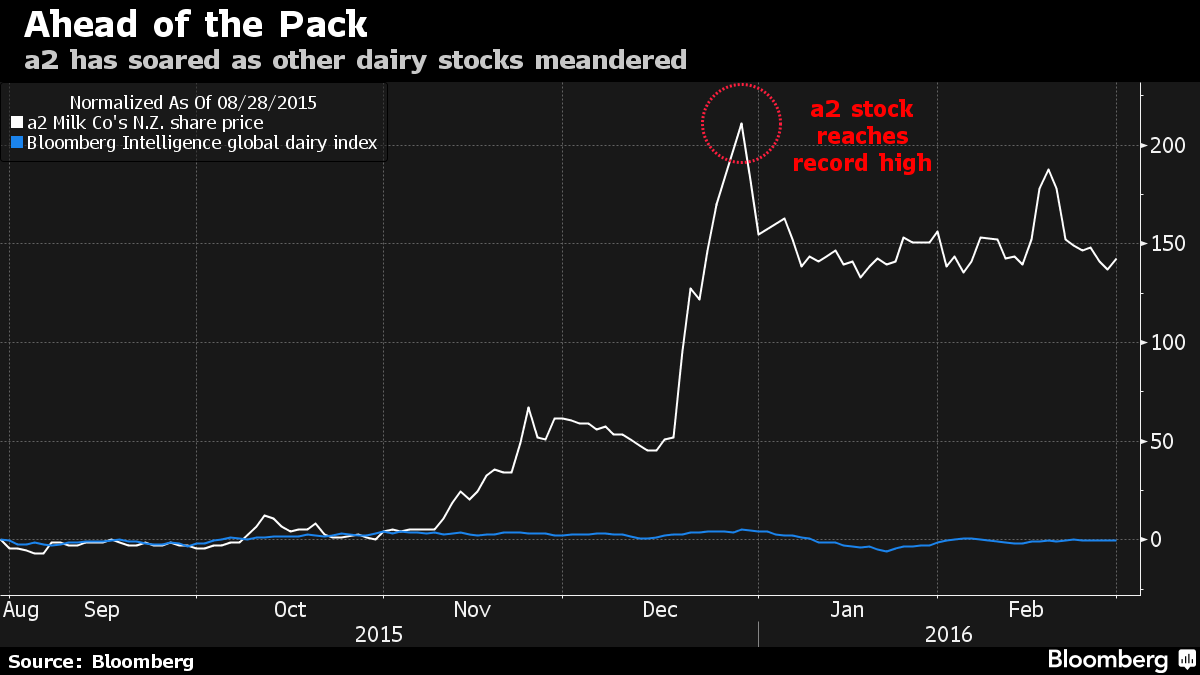
Sydney-based A2 Milk sells dairy products to China, the U.S. and U.K that's less allergic compared to your typical milk with the A1 protein. It makes sense because milk doesn’t suit everyone, particularly in China where dairy can be a new phenomenon for some.
Fonterra called this just a “marketing concept”. Maybe they could do a bit of “marketing” themselves if it gets double the price.
A2 Milk has been very successful in Australia:
Since its debut in 2003, a2 Milk has challenged the common wisdom in dairy retailing, grabbing almost 10 percent of the fresh milk market in Australia with a product that sells for about A$2.80 a liter ($2 a quart), more than double the price of regular house-brand milk.
7. IEA claims that oil has bottomed.
The International Energy Agency (IEA) reckons that oil has bottomed.
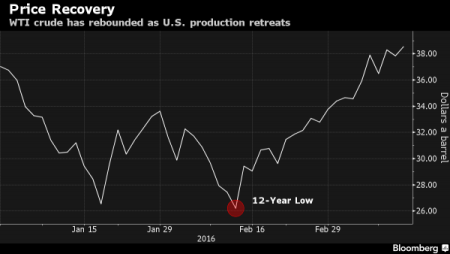
As a reminder, on February 9, the IEA said "supply may exceed consumption by an average of 1.75 million barrels a day in the period, compared with an estimate of 1.5 million last month." Curiously since then prices are far higher, and are now pushing into territory where even shale companies are considering resuming production.
As shown in the chart below, oil prices have recovered 50 percent from the 12-year lows reached in early February when news of possible oil production cuts by OPEC unleashed a dramatic rally; instead all that was unveiled was a tentative production "freeze", one which may never happen as Iran has sternly refused to comply with the term. This “freeze” which caps Russian and Saudi production at already record high levels, while currently supporting prices, is unlikely to have a substantial impact on markets in the first half of the year, the IEA said.
The world is getting used to record fatigue, where temperatures are constantly breaking records:
There are sure to be more climate records broken this year. But we treat them as we treat new fashions, phones or films. More novelty, newer features, more drama. We seem unable to understand that we are driving such changes. Record breaking changes that will ultimately break our civilisation, and so scatter all that we obsess and care about.
Chart from NASA.

9. How low-cost labour market information benefits job seekers.
This study finds that if you also look at complementary occupations when searching for a job, the number of interviews increases by 30%. Here are the results:
• We find that the suggestions alter the job search strategies of its users. Those who are offered the alternative search interface consider a set of vacancies that is broader in terms of the diversity of occupations, and they receive a 30% increase in job interviews.
• These effects are largest for job seekers that searched occupationally narrow in the first three weeks of the study.
• When they are exposed to the treatment from week four onwards, they increase their job applications by 30% and experience a 50% increase in job interviews (compared to similarly narrow searchers in the control group).
10. Computers predicting the future with tweets.
One tweet can have a massive impact on financial markets. To predict the future, some companies are building software to analyse tweets – much quicker than humans:
Sometimes a tweet can cost a lot. On Tuesday April 28 the content and media analytics firm Selerity released a tweet about Twitter’s earnings before they were public record. Six seconds later, Twitter’s shares plunged. According to analysts, high-frequency traders used this information leading to the deep and sudden decline of Twitter’s stock price…
Institutional players such as financial markets, security and crisis management, health industry and insurance companies have a particular interest on what is happening on social media. Companies such as Selerity and Dataminr are building software systems that comb through twitter data. These systems use algorithms and Natural Language Processing to analyze the content of tweets. What they are looking for from the data is the future.


We welcome your comments below. If you are not already registered, please register to comment
Remember we welcome robust, respectful and insightful debate. We don't welcome abusive or defamatory comments and will de-register those repeatedly making such comments. Our current comment policy is here.