
Today's Top 10 is a guest post from Shamubeel Eaqub, the principal economist at the New Zealand Institute of Economic Research. His is the second Top 10 in our new Friday series from a range of different contributors.
As always, we welcome your additions in the comments below or via email to david.chaston@interest.co.nz. And if you're interested in contributing the occasional Top 10 yourself, contact gareth.vaughan@interest.co.nz.
See all previous Top 10s here.

1. Food, fertilisers and minerals the future
The legendary Jeremy Grantham of GMO calls food and scarce minerals as good long-term investments.
Mr Grantham is known as the perma-bear, because he called the internet bubble and the housing bubble. He says that the rising trend in commodity prices over the past decade is a reversal from 100 years of real declines.
I happen to disagree with this Malthusian view. Over the next 100 years we will find alternatives.
In fact rising prices spurs the required investment and innovation to find alternatives. Look at what shale oil is doing to energy prices in America.
Still, read Mr Grantham’s interview in the WSJ. He has called it before.
They [commodity prices] came down for a hundred years by an average of 70 percent, and then starting around 2002, they shot up and basically everything tripled—and I mean, everything…The game has changed. I suspect the game changed because of the ridiculous growth rates in China—such a large country, with 1.3 billion people using 45 percent of the coal used in the world, 50 percent of all the cement and 40 percent of all the copper. I mean these are numbers that you can't keep on rolling along without expecting something to go tilt.
As a side note, I really enjoyed this tit-bit on Aussies and calling a housing bubble, sounds a bit like NZ ;)
If you have … [a conversation about a housing bubble] … in Australia, you have World War III! They hate you. They hate you for years! The idea that you could suggest that they were having a housing bubble.
Rising Commodities: Total return over 10 years (2003-2013)

2. The African century?
Africa has been hailed as the investment promise of the future. But it has been interrupted by war, politics, and weak social and economic infrastructure. Will this be Africa’s century?
If your view of Africa is gleaned from the horrors of war and famine on TV, you are missing the other Africa, where the people are young and optimistic, and the landscape breath-taking.
Africa is a huge continent. It has a land mass that is larger than most people realise, because of the tricks of cartography (map making). Its recent growth hasn’t been just about resources, even if Blood Diamonds is a great movie.
Africa has most of the world’s uncultivated cropland – which will make it strategically important in the future. China is investing heavily in Africa. Its population is young, growing, urbanising and is increasingly educated. It is leapfrogging legacy technology, moving straight to mobile phones for example.
Check out Jonathan Berman’s 7 reasons why Africa’s time is now on the Harvard Business Review.
Africa’s economy is growing faster than the economies of all other continents. About a third of the 54 African countries are seeing annual GDP growth of more than 6%. But this isn’t just about diamonds and oil: Only 24% of the growth from 2000 to 2008 was attributable to natural resources.

3. RBA: No housing bubble
The RBA’s assistant governor, Dr Malcolm Edey, says Australian house prices are not in a bubble and the doom-mongers need to keep things in perspective.
Dr Edey’s is reported in the AFR:
“There is no doubt [house prices have risen] but we have to keep in perspective. House prices have risen at a rate similar or level to growth in household income,” he said.
“But we shouldn’t be rushing to reach for the bubble terminology every time house prices are above average because you will be unrealistically alarmist,” he said.
True, house prices are reacting to recently low interest rates. But it is also undeniable that Australian house prices are very high relative to incomes and rents, households are massively indebted, banks hold huge amounts of their book in mortgages and the Australian economy is slowing. It seems a little scary to anyone who doesn’t buy into ‘house prices only ever go up’ mantra. Read Leith van Onselen at Macrobusiness for a rebuttal.

4. UK’s 40 year mortgage slaves
In the UK many new borrowers are increasing borrowing terms from the traditional 25 years up to 40 years. LSL figures reported in The Guardian say:
Hard-pressed first-time buyers are abandoning traditional 25-year mortgages and opting for much longer repayment terms – some as long as 40 years – so they can afford bigger loans, in the latest indicator of Britain's emerging property bubble.
Financial liberalization allowed massive growth in borrowing. We have had loads of innovations, including lower deposits, longer repayment terms and how much of your income goes to mortgages. More recently it was CDOs and other financial shenanigans that combined with fraud led to the GFC. Five years on, it seems we have learnt nothing and banks still hold sway:
After the financial crisis in the UK, the Financial Services Authority proposed strict affordability tests that would make lenders assess home buyers on their ability to repay over 25 years, but dropped the idea last October after lobbying by the banks.
They would say that, wouldn’t they?
Mortgage lenders argue that improved longevity, combined with higher house prices, make extended mortgage terms more sense. But critics point out that the average age of a first time buyer has risen markedly in recent years, and that terms of 30 or 35 years will leave some facing hefty mortgage payments well into retirement.

5. $1m meager retirement
A$1m in retirement will buy you a no-frills retired lifestyle. To live a comfortable retirement you need A$1.6m for a man and A$1.8m for a woman at retirement, according to Deloitte estimates:
To achieve a comfortable retirement, today's 30-year-olds need to make additional contributions to super beyond the employer contribution, with men putting in another of 5.4 per cent on top of their current rate and women adding an extra 7.5 per cent.
Because we are living older the cost of living in retirement is rising. In Australia there are large contributions to a compulsory super scheme, which will see a 30 year old on the average income of $60,000 save $1m by the time they turn 65. Deloitte is suggesting that people need to put even more away. How many Kiwis are saving enough for retirement?
In the US, many cities are now bankrupt because they haven’t prefunded their pension liabilities. If a future NZ government breaks the universal super promise, will it be unfair or because of pig-headed politics that refuses to make the small necessary steps (increases in the retirement age and indexation to CPI rather than wages)?

6. Fees cost dear
Standardised KiwiSaver fees will be published in mid-October, according to MBIE.
That’s a very good thing and I can’t wait. The difference between low and high fees can mean up to a 20% difference in a retiree's standard of living. This is vital information for the 2.1 million KiwiSavers who put $3.1b into managed funds in FY2013 (see statistics here).
There seems to be an unhealthy obsession with short-term returns of KiwiSaver funds, apparent in ‘league tables’ in the weekend papers. There is reliable international evidence that a successful investment manager today is unlikely to be consistently successful. It can happen, like the legendary Warren Buffet of Berkshire Hathaway. But that’s why he is legendary.
The most important difference tends to be fees. William Sharpe (of the Sharpe ratio fame) wrote an excellent article, a little technical, in the Financial Analyst Journal:
Recent regulatory changes have brought a renewed focus on the impact of investment expenses on investors’ financial well-being. The author offers methods for calculating relative terminal wealth levels for those investing in funds with different expense ratios. Under plausible conditions, a person saving for retirement who chooses low-cost investments could have a standard of living throughout retirement more than 20% higher than that of a comparable investor in high-cost investments.

7. Inequality: invest in the young
Income inequality is a topic that stirs up a lot of emotions. And not surprisingly there are very partisan views on the ‘right’ solution. The left wants taxes on the rich, the rich want smaller government, and on the hard right many deny there is even a problem.
Income inequality is too important and complex to be solved on partisan black and white lines. The Economist newspaper makes a compelling case that secular forces could further deepen the income and divide and we need a sprinkling of left and right solutions: make fat cats leaner and create better opportunities for the underprivileged, particularly by investing in the young. We spend far too little time to talk about the quality of education – which we know is absolutely vital to reduce inequity of opportunity.
Many of the underlying causes of the growing gap between rich and poor—fast technological change and the rapid globalisation of the economy—are deep-seated and likely to persist.
Government policy matters:
Inequality is not impervious to government policy, but higher marginal tax rates are not the only or the best way to address it. A two-part agenda drawing on ideas from both left and right, aimed at reducing boondoggles for the affluent and increasing investment in the young, could achieve a lot.

8. Is college worth it?
One of the salves for inequality is education. But education is becoming more expensive and in some countries the returns may be smaller than others. For example, in New Zealand the returns to education are not as high as some other rich countries – but that’s another discussion.
According to the OECD, a think tank funded by rich countries, the US has some of the highest returns to education. But the cost of education there is rising rapidly, even faster than healthcare! With it there is rising delinquency of student borrowing.
A look at the US data by Alex Mayyasi on priceonomics.com suggests college is still worth the investment:
…the [research on] financial value of a college degree all concurs: A bachelor’s degree is a sound investment whose value is growing. The extra income graduates earn compared to high school graduates more than compensates for the high cost.

9. Fear the boom not the bust
For an alternative take on the economy, I like reading the material from the Mises Institute, an Austrian Economics think-tank. It is consistently gloomy and essentially says: stop tampering with the money supply or each new boom is sowing the seeds of the next bust.
I enjoy how Frank Hollenbeck on mises.org draws on history to paint a vivid, if alternative, picture of how we should fear the super-easy monetary reflation following the GFC. Because price signals are so distorted, the economy is on an uneven keel. When the bust comes it will be more painful than it needs to be.
By late 1936, The Fed started to get worried, and in March 1937 the chairman of the Fed, Martin Eccles, said “[r]ecovery is now under way, but if it were permitted to become a runaway boom it would be followed by another disastrous crash.”
The bust was written in the cards. It could not be avoided, just postponed. It is not the bust, but the boom that should be feared. The bust was of short duration, and could have been much worse if the Fed had not pulled the punch bowl then and there.

10. Affordable housing, but not in my ‘hood
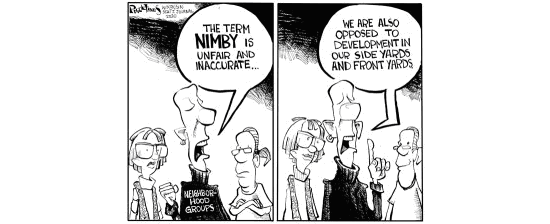
There is much talk of affordable housing and the plight of the first home buyer, both here and in Australia. In both cases planning rules and NIMBYism makes smaller, cheaper and/or multi-unit homes hard to supply.
If we truly want to have affordable housing, a number if things have to happen. Reining back debt reliance and increasing supply of the right type and the right place.
The planning, regulatory and objections processes favour the incumbent and not the first home buyer. Gethin Davison’s report at AHURI finds:
…opposition to affordable housing development tends to be greater in neighbourhoods that are affluent or aspirational, and where there is already anger and/or fear in the community. Opposition to affordable housing proposals is usually most fierce and most widespread early on, usually subsiding as time passes and disappearing once a decision has been made.
We welcome your comments below. If you are not already registered, please register to comment
Remember we welcome robust, respectful and insightful debate. We don't welcome abusive or defamatory comments and will de-register those repeatedly making such comments. Our current comment policy is here.