
By Bernard Hickey
The holy grail for any investor is making money by doing nothing. The second best option is to sit there and do nothing while stopping someone else from doing something that would hurt the value of the investment.
This central fact is now dawning on policy makers trying to solve New Zealand's biggest economic and social problem - housing affordability in Auckland.
The debate around the new Auckland Council's Unitary Plan and how to build 400,000 houses over the next 30 years to cope with forecast population growth has concentrated the attention of planners, politicians and economists alike.
The renewed 10-20% surge in house prices in Auckland this year to record highs has further focused attention.
The scale of the task is enormous and the roadblocks are as big they can possibly get, starting with inertia and the second most powerful force in the universe after compound interest - Not In My Back Yard.
NIMBYism is a force magnified by the power of tax-free capital gains and the forces of supply and demand, and it is alive and thriving in Auckland.
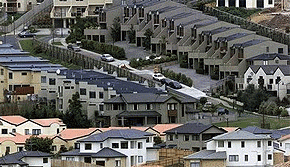
The essence of the problem in Auckland is that if Auckland is to build 300,000 of those 400,000 new houses within its existing boundaries, as specified in the Unitary Plan, then it has to intensify its housing massively with all the changes that entails.
Former McConnell Property CEO Martin Udale said this week 1 in 5 of Auckland's 385,000 existing homes would have to be demolished to allow for the development of medium and high density houses to hit that 300,000 target. The phrase 'medium and high density housing' is much less politically and emotionally explosive than what is really being talked about. This would mean a lot more apartment blocks, townhouses and intensified shopping, schooling and other infrastructure to cope with these extra people and services.
That means building up and around. It means the Auckland dream of a villa in a quiet suburb with a sea view and a back yard close to town is dead, or at least over-looked by an apartment block blocking the views to the sea.
This tension is at the crucible of the recent clash between Len Brown's Auckland Council and John Key's Central Government over the Auckland Plan.
The government is creating a panel to review objections to the Auckland Plan, blocking an attempt by the Council to get it exempted in its entirety from the Resource Management Act. This will allow many of the NIMBYists to challenge many aspects of the plan.
Udale captured the mood best when he said: "We can't allow the politicians to hide behind community nimbyism and the cave dwellers." He went on to refer to Auckland's phobia about building height.
Now we are getting to the crux of an issue which threatens to derail our economy and our population structure. Finance Minister Bill English is rightly concerned about the rapid ramp up in house prices in Auckland beyond the reach of ordinary young families, many of whom are either leaving New Zealand altogether or sinking back into the dispiriting prospect of long term and increasingly expensive renting. English is right to target Auckland's chronic inability to build new houses quickly that don't dissolve in the rain.
Auckland's building consents have languished around 3,000 to 4,000 a year for the last four years, well down on the 2002 to 2005 levels of around 12,000 a year, which is what's necessary year in and year out to meet expected population growth.
Something's got to give if Auckland is to avoid deepening its affordability crisis. Either Auckland quickly bulds up and around its centre with all the blocked views and population density that entails. Or it can sprawl to Hamilton and Warkworth in a blanket of single level dwellings and traffic jams.
The third option is the easiest for existing property owners and the most likely given the current players and approaches. That's the option of doing nothing and blocking development.
It has proved an exceptionally profitable strategy for home owners and land bankers alike, given the median house price in Auckland has more than doubled to NZ$515,000 in the last 10 years as the number of building consents has more than halved.
NIMBY is the most profitable investment strategy in New Zealand.
-----------------------------------------------------------------------------
This piece was first published in the Herald on Sunday. It is reprinted here with permission.
We welcome your comments below. If you are not already registered, please register to comment
Remember we welcome robust, respectful and insightful debate. We don't welcome abusive or defamatory comments and will de-register those repeatedly making such comments. Our current comment policy is here.