
House price corrections lead to a country's Gross Domestic Product dropping by about 6%, credit rating agency Moody's says, as the impact of falling house prices flows through to the broader economy.
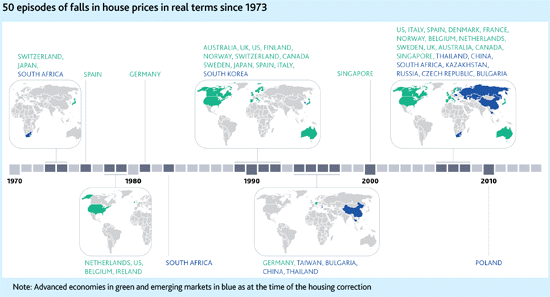
Moody's says a series of 50 house price falls since 1973 in real terms, in various countries around the world, show house price falls coincide with a GDP shortfall of about 6% compared with the pre-house price peak paths. Such GDP shortfalls are typically associated with a decline in credit worthiness for an array of debt issuers.
"Corrections in housing markets can have an impact on the creditworthiness of sovereigns and other issuers through four broad channels," Moody's says.
These it lists as;
1) Lower economic activity in sectors directly related to real estate and house building spills over to the rest of the economy through supply-chain linkages;
2) Lower house values dampen households’ wealth, which has a negative impact on consumption – so called wealth effects - especially in advanced economies.
3) The decline in the value of collateral backing housing loans raises credit risk.
4) Finally, for some countries, lower house and land values dampen revenues for local or national governments, especially for those heavily relying on the housing and construction sectors.
The Moody's report comes after Reserve Bank deputy governor Grant Spencer pointed out, in a speech last week, New Zealand’s house prices, when compared to incomes or rents, are high on an international basis and very high when compared to New Zealand’s historic trend.
Spencer noted New Zealand is one of few advanced economies that hasn't suffered a major house price correction in the past 45 years.
"A correction in house prices in New Zealand could be prompted by a range of potential shocks to the economy or financial system," Spencer warned.
"Global interest rates are at record low levels and large mortgages have been ‘affordable’ at these rates. As global interest rates return to more normal levels, many mortgage borrowers could come under pressure as they are required to refinance at higher rates. Alternatively, a downturn in the global economy and financial markets could lead to a drop in national income and rising unemployment, at the same time as foreign creditors are requiring an increase in the interest rate premium charged to New Zealand borrowers."
"In such circumstances, we could see the cost of credit rising at the same time that incomes and employment were under pressure. Such stresses would be expected to cause housing demand to ease. If this occurred when new supply was coming through in volume, then prices would begin to fall. A withdrawal of speculative interest in residential property or decline in migration inflows would accentuate any such fall," said Spencer.
"With 60% of its lending in residential mortgages, the New Zealand banking system could be put under severe pressure in such scenarios. The resulting contraction in credit would amplify the impact of an adverse external shock to the domestic economy and financial system, making it more difficult to avoid a severe downturn," Spencer added.
Moody's says for every 10% fall in house prices in real terms, GDP drops by about 4% from its pre-peak path, according to its study of 50 global cases of housing market corrections since 1973.
"Property price downturns since 2006 have been linked to a larger fall in GDP. The GDP gap between pre-peak trends has increased from around 4% before 2000 to around 7% since then," says Moody's.
"Corrections can also raise the credit risk of housing loans by cutting the value of the collateral, while government sometimes adopt fiscal and monetary policy to mitigate the effect of lower house prices."
The chart below comes from Moody's.
This article was first published in our email for paying subscribers. See here for more details and how to subscribe.
We welcome your comments below. If you are not already registered, please register to comment
Remember we welcome robust, respectful and insightful debate. We don't welcome abusive or defamatory comments and will de-register those repeatedly making such comments. Our current comment policy is here.