
Nationwide economic activity fell 0.2% in the three months to September after five consecutive months of expansion, the National Bank said in its latest Regional Trends survey.
The downturn was led by the South Island, where economic activity fell 0.6% over the quarter, National Bank said. This was partly offset by a 0.2% rise in activity in the North Island.
Despite the quarterly contraction, annual growth rose to a two and a half year high in September of 2.3%.
Here are the National Bank's comments:
Quarterly percentage change
Eight regions recorded a rise in economic activity in the three months to September, while five regions recorded a decline.
The two smallest regional economies (West Coast and Gisborne) recorded the largest increases in economic activity, lifting 1.2 and 1.0 percent, respectively. Taranaki recorded the largest decline in economic activity, joined by the heavyweight regional economies of Canterbury, Otago and Wellington.
Our nationwide measure of economic activity eased 0.2 percent, following five quarters of increases. The decline in activity was more pronounced in the South Island, with a 0.6 percent retracement from three months earlier. In comparison, the North Island recorded a modest 0.2 percent rise in economic activity in the September quarter.
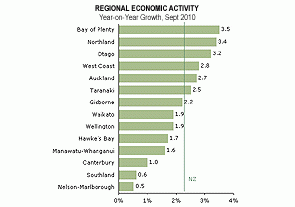
Year-on-year growth
Year-on-year economic growth lifted to a 2½-year high of 2.3 percent in September. The North Island recorded the strongest rise, expanding 2.6 percent in the twelve months to September, while the South Island economy recorded only a 1.6 percent rise in economic growth.
Three regions (Auckland, Gisborne and Otago) shared the strongest annual rate of economic growth, at 2.1 percent. At the other end of the spectrum, Southland has the lowest (and only negative) year-on-year rate of change (-0.3 percent).
The Bay of Plenty recorded the strongest rate of annual economic growth in September, lifting 3.5 percent from a year earlier. Northland was a close second, expanding 3.4 percent, with Otago third fastest on 3.2 percent growth. Nelson-Marlborough and Southland were laggards across the regional mix, only expanding by 0.5 and 0.6 percent, respectively.
22 Comments
Unbelievably some think that retail is still the place to be in the economy:
http://www.stuff.co.nz/business/industries/4354196/Auckland-mega-mall-g…
Retail and tourism are 2 sectors which will do particularly BADLY in the future.
Correct Andy - Retail and Tourism are stagnating. I cannot see any signs of improvements – the opposite – even middle-class tourists are now spending down to the major “ Must Do and Must See” only.
I reckon these banks could turn effluent into wine.
That's at least one up on Jesus Wolly
Distinctive...full of character...depth of colour...some sedimentation...!
The problem the country has is that John Key and National have not delivered and look unlikely to deliver before the next election.
Two years ago the country voted for change with a big vote of confidence for John key and his colleagues. John Key was going to be the answer to our problems and the intelligent ex Investment banker would be smart enough to come up with policy that would be great for the NZ economy long term.
Two years later he has kissed many a baby and granny, attended every international forum that he can get an invite to and started a number of trade deals - all of which aren't life changing or country changing events. Babies and Grannies don't equate to income. Trade deals don't necessarily result in additional trade over and above what is currently sold internationally. What happens when we have tarde deals with every country - we are back to square one because every other country will have similar arrangements. What increases exports is great NZ product - any country will buy great product from us. And great product with a point of difference results in great prices for our products.
So shouldn't the Government be supporting and encouraging new products that the country can export.
If John Key and the National Government don't get their act together shortly they will lose the next election and it won't only be Labour getting anew leader but National will dump John key if he fails to win the election. They are currently at 43% down 10% from 6 months ago and another 5% drop and a 5% gain by Labour makes life interesting.
John your holiday is over mate - forget about your overseas trips to secure your next job and do something constructive for NZ.
Key - by his comments to FF (on Nat Radio this morning), clearly understands that we are coming up against planetary limits.
His problem, is that the mass of the populace - in an increasingly dumbed-down manner, and in increasingly short sound-bytes - are bombarded by promises that increased consumption will lead to increased euphoria.
The fact that their consumption thus far hasn't apparently done the trick, says a lot about the average intellect.
These are the folk he needs to vote him in.
Their expectations were fuelled by debt in the last decade, and overran any ability to rectify that debt, globally.
Getting that message across, while staying in power, is an impossible ask. I wrote this recently, for the Otago Daily Times:
http://www.odt.co.nz/opinion/opinion/135743/time-now-fireside-chat
In the logic-path, change is a constant, those who cling to the status-quo will always be wrong at some point, and all conservative politicians eventually become obsolete. To wit: 1030-5 in NZ..
Key is a click smarter than that, I suspect Nick Smith probably gets it too. On the other side, you could probably persuade David Parker, but that's about it. Turei is busy wasting time talking about increasing housing without limiting population.....
Whats 'FF' an abbreviation for? I wouldn't mind tracking down the interview by Key. I'm yet to be convinced that he gets it.
Its not even difficult to 'get'.
Federated Farmers
Cheers
Cheers.
Only been out of the country for a few years and I'm already out of touch.
... clearly understands that we are coming up against planetary limits.
Good lord powereddown, 'planetary limits' no less. Oh no, we're all gonna die. We're all gonna die!
Hey wait a minute, silly me, I forgot, you're a luddite.
To counteract this nonsense, you might try taking your head from Revelations, and reading something sensible:
Sustainability Isn’t Sustainable : http://pc.blogspot.com/2010/11/guest-post-sustainability-isnt.html
Quoting the summation:
The supposed solution for our “Peak Oil problem” is to develop renewable energy resources. Renewable energy is natural energy which does not have a limited supply.
What is “natural” energy? Either all energy is natural and comes from nature, or only animal muscle power is natural. The “natural” qualification is complete nonsense – unless they really want us to go back to animal muscle only.
Moreover, the “never run out” qualification itself violates entropy. All energy resources will run out eventually.All energy sources—fossil fuels, solar, hydroelectric, tidal, biomass, hydrothermal, fission, fusion, etc.—are at base solar, or at least stellar.** And the Sun will not last forever and does not provide unlimited energy. The concept of renewable energy that “will never run out” and “can be used over and over again” is fatuous nonsense. It violates the second law of thermodynamics, entropy.
This concept of “peak resources” is not new. For instance, the fertilizer crisis of the 19th century. In 1830 it was discovered that guano was an excellent fertilizer. Population exploded, as guano was used in Europe, because of the additional food that was produced because of this excellent fertilizer and mechanization. The best sources of guano began to run out fairly quickly. People predicted the equivalent of “Peak Guano.” The question was not whether we would have “Peak Guano,” but Peak Fertilizer? We did not have a guano problem we had an invention problem. The Haber-Bosch process was invented in 1909, which allowed fixing nitrogen in air and solved the “Peak Guano” problem.[5]
And therein lies the lesson.
...
Inventions are not subject to diminishing returns or entropy. Potential inventions grow factorially, which is much faster than diminishing returns from natural resources shrinks. We do not have a natural resources problem, we have an invention problem.
The sustainability crowd are not pushing science, they are pushing a political slogan. And in the process, by diverting resources from the most promising technologies to the most politically acceptable, they are actually inhibiting new technologies from being developed.
Okay now, back to your earthship or whatever hole in the ground you live in. (Do you have a bar? Probably not enough power to even run a beer fridge.)
Of even greater threat to mankind than peak-oil , is the fact that the universe is expanding at an increasing velocity . Within 14 billions years , give or take , all matter will have disintegrated , even atoms will be shredded ............ A dull , cold void is existence , at that terminal point .......
........ PDK , we gotta act ! Write some letters of complaint to our MP's . Get some tee-shirts printed up : " Save Our Universe , Luddites " . Mobilise the professional protesters , Minto & the bald Maori guy with the tats and the attitude , we're marching on parliament about this , fecking National Government !
You guys get cracking ....... I'm off to burn some rubber , no point in being fuel efficient is there , we're screwed anyway .. ... Must stash a few tin of beans , before the cataclysm .
Gummy gummy...put the bottle down....14 billion indeed...try a trillion and you might be close and then you gotta factor in that all knowledge on this comes from the energy reaching us today...for all the experts know the whole ballgame could already have reversed at the outer edge and the final end be a big squeeze followed by a repeat sneeze.
Minto will be at the head of the wrong march....err...the long march....whatever!
No reversal at the outer edge Wolly ! Much alike an old Tellus , it'll be just a big vacuum with no energy . Man , that sucks !
Where's Hickey at , when you want someone who does a superb panic attack ? Why aren't PDK & tofu steven picking up on this ? The pointy heads are serious . No big squeeze , no sneeze . All is just dust in the wind ................. 14 billions years , that is all we have to get ready for the end of life , the universe , ......... time ! ................... Better have a cuppa tea , while I can . Pip pip !
Time to polish off many a bottle Gummy but not 14 billion.....more like 14 trillion!
My money is on a big squeeze followed by another sneeze. I'm investing in selling big squeeze shelters...care to buy some shares in the IPO. Could be onto a winner.
Good grief. I thought you objectivists were supposed to at least pretend to be logical?
Equating an understanding of the relevant science with being a religious prophecy nut is just a transparently invalid attempt to discredit anyone disagreeing with you by a completely false smear. Beneath contempt.
As for the rest of that nonsense, do you have any idea what the 2nd law of thermodynamics actually is, and how it works? You've admitted before that you know nothing about science. You see that big hot yellow thing in the sky? While Earth has access to that source of outside energy life is possible despite increasing entropy in the closed system of the universe, on a purely temporary and localised basis. Incoming solar energy isn't renewable in the sense that we can make more of it, but in the sense that there's more coming in every day. That's not everywhere in the universe and forever of course, if you want to get pedantic about it, but certainly enough for our purposes.
All energy resources will run out eventually.All energy sources—fossil fuels, solar, hydroelectric, tidal, biomass, hydrothermal, fission, fusion, etc.—are at base solar, or at least stellar.
This part of the quote is technically correct, but ignores the fact that these sources will run out on different timescales, and can be accessed with varying degrees of expense, convenience and efficiency. The fact that the sun will go phut in umpty-billion years time has no bearing at all on the validity of peak oil.
That screed you've cut 'n' pasted does nothing more than attempt to do a distracting little twirly dance around reality and the laws of physics by redefining words.
When that Netwriter chappie made his claims, I went back to first principles. Spent 30-odd hours retracing the science. Intervieved two Professors in the process.
Got myself informed, which is the opposite of choosing to remain ignorant.
It saves having to resort to cheap invective.
Yes I have a lot of sympathy for that view, Tribeless. There is no 'energy' shortage and neither will there ever be one. Energy is massively abundant throughout the Universe in quantities far greater than mankind on some puny little spec in the infinite cosmos could ever even begin to imagine or comprehend.
What the peak oil people are talking about is that there is a finite amount of chemical energy stored in the form of fossilised organic matter, e.g., oil, gas, coal, that is stuck in the ground, and that is easily released upon combustion. And that is correct. We will never run out of ‘energy’, but we may run out of fossilised fuels. Let us hope that before that happens, we will have found ways to tap into the limitless supply of energy that abounds throughout the Universe in ways that have improved upon atomic energy for example. We should never rule out the inventiveness of man or our ability to discover.
E=MC2! There’s an awful lot of energy in a very little mass.
"There is no 'energy' shortage and neither will there ever be one."
Just as there's no "land shortage" or "housing shortage", yet certain people keep saying there is in the hope it will come true.
"Let us hope that before that happens, we will have" Spare me. You justify continuing as you do on that basis?
get a maths-savvy friend to fault this:
http://www.hubbertpeak.com/bartlett/hubbert.htm
few seem to grasp the exponential function - if you wait until you're half-way through an energy resource, and are establishing a growing edifice based on it, then you're already overdue to find a quantum replacement.
Given that the first half was cherry-picked, the last won't be as productive - that's a 'given'.
It will be eaten up much quicker - also a given. If you did half in 100 years, the math says 18 for the last half. Doesn't happen, though, when all your activity depends on the resource - even Julian Simon recognised energy as being different. I waited during the '90's - there was still time. Now there isn't - you can't turn the infrastructure round at this point, so I'm on solid ground, 5 years since Peak Oil (the IEA say 4 - has be funny as a fight watching them.)
With a shareholder/boardroom mentality that only sees short-term profit. And a political system that only worries about 3-5 years out.
Hope indeed.
Evidently I have more faith in human resourcefulness than you do!
Don’t allow yourself to become too seduced by mathematical models. All mathematical models are constructed around a series of assumptions, any one of which may in fact be wrong. If the underlying assumptions are wrong then the predictions the model makes will also be wrong.
Things are not as hopless or gloomy as you paint them.
well well well!
Bernard - look at this:
http://www.odt.co.nz/opinion/editorial/136845/reviving-gold
"There are also alternatives to gold, including energy-based currencies, in a world where co-operation and self-discipline no longer seems to exist".
That is a conservative paper - very. Maybe we're starting to get there.
We welcome your comments below. If you are not already registered, please register to comment
Remember we welcome robust, respectful and insightful debate. We don't welcome abusive or defamatory comments and will de-register those repeatedly making such comments. Our current comment policy is here.