
Productivity in New Zealand is lagging. This is clearly evident from data produced by the Stats Dept and published on 23 April.
In the last five data years (2020-2025), labour productivity increased by just over one percent in total. Capital productivity during this period declined by 6.7 percent. Multi-factor productivity declined by 3.0 percent.
According to Deloitte, New Zealand’s recent performance places us at 63 out of 67 mid and high-income countries.
These data align with the same story I told in my recent article ‘Searching for growth’.
The New Zealand economy is in a funk!
What are we doing wrong? Or is this just ‘the way things are’ for a small country isolated at the bottom of the world?
I decided to seek out the conventional wisdom as to why our productivity growth is so disappointing. I did this by inquiring of AI as to what was the cause of the problem, knowing that AI would give me the conventional wisdom, but most likely an absence of insights.
And I was right. AI told me that it was due to too many small firms, lack of capital, lack of innovation, and a ‘she’ll be right’ attitude, but nothing helpful in finding a path forward.
I then searched the internet looking for insights from the leading commentators. Once again, I came up with lots of generalities but nothing specific that I found particularly helpful.
I then decided to look at individual sectors of the economy, as to which ones had experienced productivity growth and which had stagnated. Actually, I knew what I was going to find, but it was good to get confirmation from official sources.
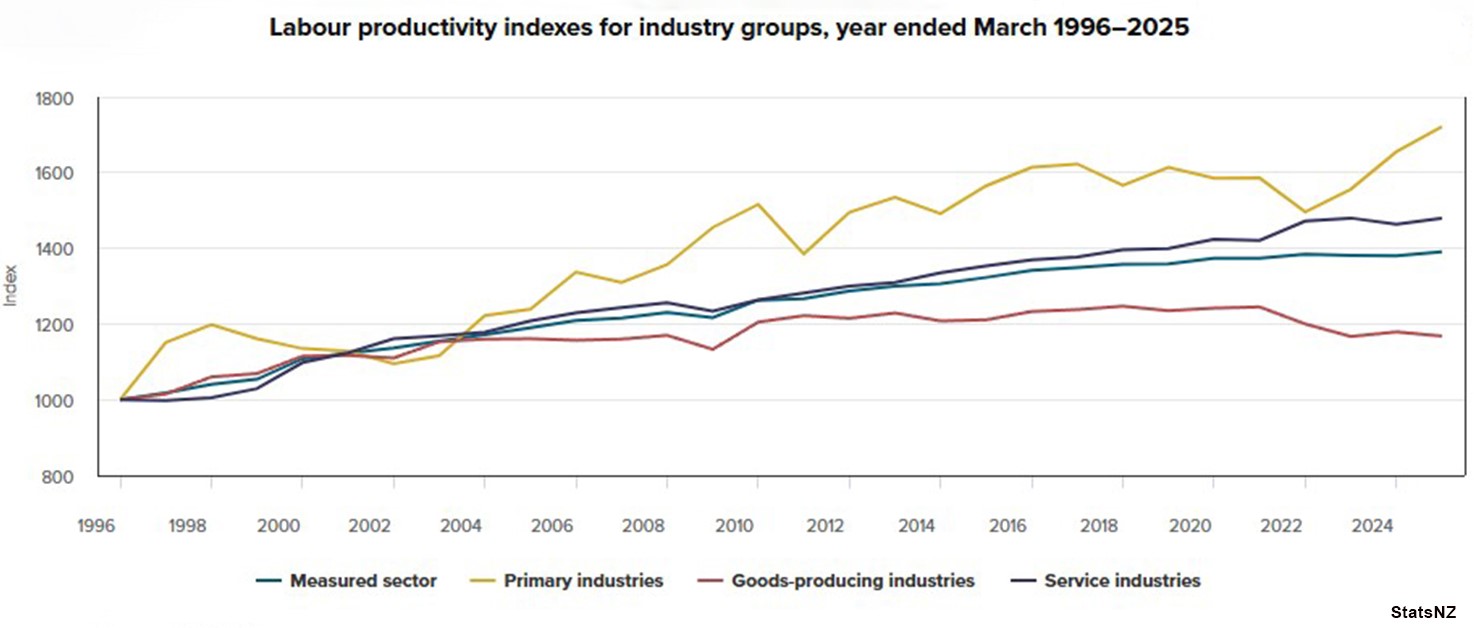
Between 1996 and 2025 labour productivity in the primary industries (see graph) increased by 72%, the service industries improved their labour productivity by 48%, and the goods-producing industries improved labour productivity by 17%.
However, all of the productivity improvement in the goods-producing sector had occurred by 2013. From there through to 2025, labour productivity in the goods-producing sector declined by 10%, right back to where it was in 2008. To put it bluntly, our goods-producing industries are a basket case.
This big decline in labour efficiency in the goods-producing sector does not mean that the workers were slacking around. But it does mean that they have been creating less inflation-adjusted value for each hour of work.
In economic language, we lack competitive advantage in manufacturing, with this arising in particular from a lack of scale, together with our isolation from the rest of the world.
I also blame our education system and societal problems that result in too many people lacking appropriate work skills and attitudes. However, some people may not agree with me about that. Or if they do agree, are not ready to make the necessary societal changes.
The big question is what are the specific things we can do to get New Zealand out of its economic funk?
I have spent all of my life focused in the main on the primary industries, and I marvel at the increase in labour productivity that has occurred there. When I first started milking cows in 1965, it took two of us two hours of hard work to milk 140 cows. These days, two people can milk 1000 cows in a little over two hours. Back in those days a one-man farm typically comprised about 1000 ewes plus perhaps 50 cows. Today, the number of ewes per labour unit would be over 2000.
Intriguingly, almost all of the technology, at least in terms of infrastructure, that has taken us from there to now’ has not come out of the formal research and development system. Rather, it has come from private companies and farmers themselves.
There will be further increases in labour productivity in primary industries, linked to further infrastructure investment. However, this will occur by using existing labour more efficiently. It won’t involve additional jobs.
Dairy is going to remain our biggest export industry, and the source of much of our national wealth. It helps pays for all of the cars, computers, clothing and even food that we import. But I see the future dairy industry looking very different to how it currently looks.
Perhaps the most exciting technology is what is called ‘wearables’. These are electronic collars and ear-tags which record what a cow is doing. This includes whether she is eating or ruminating, whether she is ready to be mated, and whether she has any health problems, All of this information is transmitted digitally back to the computer in the farm office.
These new wearables can also control where a cow is allowed to go without any physical fences. With current technology a herd can be shifted up to six times a day. This means that in winter time the invisible fence can be set up to shift itself one or two metres each hour so as to provide a fresh break of feed, thereby greatly limiting wastage.
This invisible fence technology is now well established on dairy farms, and is in the ‘early follower’ stage in the innovation cycle. It probably won’t be long before the majority of farmers use the technology as a management aid.
Equally exciting is the potential of this technology on beef farms, particularly in the North Island, as a management aid.
It has long been established that intensive grazing is fundamental to high performance on pastoral farms, but the cost of fencing, plus the labour in continually shifting stock, has been a constraint for beef. Invisible fences, that are set from a laptop computer, and send gentle messages to the animals where they must not go, are changing all of that.
I could write a lot more about the wearables technology, but the key point here is that these digital technologies will further increase labour productivity on New Zealand pastoral farms. In the process, it will lead to less workers rather than more.
This brings us back to the reality that it is the primary industries that underpin our wealth as a nation through the primary industry export earnings that, according to the Ministry of Primary Industries, comprise 82% of the goods that we export.
However, our major primary industries are limited by nature. There is no more land to be developed into pastoral farms. And in the last 25 years, science has been unable to improve the efficiency of converting solar energy via photosynthesis into grass.
Also, there is only one crop that I can identify with the potential to significantly increase multi-factor (capital and labour) productivity of our primary industries. That crop is kiwifruit.
At this point I am going to raise a fundamental issue without attempting to resolve the issue in this article. The key issue is population.
Do we need an increasing population to raise productivity in the economy? Or does an increasing population simply mean that we have to spread our national export earnings, constrained by nature’s boundaries, across more people?
Does this mean that a population policy is necessary to underpin the economic wellbeing of New Zealanders? I see that as a topic for an article in the near future.
*Keith Woodford was Professor of Farm Management and Agribusiness at Lincoln University for 15 years through to 2015. He is now Principal Consultant at AgriFood Systems Ltd. You can contact him directly here.
59 Comments
To answer the primary question: Because the 2nd Law of Thermodynamics is immutable.
I’d like to see your reasoning? I doubt the Iraq conflict was in Keith’s data, and before that energy was abundant and cheap.
The main cost increases I can think of are labour costs and land costs. Not sure if they would change the productivity equation much? Otherwise it must be things like safety and compliance?
We are probably too small to fork out for machinery that would improve our productivity?
You don't learn, with respect. With some tenacity, also noted.
Why do you - a self-proclaimed 'engineer' - mentions 'cost' and associated terminology FIVE TIMES in such a short comment - ostensibly addressing energy efficiencies?
I’ve learned alright, no matter what happens it’s because of energy according to you.
Fossil energy supply has been decreasing for centuries and hence the average worker must be less productive now than say the 1800’s ?
You aren't really that silly, are you?
Fossil energy supply HAS NOT BEEN DECREASING - but stocks have.
You conflate flow with stock - and seem to believe yourself?????
That makes you an economist - not an engineer.
Oh - and your 'newer machinery' is a euphonism for 'more energy efficient' - which runs into the 2nd Law of Thermodynamics (and Sadi Carnot).
You never answered my question though, just diverted the question. What makes now any different to say 50 years ago when fossil fuel stocks were also depleting and finite? Are we now at peak oil? I can’t say we are not, but how can you say we are? People were certain of it 20 years ago, they were wrong.
Bull--it.
Read the two textbooks, and learn.
Or at least, try.
It's you PDK that is incapable of learning. Using the Second Law as a causal explanation for productivity trends mistakes a universal physical boundary for an economic mechanism. You repeatedly make the same, very basic, category error even after having it pointed out to you numerous times. Even your acolytes plead with you to cease this foolishness.
The reverse it true - the physical limitation is unread by your 'economics' - which is why the current system is in overhang.
I have given Professor Woodford two textbooks to read, and a visual link. He has promised to peruse. It will be interesting to see what he comes back with; this comment: 'However, our major primary industries are limited by nature. There is no more land to be developed into pastoral farms. And in the last 25 years, science has been unable to improve the efficiency of converting solar energy via photosynthesis into grass.' suggests he is on the right track.
Both textbooks are by Physics Professors - both with impeccable credentials. Don't think that by denigrating me, you can dismiss physics.
Energy and Human Ambitions on a Finite Planet
Power, Overshoot, and Climate with Tad Patzek | TGS 219 - YouTube
(the latter from Tadeusz W. Patzek - Emeritus Professor, Earth Systems Science and Engineering - King Abdullah University of Science and Technology )
Good luck denigrating an unwanted message, by shooting at ONE messenger...
Apparently in the last 25 years no one has been trying to improve the efficiency of converting solar energy via photosynthesis into grass anyway. However, with other things they have:
-
RIPE Project (University of Illinois) - engineered crops with improved photoprotection and CO₂ fixation, yielding 20–40% higher biomass. These are direct improvements in photosynthetic efficiency.
-
Cyanobacteria and algae engineering - increases in light‑use efficiency and carbon‑fixation rates well above natural baselines.
-
Synthetic photo‑bioreactors - artificial photosynthesis systems with efficiencies far exceeding natural grass.
Again we see the fooishness, thinking-wise.
In this case, perspective-curtailment.
The key is in this Woodford comment: 'There is no more land to be developed into pastoral farms'.
So obviously, bioengineering take space from food-production. But last time I checked, bioenergy delivered non-gain EROEI.
Again, please read the textbooks before peddling self-supporting stuff. And run a test or two to prove to yourself that they stack up, before taking the space and time. For instance - what is the energy source for your 'synthetic' energy-capture?
Because the dam-ed stuff cannot be created - not even by those who believe in magic.
'However, all of the productivity improvement in the goods-producing sector had occurred by 2013. From there through to 2025, labour productivity in the goods-producing sector declined by 10%, right back to where it was in 2008. To put it bluntly, our goods-producing industries are a basket case.'
No, they are not. They are beginning to reflect the down-side of the Limits to Growth graph, Keith. Im my circles - those who study the thermodynamics/physics/chemistry/biology interface - we describe it as witnessing the Red Queen effect; where we run faster to stay on the same spot.
Our 'goods producing industries' are, rather than being a 'basket-case', perhaps doing better WITH THE CARDS THEY HOLD than they were with the hand(s) they held in the past.
I like your thinking Keith. Questioning. First seek to understand. As an old beef farmer and accountant, I can say within my two businesses, I had those kinds of productivity gains. Example: Moving from conventional hay bales to silage bales, prior to this move I palletised conventional hay, from picking up to feed out. Example : Moving my customers onto Xero. Now AI boosting both.
My experience in driving change is always limited by regulators and commercial acceptance. As for my customers, it seems that we don’t have an ethos of continuing education, only changing our processes when we are compelled to. Or perhaps it’s thinking styles, managerialism thinking kills progress. How do we train in creative and critical thinking? How do we reward those who have those skills?
'The big question is what are the specific things we can do to get New Zealand out of its economic funk?'
No it isn't.
Not by a country mile.
The big question is: How do we negotiate the oncoming period of accelerating de-growth?
It will not be pretty but better attempted with maximum understanding. De-growth answers the population query, en passant; we are overpopulated; therefore we need to de-populate.
The problem is the measure.
How is productivity measured and what role do exports and exchange rate play in that equation?
Like GDP it tells us little of real worth.
An individual firm/industry may improve its output per labour hour by simply increasing its price, or paying its employees less with no increase in output, similarly a change in exchange rates may achieve a similar result. Indeed nothing may change within one economy but productivity without may change also impacting that equation in the comparrison.
In reality what we are seeking is a trade balance/surplus.
The answer is simple: follow the money
Look at the money leaving the country that brings no economic value. That's where we're leaking productivity and that's where we should look for solutions
The first two things that come to mind: rents and fuel
We're paying higher salaries, of which a part go to impossibly high rents / mortgages that siphon out of the country via bank profits
We're paying for fuel to drive people into offices with no improvement to actual productivity, when they could work from home. All our fuel is imported, so as a country we're paying for fuel which brings zero productivity
Start with these low hanging fruits, take it further from there if need be. My money is that they'll provide enough of a boost. Pity there's zero political will to fix either
No mention of the major overseas banks that comprise the majority of our banking sector?
I have spent a decent part of my career working on efficiency / productivity projects - and have seen rapid results from the right investments.
My main issue with this oft-repeated pondering on productivity though is that labour productivity measurements at the macro level are next to useless. You are basically measuring GDP(P) / hours worked by sector, which broken down a bit more is (wages+operating profits) / (hours worked) with some relatively minor adjustments. To give you an idea of how bonkers the underlying numbers are - labour productivity in the real estate services sector is about $1,000 per hour, healthcare is $53, education is $43.
So, during a slump, when operating profits fall and wage growth is limited, of course productivity goes down - that's just maths. As we move from making stuff to selling stuff to each other and paying for care, we also see major componsitional shifts that are difficult to adjust for. This is why Stats NZ measure across economic cycles. But, even then the data is fraught with errors and twists. For example, check out labour productivity for our energy and water sector. We mostly privatised our state companies, they cut back staff, reduced maintenance, and started making profits - voila, a labour productivity miracle! Well, until we got found out and had to hire loads of people to patch things up. Labour productivity trebled between 1989 and 2009 but has now dropped back to where it started!
Thay avoided addressing entropy.
It bit them in the bum.
Used to be called a stich in time.
Why not blame gravity?
Why blame gravity?
Silly comment.
Nothing to do with it - except maybe that neglected pieces of infrastructure eventually fall down - somewhat like falsely-based arguments.
Blaming entropy is just as silly as blaming gravity.
Read both those textbooks.
Learn something.
Then come back and retract that statement.
Thank you in advance...
It evidently hasn't helped you learn anything. Constantly mentioning the 2nd Law just shows that your argument is weak. You use it as conversation stopper, something that you think no one can argue against because it is a fundamental law. You fail to see that it is in a different category to what everyone else is discussing.
Go away, read the texts, then opine.
Please.
Yes, you are talking in a different arena - sorry, but it's nonsense, and easily demonstrated as such. Try something; print up some money. I don't care how much, nor in what/which denomination. All yours, that. Right, for the next month, only eat that hoard, and only put it in your ICE tank(S).
Hint - nominate someone else to do your reporting for you.
I have a car that measures my average speed over a period that resets when I hit the button. I haven’t reset it for a few years. I live semi rurally and travel mainly outside cities. The average speed is 55kmh. If that could be increased to 80kmh how much would productivity improve? Trucks delivering 40% faster. Tradies on site 35% longer for same hours. Has this been modelled by Waka Kotahi? Is this worth addressing or a waste of time ?
If you increase your average speed you will also increase your fuel consumption...and that fuel is imported.
Then there are the other additional costs.....
To add an example of what we're up against in the Beehive, an announcement was made yesterday to cut the funding of the free third year tertiary education programme. If that wasn't an intelligent allocation of taxpayer funds to help improve productivity, I don't know what is.
Balance the books at all costs. That's all that matters.
But how many lawyers, communications and sociology graduates were we training for overcrowded and AI-vulnerable fields, as opposed to the trades, medical, engineering and other skills we actually need?
However, maybe time to make some choices about who gets funding, rather than just cancel everything.
We need more tax, then tax charities..... oh Iwi's run as a charity......
and while at it tax google etc , perhaps a tax on AI Tokens?
Certainly some degrees sound a lot better than others , but it's so hard to draw a line between a degree of any sort and economic success.
Here's five names that have brought billions into the NZ economy. See if you can match their qualification:
Nick Mowbray, Peter Beck, Peter Jackson, Fran Walsh, Rod Drury
(BA, BCom, Law dropout, two with no degree)
Usefulness to society, big-picture (in my humble opinion):
none; none (but less than none if militarily involved); some culturally; ditto; none.
A way to improve in our agricultural sector, where we do things well, might be to add value to create high quality products that are hard to replicate. From finished timbers to exotic cheeses to high quality fabrics to specifically bred produce...
The manufacturing part of that equation can be underpinned by the rapidly evolving 4th Industrial Revolution that can underpin effective and efficient re-localisation of the production, processing and manufacture.
That would, however, require us to eschew our history of:
- Turning out commodity items for export, like bulk milk powder, wool by the bale and raw logs, that make us a market price taker, where complex processed products give a chance of setting prices and improving returns.
- Not investing in new training, plant and equipment until the existing training is obsolete and equipment is running on optimism. Think: the inter-island ferries.
- Politicians who don't understand technology and manufacturing.
- Unpreparedness to facilitate and underwrite change by evolving the regulatory environment and developing infrastructure that is relevant in application, technology and scope.
- Vested interests in the status-quo.
- Focussing on the short term at the expense of all other things.
- The attitude that it's all just too hard...
I do not understand why we do not make the best cheese in the world here...
We do, try any of the small cheese makers, such as Mercer Cheese
That's the thing, though, 'small', when we need to figure out how to scale.
Most enterprises here are essentially cottage industries of lifestyle businesses, and it's difficult to make them profitable.
A way to improve in our agricultural sector, where we do things well, might be to add value to create high quality products that are hard to replicate. From finished timbers to exotic cheeses to high quality fabrics to specifically bred produce...
Actually we have been focused on added-value products - or nice to haves - in both the food and wool sectors. There are many examples of that. The recent food and hospitality trade show in S'pore was dominated by these kind of products.
That's great to hear!
How many of them were in the elaborately transformed class (high value add) and at scale?
Congratulations PDK. You’ve just ruined another comments thread.
By what measure?
Mine is truth.
Yours?
Edit - the comment re the texts which Keith says he'll read, applies to you too.
I'd be more interested in your comments after reading those two textbooks, than your pre-informed ones.
Mine is truth. You’ve ruined this thread with your tangents. It’s tiresome.
Just don't engage: anything else simply encourages the harangues and invective.
Ah yes, the mature approach to a predicament -
bury one's head in the sand.
"..send gentle messages to the animals where they must not go"
How is that achieved? Gentle electric shocks?
This was the subject of a recent edition of Country Life or Country Calendar.
Initially the farmers use little electric shocks but once trained the cows just require electronic beeps to stay within the boundaries of the invisible fences. IIRC, sheep don't seem to learn though.
My sheep will not stay in the boundaries of physical fences, their are feral. Their only redeeming features are they breed like rabbits, and taste great.
You sure they're not goats?'
we have wild goats as well, great for curry. You could meet for free here. Friends shot a deer at 6am a few weeks ago... great biltong
Wool may be quite a good electrical insulator, as well.
How is that achieved? Gentle electric shocks?
Electric pulse. Each cow wears a GPS-enabled smart collar that knows the location of “virtual fences” set in an app. As a cow approaches a virtual boundary, the collar first emits an audio tone (piezo sound) and sometimes a vibration to signal it should slow or turn. If the animal stops or turns away, no electric pulse is given; the collar stops at sound/vibration only.
Halter and independent reports claim this pulse is set to the lowest level that still changes behaviour and is a small fraction of a typical electric fence shock.
Residential construction has been very disappointing in terms of productivity gains. There's so many ticket-clippers, which doesn't help.
I had hoped we would have seen much more pre-fabrication. Mike Greer homes were talking big on that a number of years ago.
It doesn't really seem to have taken off. Perhaps market size. And also the incentive to keep going with ticket-clipping....
I don’t think it saves much money. The overheads of a very big factory etc.
For a standard build the framing is already pre fabricated, as are the windows / doors / kitchen / etc. So all the builder really does is nail it all together and add the cladding and gib (now done by specialist teams). Then there’s all the other stuff that adds up either way: drainage, levelling the site, driveway, fences, etc.
It’s a bit like this new legislation to enable granny flats. All it saves is the $5000 or so for the consent. It sounded like a good idea but in reality it’s pointless.
Kudos to Keith, he's actually asked the right question; "The key issue is population." etc. and his following questions pose the base issue within the context of population, what is "productivity".
An early definition suggested that 'productivity' was the efficient use of resources. While mostly labour, it also includes materials and energy. But the core problems that we face are not just the lack of productivity, but the loss of jobs due to the introduction of technology to lift productivity. As a nation we should also be asking if that is a desirable outcome? Especially if there are no other jobs for those losing theirs to move into? This is quite a complex discussion.
PDK is focussed on energy, but that is just a piece of the puzzle not the whole problem. As a nation with responsibilities of creating the environment for Kiwis to provide and support themselves does 'productivity' help or hinder this?
Productivity is merely energy efficiencies.
That Tad Patzec link - if perused, and I find it ever-interesting the number who need not to; who think they can be correct by denigrating/ignoring/bypassing - makes that very, very clear.
What I put in front of Keith was three treatises from emeritus Professors I would rank as impeccable. He said he'd peruse. Let us wait and see.
As for the put-down rabble, I sort of feel sorry for them - but that stops when I see my grandchildren and I re-ask what I can do to make their disastrous-looking lot, even one notch better.
Yep. It is often easy to see that many who try to promote a perspective don't look too far forward.
The bigger debate should be Productivity - population - democracy.
I actually had a couple of young National chaps appear on my drive on the weekend canvassing for Carl Bates. I was impressed that Carl actually has a team out there seeking feedback from the community, but these two had all the blinkers and blind spots that are so evident. They bit off more than they could chew when they met me!
One of the questions I asked them; your party are in power and formed the government, who do you, as the government represent? They started to waffle about the people who voted for them. I called them on it and coached them to understand that any government in power represents every single Kiwi whether they voted for them or not. Not sure they were convinced. I reminded them of Lincoln's speech at Gettysburg, talking about a government for the people. I tried to prompt them in doing some research in how money actually worked in the economy, and told them Willis was destroying it.
I pushed hard. I doubt it would have any effect.
At least you tried and politely so which probably wouldn’t have been me, but then I don’t have the dogs anymore. What gets me, and it was really starting to become noticeable when I stopped working 20 years ago, is the lack of basic comprehension and associated thinking that is absent from the younger ones coming into the workforce. Their knowledge is narrow and inflexible and if the computer screen doesn’t cough up the answer they are lost. Being able to depend on AI to formulate is going to make something already bad immensely worse.
A good reinforcer of the notion that one's education is the greatest asset they will ever have.
Being able to think, is perhaps the greatest asset.
If their education includes that - and the System increasingly requires that it doesn't - then fine.
That’s the irony in a way isn’t it. Computers and in particular the internet have created fantastic easy access to information, analysis and plain damn facts. All of that should be appraised and analysed in return. But unfortunately the tendency is more to cherry pick or just learn it off pat which makes anything actually learnt shallow, hollow and likely short lived.
We welcome your comments below. If you are not already registered, please register to comment
Remember we welcome robust, respectful and insightful debate. We don't welcome abusive or defamatory comments and will de-register those repeatedly making such comments. Our current comment policy is here.