
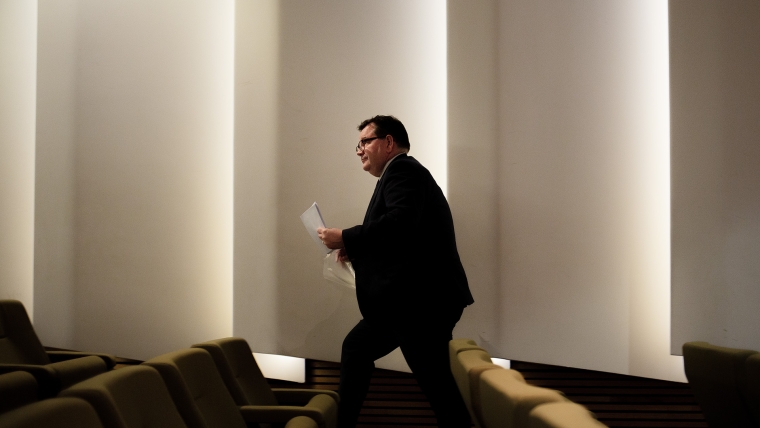
Wellington’s rumour mill was in full swing on Thursday, with opposition politicians making wild claims about a multi-billion dollar shortfall in the Government’s finances.
The gossip train appears to have started with a three line statement New Zealand First party leader Winston Peters emailed to media, alleging a $20 billion hole in government revenue.
State Services Commissioner Peter Hughes had reportedly been called into a meeting with Finance Minister Grant Robertson to search for cost savings.
Robertson confirmed he had met with public service bosses on Wednesday to discuss fiscal sustainability but denied the $20 billion figure — which Peters was unable to back up.
Act Party leader David Seymour added fuel to the fire with a press release claiming the fiscal hole was “closer to $30 billion”.
This unrealistic number was reached by calculating the difference between the Treasury's forecast tax revenue and the actual tax receipts received by the end of May.
In the 11 months ended May, Core Crown tax revenue was 2.1% (or $2.2 billion) below Treasury’s forecast at $103.3 billion. This shortfall was expected to persist to year-end.
Since the forecast was released in May with the Budget, Treasury would have had access to actual tax data up to March. This means they were only forecasting April, May, and June.
Total tax receipts were 13.8% behind the forecast in the month of April and another 6.4% in the month of May. A shortfall of about $2.3 billion in only two months.
Robertson acknowledged there had been softening in Government revenue, as shown in the Crown accounts released in July. The pre-election fiscal update (PREFU) in September would show whether or not that trend would persist.
An operating deficit of $20 billion in this fiscal year would not be plausible. It was forecast to be $7 billion this fiscal year and $7.6 billion in the next.
‘Not news’
Nathan Penny, an economist at Westpac, said he was expecting the lower tax take to continue and put some pressure on the Government’s finances in the coming years.
“We expect a lower operating balance than in the Budget and a return to surplus a year later than forecast in the Budget,” he said.
Whichever parties form the next Government, they will face some choices about how to bring the operating allowance back into balance. But there wasn’t an unexpected crisis brewing.
“This is not news to us, it is not news to the Treasury. It’s only news because it is the subject of debate in Parliament,” Penny said.
Westpac was working on a forecast of the Crown accounts which will be released closer to the PREFU in September.
Penny said it will show a larger operating deficit than Treasury, but it would be “cyclical not structural” — meaning it wouldn’t lead to dangerous debt levels or financial stability risk.
National sticks to its tax plan
Nicola Willis, the National Party’s finance spokesperson, did not back the multi-billion dollar shortfall accusations, but said she expected the PREFU to show more deficits ahead.
She said if Robertson was seeking “urgent meetings” to ask public sector bosses to cut costs, then he must have received new information that had worried him.
“It could be that the Treasury has said its forecasts were far too chipper and things are much worse than we had hoped,” she said.
National will still release its tax policy prior to the PREFU but its final policy platform won’t be finalised until after it has seen the fresh forecasts.
Treasury warned in last year’s Half Year Economic and Fiscal Update that higher-than-normal inflation and wage growth would create cost pressures over the next few budgets.
It also gave some options for what the Government could do if additional funding was required to meet the commitments in Budget 2023.
These were to reprioritising money from existing services, increase tax revenue, or increase the operating allowance (in essence, use debt to fund services).
Surplus stayed
Treasury had forecast a very small operating surplus in 2026, but that seems unlikely with tax revenue so much lower than had been assumed.
Penny is still expecting a return to surplus the following year, subject to Government policy decisions between now and then.
Prime Minister Chris Hipkins almost admitted this would be the case during a debate in Parliament on Wednesday.
National Party leader Christopher Luxon asked if Robertson was correct to forecast a return to surplus in 2025/26.
Hipkins said: “At the time the statement was made, yes”.
When pressed further on whether he’d received any advice on whether the return to surplus would be delayed again, Hipkins dodged the question.
Minister Moody
On Thursday, Robertson was quick to point out that global credit rating agency Moody’s Investors Service had given New Zealand its tick of approval this week.
It reaffirmed NZ’s AAA credit rating with a stable outlook, citing a healthy fiscal position compared with its peers.
“The New Zealand government has a strong track record of managing shocks through effective fiscal policy, while demonstrating fiscal discipline over the long term,” it said.
“We expect this discipline to persist, despite substantial economic and fiscal stimulus measures announced in response to the cost-of-living crisis and the pandemic”.
The North Island floods and Cyclone Gabrielle had imposed extra costs on the government, which would result in wider deficits and a slower return to surplus in 2026.
“We expect the economic slowdown and higher climate-related expenditure to cause a slight delay in the fiscal balance returning to a surplus”.
While this will cause debt levels to rise, it will “remain well controlled and largely in line with those of similarly rated peers”
We welcome your comments below. If you are not already registered, please register to comment
Remember we welcome robust, respectful and insightful debate. We don't welcome abusive or defamatory comments and will de-register those repeatedly making such comments. Our current comment policy is here.