

Higher fuel prices have added pressure to household budgets. Evidence suggests Auckland households are responding with changes in spending and travel patterns.
Fuel prices remain elevated
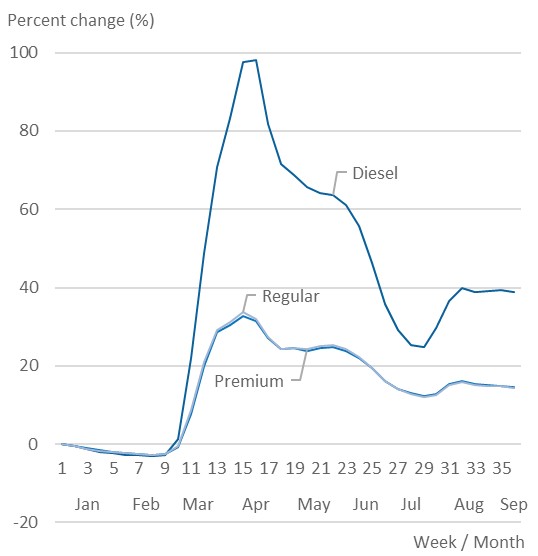
Fuel prices remain well above the levels at the start of the year as conflict and supply disruptions in the Middle East have pushed up global oil prices. Although prices have eased from their April peak, they are still well above pre-shock levels (Figure 1).
As of late August, diesel prices were just under $2.70 per litre, 40% higher than in January. Regular petrol was around $3.00 per litre and premium petrol $3.13 per litre, both 15% higher. This represents an increase of around 75 cents per litre for diesel and 40 cents per litre for petrol.
Diesel prices increased more sharply than petrol prices because diesel is widely used in freight, agriculture and industry, where demand tends to remain relatively strong even when prices rise. Combined with limited ability to quickly increase production, this makes diesel prices particularly sensitive to supply disruptions.
Figure 1: Change in fuel prices indexed to first week of 2026
Source: MBIE weekly price data; Chief Economist Unit analysis
Pressure on household budgets
Households have faced a tough economic environment in recent years, and higher fuel prices are placing further pressure on budgets. Stats NZ estimates that higher petrol prices accounted for almost one-third of the rise in household living costs in the year to June 2026.
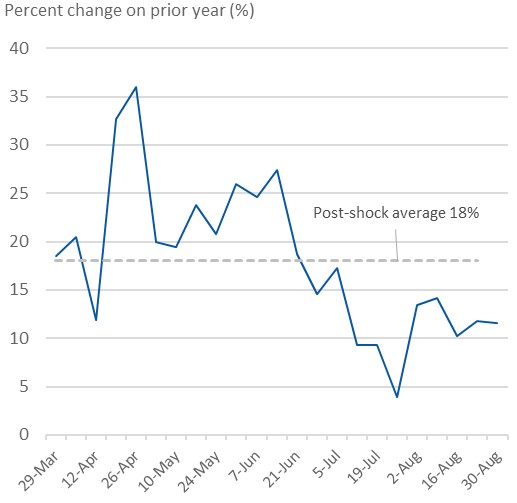
Auckland data expands on this story. Spending on fuel rose sharply following the price shock, reaching around 35% above 2025 levels in late April (Figure 2). Since then, fuel spending has remained well above 2025 levels. Over the post-shock period, spending has averaged around 18% above the same period in 2025.
For many Auckland households, fuel is a necessary expense and opportunities to reduce driving are limited. Higher fuel prices mean transport costs are absorbing a larger share of household income.
Figure 2: Weekly fuel spending in Auckland, 2026 vs 2025
Source: Marketview card data; Chief Economist Unit analysis
How households are responding
When fuel prices rise, households can respond in two broad ways. The first is to reduce discretionary spending in other areas of the household budget. This is known as the income effect, where a price rise reduces households' effective income and therefore their purchasing power.
Auckland spending data points to some evidence of an income effect, with higher spending on fuel and lower spending in several discretionary categories. Following the fuel price shock, hospitality spending has averaged around 10% below the same time last year, while spending on both takeaways and apparel has averaged around 3% lower. This is consistent with Auckland households directing more of their budgets towards fuel.
The second way households can respond is to reduce fuel consumption by changing how they travel. This is the substitution effect, where households switch to alternatives such as sharing car trips, public transport, walking or cycling in response to higher fuel prices.
Auckland traffic data indicates a shift in light vehicle traffic patterns. Between March and July, a majority of traffic count sites recorded lower counts than a year earlier on 61% of comparable days and higher counts on 39% (Figure 3). In contrast, over the same period in 2025, a majority of sites recorded lower counts year-on-year on just 24% of days. Many factors influence traffic, but this shift suggests some households are reducing car use in response to higher fuel prices.
Figure 3: Daily light vehicle counts versus a year earlier
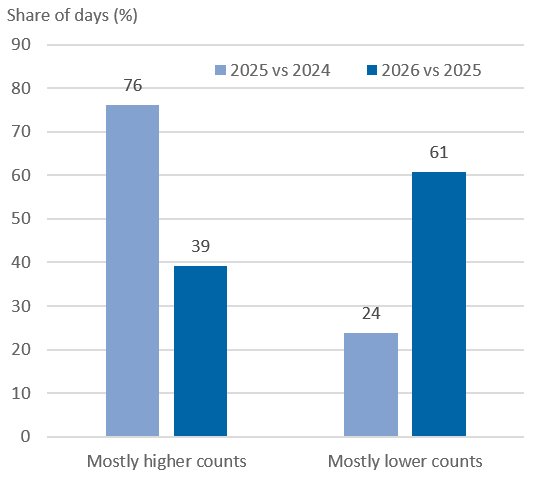
Note: Light vehicle counts from Auckland traffic monitoring sites were compared with the same day a year earlier (excluding public holidays). The chart shows the share of days on which a majority of sites recorded either higher or lower counts. Comparisons are for March-July 2025 vs 2024 and March-July 2026 vs 2025.
Source: Ministry of Transport data; Chief Economist Unit analysis
Public transport patronage has also risen. Between March and July 2026, public transport patronage was 9% higher than over the same period in 2025. In comparison,patronage was essentially flat over the equivalent period between 2025 and 2024. Although public transport use is influenced by many factors, higher fuel prices may have contributed to some of the growth in patronage.
Location and transport choices shape resilience
Auckland households are responding to higher fuel prices by changing their spending and travel behaviour. The extent to which they can respond depends in part on where they live and what transport options are available. Auckland's urban form means many households remain reliant on private vehicles for work, education and other activities. In lower-density areas, public transport or other alternatives to car use may not always be practical.
As a result, higher fuel prices affect households differently. Those with good access to jobs, services and a wider range of transport options may be better able to adapt, while others may have little choice but to absorb higher fuel costs or cut back elsewhere.
If higher fuel prices persist, some households may place more weight on transport costs when choosing where to live or work. Over time, locations that offer proximity to jobs and services or better access to public transport may become more attractive.
An urban form that offers households more location and transport choices is likely to be more resilient to fuel price shocks
An urban form that offers a wider range of location and transport choices is likely to be more resilient to current and future fuel price shocks. When households have more options about where they live, work, and how they travel, they are better able to adapt when costs change.
This resilience can be strengthened through planning policies and transport investment.
- Planning policies can increase opportunities for households to locate closer to jobs, services and public transport. For example, Auckland Council’s proposed changes to the Auckland Unitary Plan, known as Plan Change 120, allow more housing near existing centres and rapid transit stations.
- Investments in public transport can provide households with alternatives to private vehicle travel. The City Rail Link is an example, making rail a more viable option for many households through new city centre stations and improved services.
The evidence suggests higher fuel prices are prompting changes in household spending and travel behaviour. How well households can adapt to future fuel price shocks will depend in part on the location and transport choices available to them.
* Gary Blick is the Chief Economist at Auckland Council. This article is here with permission. Find out more at Auckland Council Chief Economist webpage. The original article is here.
We welcome your comments below. If you are not already registered, please register to comment
Remember we welcome robust, respectful and insightful debate. We don't welcome abusive or defamatory comments and will de-register those repeatedly making such comments. Our current comment policy is here.