sign up log in
Want to go ad-free? Find out how, here.

The housing market is heading into spring with high stock levels and declining asking prices

Property / news
The housing market is heading into spring with high stock levels and declining asking prices

The housing market could be heading for a soggy start to spring, with stock levels high, new listings low and asking prices in decline.

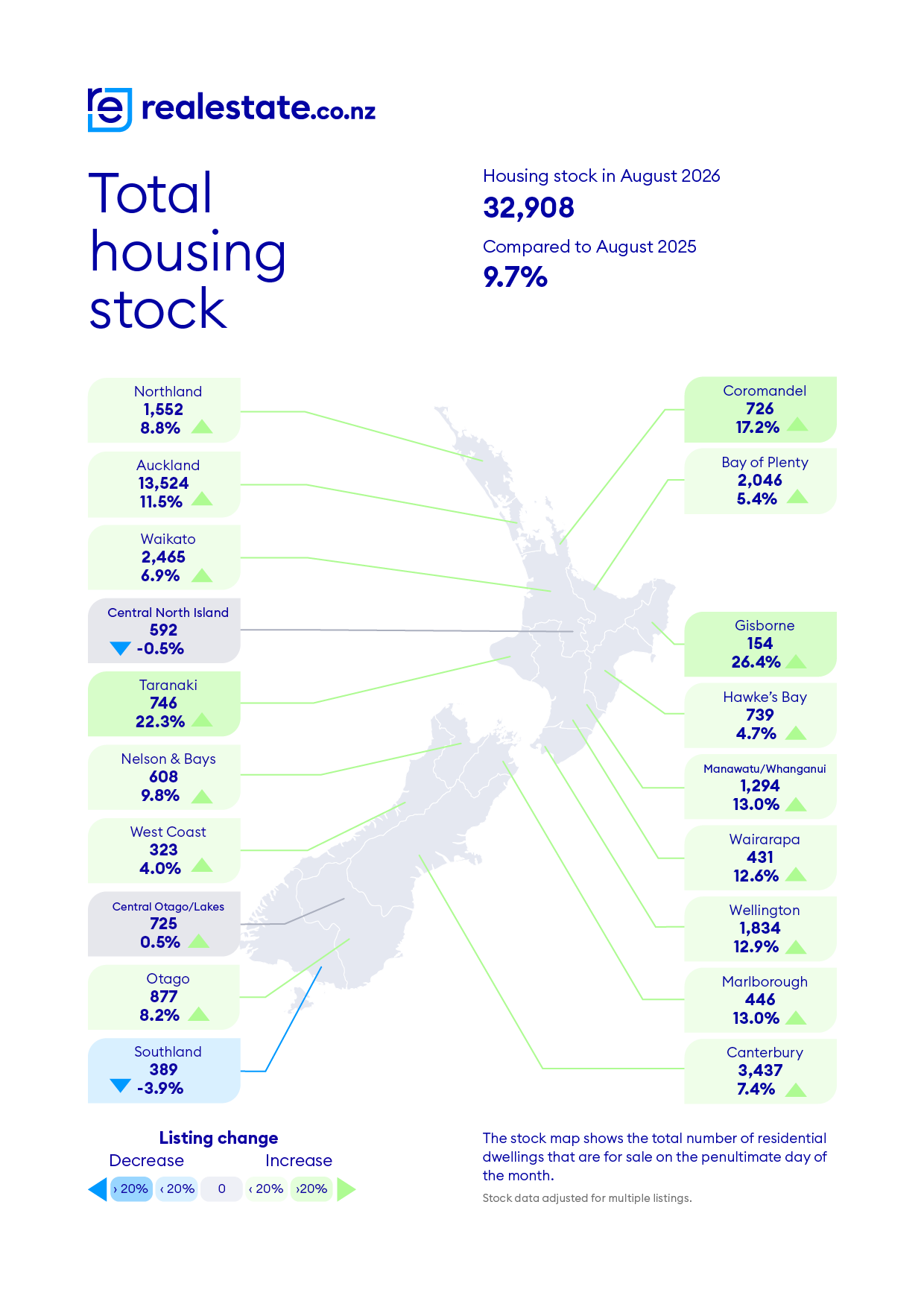
Property website Realestate.co.nz ended August with 32,908 residential properties available for sale, 9.7% higher than at the end of August last year. That means stock available for sale on the website is at a 12-year high for the time of year, and has more than doubled since the boom year of 2021.

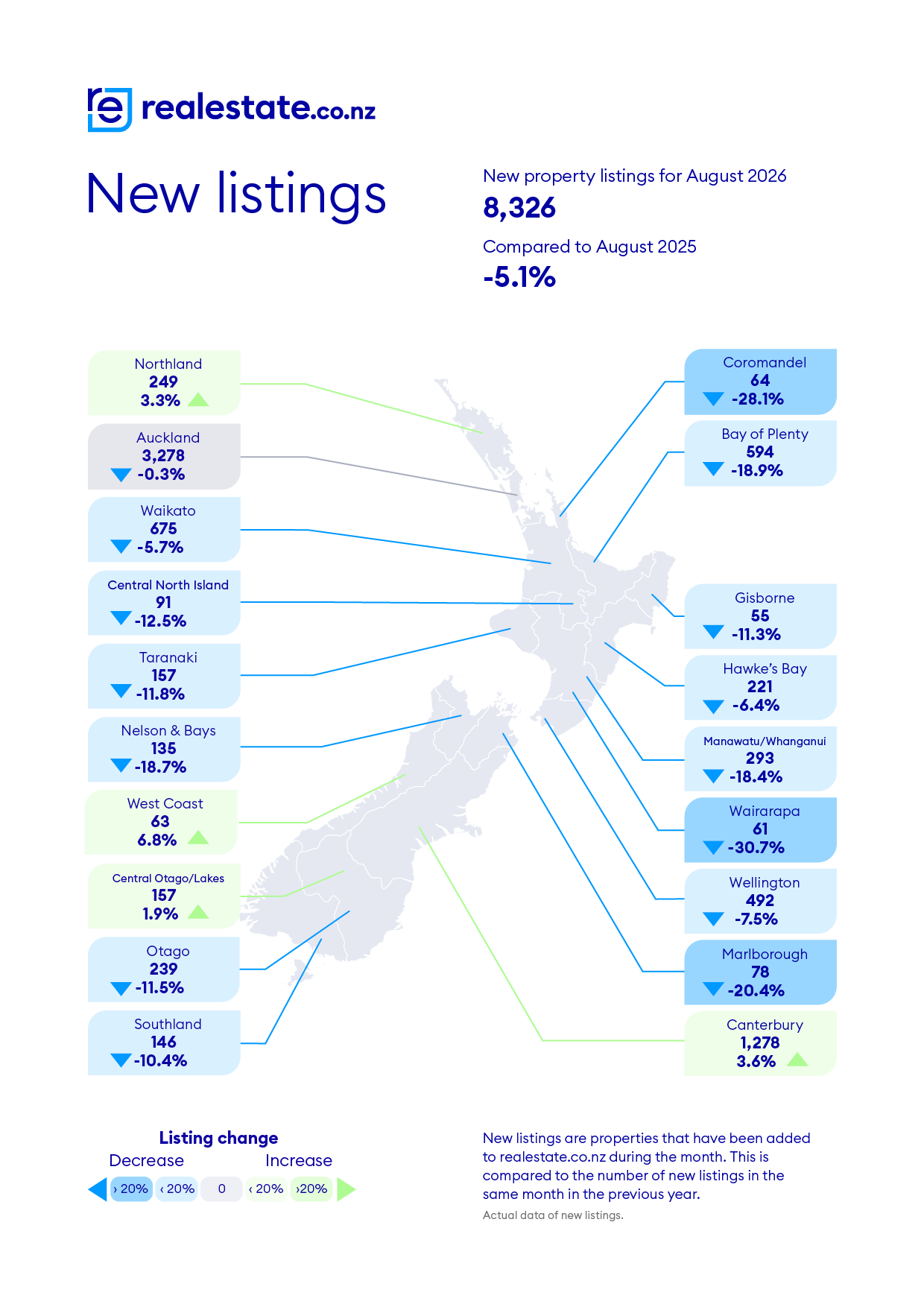
The high stock levels are particularly significant because just 8326 new listings were received in August, down 5.1% compared to August last year. That suggests many of the properties currently on the market are older stock which is proving difficult to sell.

The build up in stock has occurred in spite of declining asking prices. Realestate.co.nz's national average asking price was $824,144 in August (non-seasonally adjusted), down 2.0% compared to August last year.

The average asking price on the website has now declined for six consecutive months and is down $74,533 (-8.3%) since February.

In Auckland, the country's largest property market, the average asking price was $986,827 in August, down $110,921 (-10.1%) since February.

The comment stream on this article is now closed.


We welcome your comments below. If you are not already registered, please register to comment

Remember we welcome robust, respectful and insightful debate. We don't welcome abusive or defamatory comments and will de-register those repeatedly making such comments. Our current comment policy is here.

18 Comments

How many people purchased houses in AKL with low equity mortgages earlier this year? (noting -10% drop this year and potentially now negative equity). 

I didn’t then, nor now, understand why the banks have been extending so much low equity lending in this market - in my opinion it’s highly reckless both for buyers and the banks. 

Up
6

Because they operate with absolute impunity?

Up
6

I didn’t then, nor now, understand why the banks have been extending so much low equity lending in this market 

To meet sales targets. Sometimes you have to move further out the risk curve to meet those targets or to make incremental sales. If targets are not met, then the top brass' bonuses are threatened. 

Like in Glengarry Glen Ross, your worth is your current sales tally. Past performance, loyalty, experience, and economic circumstances do not matter. In the office’s logic, only this month’s ranking counts - a compressed picture of ruthless “survival of the fittest” capitalism. Selling is tied to dominance, self-worth, and humiliation. “Winning” is portrayed as proof of personal value, not merely a business outcome. 

Up
3

The banks don't need to protect the buyers any more as the government (CCCFA) and RBNZ decided they could do a better job. 

In terms of the banks position, its only a problem if they are underwater and lose their job. I guess the reward is still bigger than the risk for the bank. 

3 years ago mortgage rates had tripled and many new buyers were in negative equity yet the banks were still profitable. 

Up
1

Because (unlike USA) NZ does not have no recourse mortgages so the banks don't have their own skin in the game.

Up
7

Bingo. But remember the Bank Term Funding Program (BTFP) protected U.S. banks in 2023 by allowing eligible institutions to borrow from the Fed against high-quality securities valued at par rather than at their lower market prices:

  • A bank owned a Treasury bond bought when yields were low.
  • Rising rates made that bond worth materially less if sold today.
  • Selling it to meet withdrawals would crystallize the loss and could destroy capital.
  • The Fed instead lent cash against the security, giving the bank time and funding to meet withdrawals without immediately realizing that mark-to-market loss.

U.S. foreclosures are elevated right now:

  • 227,548 U.S. properties received foreclosure filings in the first half of 2026.
  • That was 21% above the first half of 2025 and 28% above the same period two years earlier.
  • Foreclosure starts rose 18% year on year, while completed foreclosures rose 33%

https://www.morningstar.com/news/pr-newswire/20260827la34293/foreclosur…

Up
0

Don't blame the banks. They are simply doing what they are permitted to do. It's interesting that you call it reckless. This isn't some reckless sub-prime mortgage gamble. The banks here do a LOT of due diligence on their clients. Trust me, I know they do, because I went through it last year. 

Up
0

A buyer's market with few buyers = a falling market

Up
4

The market has "matured" 

Up
2

It's getting a bit wrinkly, whiffy and stale by now after stagnating for so long.

Up
1

stock levels high, new listings low and asking prices in decline

Covers it well. Whaaaaa..... I still want my Capital gains. As interest rates inevitably trend back to long term mean, prices can only come under ever greater lack of affordability pressure. Lets see what the U.S. Treasury and Bond Market Reset, forecast at 5% or thereabouts, delivers in the back side of 2026. 

Up
5

Hi ho, hi ho, up the mortgage rates go, go, go...........

Up
2

thats not a knife...   https://youtu.be/HxlV_hoAnXI

Plummeting house prices in some of Sydney’s most expensive suburbs are setting the pace for the national real estate downturn, with declines of up to 16 per cent or more in some areas this year as buyers baulk at escalating borrowing costs after successive interest rate rises.

Prices in the small beachside suburb of Malabar in Sydney’s east have fallen $585,000 this year, equivalent to 16.5 per cent, to a median of $2.95 million, the sharpest decline of any suburb in Australia.

16.5% would be enough to rip a nightie... the market is drier then a dead dingoes donga

for reference this is like the distance Kohi or st helliors to akl cbd, this Aussie crash could make nz crash look like a flick knife

what will happen in NZ over summer as aussie burns, first out best dressed?


Up
2

We are looking at a possible purchase, whilst talking with locals to see what they think.  I asked about prices and so far out of 7 responses, all have said - prices have fallen enough.  I asked if prices had fallen 'enough'. were first time buyers able to afford to buy, and the response was a resounding NO.  I can thus assume that prices have not fallen enough.  All admitted to being home owners, and thus having no interest in falling prices.

I then asked about forecast OCR increases, the response to which was - what/they are high enough/when/well that will be a problem etc.

I am thinking that with the OCR rate very likely to rise, surely prices will keep falling, and they need to!  Looking at a few on our watch list, they have been sitting on the market for over a year, some have reduced their price, but only modestly so (5% or less), others are sitting with a loss at the current asking prices, others are empty - $600k for a box, cold, in need of work, no land!  Go up to £750k -$800k outside a city and there are masses of family houses for sale, masses.  Where and what is the market for them?

In all, with an election approaching, and the OCR set to rise, why buy now!


Up
4

Agreed Marcus, you’re highlighting the seller endowment effect driving major buyer/seller disconnect at present.

We’re positioned to buy, but instead have just moved into another 12 month rental.  We actually moved into a larger place in a nicer area for the same rental cost, so no complaints.  Because I have no desire nor time to entertain delusional seller expectations at this part of the cycle.

Everything looks bad enough domestically, but globally there is much more trouble to come..  Best to step back for now and watch SHTF

Up
0

Many sellers are waiting for the election to somehow save them and give hope prices will increase before they look to sell a rental or their own home.

FYI Propertyvalue.co.nz is ceasing to exist end of October, but can be useful in seeing a timeline of when a property has been historically sold and for how much (unless was private sale).

Up
0

both oneroof and homes.co.nz have the same data, tho oneroof is not reliable and misses sales


Up
0

You are in the drivers seat. You can see sales data on most apps and ring agents to see recent sales that are not listed online. Clearly ask about price prior to even spending time visiting. Make offers that make sense. If declined, politely advise the agents that deluded sellers cannot expect today and tomorrows buyers to bail them out from poor decisions/expectations. Move on to the next...

Up
1