

Here's my Top 10 links from around the Internet at 10 to 1 pm in association with NZ Mint.
I'll pop the extras into the comment stream. See all previous Top 10s here.
I welcome your additions in the comments below or via email to bernard.hickey@interest.co.nz.
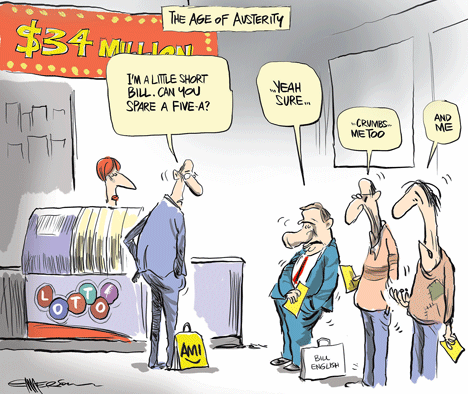
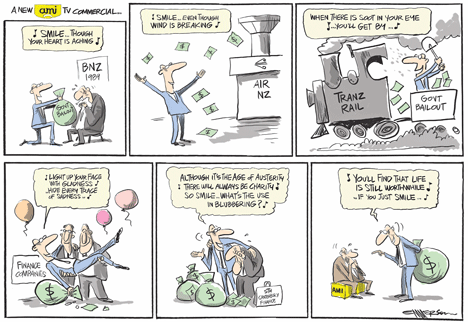
Plenty of good cartoons today. And my favourite these days. A Clarke and Dawe video at the bottom.

1. 'You're not fooling anyone' - Closely watched China watcher Andy Xie writes at Caixin that an inefficient public sector and negative real interest rates are pushing China toward stagflation and instability.
He even suggests China may be forced into a devaluation, not the revaluation that most expect.
He sees financial crisis. It is today's must-read for anyone who cares about China, which should be everyone.
China is now the major driver in the economic future of Australasia, and, many would say, the rest of the world.
Xie is saying there is a major financial crisis looming there. HT Colin.
China's monetary policymakers are too far behind the curve. Inflation is entering crisis territory, as consumer prices for many products and services rise at double-digit rates. Signs of panic have appeared along with hoarding which, when it spreads, could trigger social a crisis.
Yet something else is happening. By shifting capital to inefficient users against the backdrop of negative real interest rates, China's economy is being pushed toward stagflation. Meanwhile, the public is afraid that the government wants to inflate away the value of their money.
What's prevented a full-blown crisis so far is a belief that the yuan will appreciate. If not for this assumption, capital flight from China would be rampant.
To change course, policy tightening must shift away from credit rationing and toward market mechanisms. Moreover, the interest rate must be lifted out of the negative column: It should be raised at least three percentage points to allay public fears. These changes are needed as soon as possible.
the current growth model is pushing the economy toward stagflation and currency devaluation risks loom large. China could see a devaluation-triggered financial crisis similar to what the United States has already experienced. The difference, however, is that China's system is not robust enough to maintain stability during such a crisis. It's easy to see why fundamental economic reforms are urgently needed.
2. Quantitative Easing explained - Here's Ticker Guy (Karl Denninger) talking about quantitative easing and the US budget deficit. He also talks about inflation. 43% of US government spending is borrowed... No worries then... HT Gertraud via email.
3. PIMCO goes short US Treasuries - Zerohedge reports PIMCO's Total Return Fund has bailed out of US Treasuries and has parked its money in cash.
The world's biggest bond fund doesn't trust the US Government not to default on its debt. Get the picture?
When will the rest of the bond vigilantes pick up their pitchforks? HT Gertraud via email.
In March, Pimco's flagship Total Return Fund (TRF) has now taken an active short position in US government debt: -3% on a Market Value basis (or $7.1 billion), and a whopping -18% on a Duration Weighted Exposure basis. And confirming just what PIMCO thinks of US-related paper is the fact that the world's largest "bond" fund now has cash, at a stunning $73 billion, or 31% of all assets, as its largest asset class on both a relative and absolute basis.
We repeat: cash is more than PIMCO's holdings of Treasurys and Mortgage securities ($66 billion) combined.

4. Even Krugman is disillusioned - I lost faith in Obama a few months after his election, but now even his high profile supporters such as economist Paul Krugman wonder why Obama is so useless and vapid. Krugman wonders here at New York Times why Obama isn't fighting the Republicans harder.
Easy. Obama is a liar, a fool and a spineless wimp.
What’s going on here? Despite the ferocious opposition he has faced since the day he took office, Mr. Obama is clearly still clinging to his vision of himself as a figure who can transcend America’s partisan differences. And his political strategists seem to believe that he can win re-election by positioning himself as being conciliatory and reasonable, by always being willing to compromise.
But if you ask me, I’d say that the nation wants — and more important, the nation needs — a president who believes in something, and is willing to take a stand. And that’s not what we’re seeing.

5. China's Lewis Turning Point - Ed Harrison at Credit Writedowns writes about how China may be at the 'Lewis Turning Point' where a shortage of rural labour pushes up wages and inflation fast.
What Lewis found is that industrial wages rise very quickly when the supply of excess rural labour is exhausted. This is called the Lewis Turning Point and is where China is right now.
This will have major implications for the Chinese domestic economy and the world economy. The first implication is inflation. Without the endless stream of excess rural labour, wages are going to go way up in China and this means inflation will be a problem. Over the last twenty years, the introduction into the global economy of the former Eastern Bloc and China has meant a huge surge in available labour. Despite a flood of money from the Japanese and U.S. central banks, this influx of labour has effectively capped consumer price inflation in developed economies. The result has been the so-called Great Moderation.
If China has reached its Lewis Turning Point, all of that is out the window and Central banks will face a Scylla and Charybdis flation challenge for years. China's labour shortage will work in concert with resource constraints and likely excess money supply as an inflationary force. These forces are countered by major deflationary forces from the debt overhang resulting from the implosion of the global asset bubble.
6. Minting money - This New York Times piece about an elaborate scam involving old scrapped one and two euro coins, Chinese metal reconstructors and German air hostess mules for the reconstituted coins is a cracker.
It's a whole new twist on the business of conterfeiting. All it takes is cheap Chinese labour.
Old coins that were supposed to be melted down in China were instead reconstituted and then flown back to Germany to exchange for notes. Achtung Counterfeiter!
According to prosecutors, in recent years a fraud ring involving flight attendants has toted 30 tons of supposedly scrapped euro coins back into Europe from China. Recyclers in China were supposed to have melted down the old coins, which had been removed from circulation and sold as scrap metal.
Instead, officials say, the band and its accomplices painstakingly restored the coins, then fooled the Bundesbank into redeeming them for paper currency or money transfers into bank accounts.
The fraud ring, which officials said had been operating since 2007, took advantage of the way the two-piece coins are made. The 2-euro coin has a nickel and brass alloy center, or “pill,” surrounded by a nickel and copper ring. The 1-euro coin has a copper and nickel pill surrounded by a nickel and brass ring. When the coins were removed from circulation, a subcontractor separated the rings from the pills before the metal was sold to Chinese recycling companies.
Somehow, the thieves discovered that they could put the pills and rings back together, bring them to Germany and redeem them at the Bundesbank.

7. Just a little bit out of control - Bloomberg reports George Soros saying Chinese inflation is somewhat out of control. This is not reassuring.
The Chinese government’s decision to keep its currency weak is leading to higher risks of wage-price inflation, billionaire investor George Soros said.
While the policy helped insulate the nation from the financial crisis in 2008, the world’s second biggest economy has missed its chance to allow the currency to appreciate to control inflation, Soros, chairman of Soros Fund Management LLC, said yesterday at a conference in Bretton Woods, New Hampshire.
“It would be very advantageous to allow the currency to appreciate as a way of controlling inflation,” Soros said. “The authorities missed that opportunity. You now have inflation somewhat out of control, and causing some serious danger of wage-price inflation.”

8. Another way to blame the bankers - US Economist Max Corden writes at VoxEu that poor decisions by financial intermediaries allowing poor investment decisions by surplus nations in US consumption and housing is at least partly responsible for the global capital imblances that caused the Global Financial Crisis.
People critical of global imbalances often blame the surplus countries and their currency manipulation. This column introduces a Policy Insight that argues that the basic problem has been the inefficiency of the world’s financial sector, which led to unfruitful investment in the US rather than productive investment in emerging economies.
A key issue is that funds from countries that are net savers called the savings-glut countries (where savings exceed domestic investment) have been lent to borrowers (notably the US) who have used these funds unwisely, namely for current consumption and for investment that is not “fruitful.” The main form of “unfruitful” investment has been in excess housing construction. The funds coming from the savings-glut countries should have financed fruitful investment in the US and elsewhere. Instead they have also been lent to the US government, financing a war and tax cuts. All this is well known.
The result is that the borrowing countries, notably the US, have failed to build up resources out of which interest, dividends, and necessary repayments can be made. Yet such debt service or returns from purchases of equity are an essential feature of intertemporal trade.
9. Why Iceland voted no again - Michael Hudson writes at Credit Writedowns about why Iceland's people have voted again to default on their debts. He agrees with their decision. Fair enough. This is a question that every heavily indebted sovereign nation must face in the end. When should they default on their unpayable debts?
Iceland was the first to be wiped out in the Global Financial Crisis. How many others will go down this path? Ireland? Greece? Portugal? New Zealand?
Hudson also points out indebted nations should ignore the rosy forecasts of central bankers and the IMF.
Prime Minister Johanna Sigurdardottir warns that the vote may trigger “political and economic chaos.” But trying to pay also threatens this. The past year has seen the disastrous experience of Greece, Ireland and now Portugal in taking reckless private sector bank debts onto the public balance sheet. It is hard to expect any sovereign nation to impose a decade or more of deep depression on its economy inasmuch as international law permits every nation to act in its own vital interests.
Attempts by creditors to persuade nations to bail out their banks at public expense thus is ultimately an exercise in public relations. Icelanders have seen how successful Argentina has been since it imposed a crew haircut on its creditors. They also have seen the economic and political disruption in Ireland and Greece resulting from trying to pay beyond their means.
Creditors did not give accurate advice when they told Ireland that it could pay for its bank failures without plunging the economy into depression. Ireland’s experience stands as a warning to other countries about trusting overly optimistic forecasts by central bankers. In Iceland’s case, in November 2008 the IMF staff projected yearend-2009 gross external public and private debt at 160% of GDP – but observed that an exchange rate depreciation of 30% would push the ratio to 240% of GDP, which would be “clearly unsustainable.” But the most recent IMF staff report (January 14, 2011) shows end-2009 gross external debt at 308% of GDP, and estimates end-2010 gross external debt at 333% – even before taking the Icesave and other debts into account!
10. Totally Richard Koo video - This is the Nomura economist who warned about a Japanese-style Balance Sheet recession happening in the indebted developed world.
He says Japan's economy could have lost 10% of GDP a year without the government jumping in to build bridges to nowhere. He points out Japan's asset prices fell 87% (!) on average from the peak, causing the mother of balance sheet recessions.
He says massive Japanese government borrowing fueled by debt saved the Japanese economy from much worse than its couple of lost decades. He says the last thing governments should do is cut spending when the private sector is deleveraging.
Is that the case in NZ? The difference between us and Japan is we have been borrowing offshore and for larger amounts than Japan.
Could we borrow so easily and so cheaply when we don't have large local savings to call on.
The video is well worth watching. His views are engaging and counter intuitive.
11. Bonus Clarke and Dawe video - Kevin Rudd makes a re-apperance.
17 Comments
Richard Koo is rather compelling isn't he.
"...the public is afraid that the government wants to inflate away the value of their money"....gosh I wonder where the Chinese govt got that policy idea from!
The world's biggest bond fund doesn't trust the US Government not to default on its debt
If this happens, would this bring down China, followed by Australia and New Zealand?
You are right to a degree relax but not for too long rising interest rates then the begining of the next phase more than likely QE3, QE4 and..............
Yeah just relax....they say the Elephant doesn't weigh that much and think of Aymereeka the brave.
Yes can someone please explain... I dont really understand but from what I gather isn't the US going to continue debasement of its currency, causing inflation rates to become higher than the current return rates on the US government bonds?
No Hamrod...the US is going to boot Obama out and Bernanke too if he is too slow to stop his stupid games. The power behind the throne are the money men and they have restored their personal wealth with the govt gifts and fed feeding...so now they want to screw the bond market fools...hence the pimco move.
Why would PIMCO tell the market that they are short on T-bonds?
If their cash is in US dollars, they are taking a bet that inflation won't erode its value.
Maybe they have a long position that they aren't telling anyone about?
They are sprooking the result they want simon...hurrying things along you might say...as for being in cash...it's no risk of loss as long as it is oncall....as rates rise PIMCO will move to collect the increases. They will likely look at picking up some quality stock in the share market drop that comes with rising rates.
We know you can't stand Obama Bernard. You're just gonna looooove the Trumpster!
Seriously though - when you consider the crap that's gonna go down in the next 12 months it's highly likely that Donald will, without a doubt, be the next great leader of the free world! Mark my words...
Any thinking person can see Obama is a puppet person. Whats changed again? eerrr nothing in fact I hear theres a new war gearing up...
Free world? It owes billions + interest it aint that free lmao...
Donald Trump yep always bankrupt great guy! A true inspiration!
lol
George Soros I wouldnt ask that guy the time in a room full of clocks!
Looks like the National Socialist State of China has a bit of inflation to deal with.
It would seem the National Socialist Capitalist approach aka Germany circa 1930's has a bit more longevity than the communist version...who would have a thought that eh?
Certainly more longevity than the Plutocratic Casino Capitalist approach in the USA.
Never has so much been written by so many about so much crap,this economic stuff is at its best a load of crap the facts are 1 Obama hates America
2 Obama is a puppet
3 Obama works for evil men
4 they are soros and the big Banks
5 by the end of 2012 the US dollar will be worthless
6 Soros wants a new global dollar
7 China is going down
8 every arab state will collapse, every one''''
9 Oil will go to at lest 200 dollars a barrel
10 and we in NZ are worried about the rugby world cup
which is underwritten by this commie Govt BAZ
Thanks for the intelligent reply.
regards
still the tired same old same old......China has inflation problems....yeh they had that 2 years ago
Short of labour .....CHINA...yeh right!
China is a massive consumer as well as a huge exporter.
Fonterra happy to invest in China.
The predictions for China so far have been all B...S....and in huge quantities.
The central financial institution of China declared over the weekend that its biggest banks must hold more cash in reserve, the fourth time in 2011 the reserve ratio has been increased. China, which has gotten the world accustomed to paying little for its goods, would send shock waves globally with a severe spike in domestic production costs. China's global impact has also drawn the attention of presidential wanna-be Donald Trump, who has drawn scorn from economists with a plan to impose a 25 percent tariff on Chinese imports.
We welcome your comments below. If you are not already registered, please register to comment
Remember we welcome robust, respectful and insightful debate. We don't welcome abusive or defamatory comments and will de-register those repeatedly making such comments. Our current comment policy is here.